

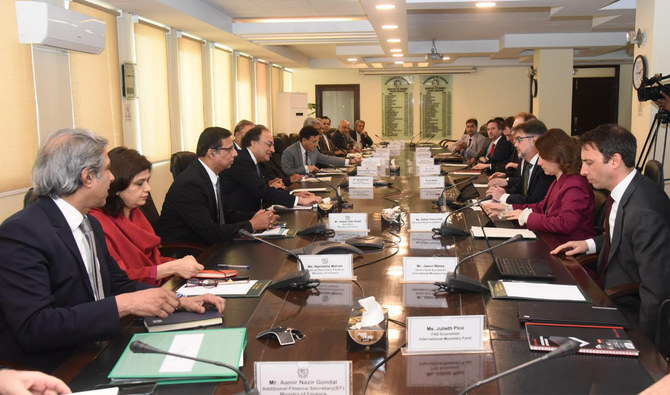

KARACHI: The International Monetary Fund’s (IMF) visiting mission on Thursday started holding meetings with Pakistani officials as it kicked off its final review of the $3 billion short-term financing program, with economic experts saying Islamabad would easily clear the review as it had met almost all performance targets set by the lender.
Headed by Nathan Porter, the IMF’s assistant director of Central Asia and Middle East department, the mission arrived in Islamabad on Wednesday and held talks with Pakistan’s finance, energy, and Federal Board of Revenue (FBR) officials on Thursday.
Pakistani officials, including Finance Minister Muhammad Aurangzeb and Energy Minister Musadik Malik. informed the IMF team about the measures taken to implement the lender’s reforms, which included hiking energy tariffs.
“The IMF mission has appreciated measures taken by the Pakistani authorities in order to achieve quarterly program targets under the Stand-by Agreement (SBA),” an official of the Finance Division told Arab News, speaking on condition of anonymity.
He said the Pakistani side was also simultaneously working on a plan to discuss the contours of next program, which he said would be longer. The size of the next program under consideration will most likely be about $8 billion, he added.
Malik shared the government’s energy reform agenda with the Fund’s team, the official said, adding that they were informed that the government had hiked electricity and gas prices according to the prescribed schedule.
Pakistan had raised the levy on petrol and diesel to Rs60 per liter ahead of the IMF delegation’s visit, while last month, it increased the gas tariff for domestic consumers by up to 67 percent to fulfill key conditions of the fund’s final review.
Economic experts believe the final review would be a smooth sailing for Pakistan as it had met almost all performance targets set by the IMF.
“The completion of the second and final review of the ongoing SBA will not be difficult as almost all the conditions stand fulfilled,” Dr. Ikram ul Haq, a Lahore-based economist, told Arab News.
“The real issue will be negotiating the 24th Extended Fund Facility (EFF).”
During the ongoing talks between the IMF and Pakistani authorities, which are scheduled to last five days, Pakistan is widely expected to ask for a new longer-term bailout program for about $8 billion.
“IMF will certainly question our debt sustainability that has eroded substantially over the period of time,” Haq said. “Fiscal consolidation will be another major issue.”
He said the federal government, after it has transferred funds to Pakistan’s provinces under the 7th National Finance Comission (NFC) Award, would not even be meeting its debt servicing targets. He said the country’s expenses are being met through borrowing at exorbitant costs due to high inflation.
“In this scenario and coupled with over Rs5 trillion circular debt in electricity and gas, the new IMF program will be very difficult,” he said.
Ali Nawaz, chief executive officer of securities brokerage company Chase Securities, said the current review of discussions between Pakistan and the IMF seem to be on a positive track.
“There are indications that Pakistan has met the established benchmarks, potentially avoiding major hiccups in this round,” he noted.
However, he said, securing a new long-term IMF program might involve fresh negotiations for which discussions could focus on broadening Pakistan’s tax base and implementing additional reforms.
Nawaz said Pakistan has a capable finance minister who is determined to navigate these discussions and secure a long-term program with the international lender.
“This program would be instrumental in putting the economy on a stable path,” he said.


