

Pakistan slams India’s new citizenship law opposed by Muslims for religious discrimination

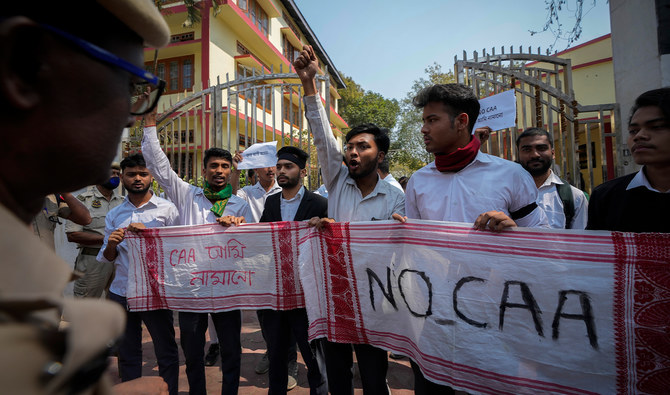
Students protest against the Citizenship Amendment Act (CAA) in Guwahati, India, on March 12, 2024. (AP)
Short Url
Updated 14 March 2024
Follow

Pakistan slams India’s new citizenship law opposed by Muslims for religious discrimination

  • The law claims to provide protection to oppressed minorities in neighboring Muslim states by offering them citizenship
  • Foreign office says it is based on the false assumption of persecution to boost India’s credentials as a safe haven

ISLAMABAD: Pakistan’s foreign office on Thursday criticized a controversial citizenship law introduced by the Indian administration to protect religious minorities in neighboring Muslim countries, saying it differentiated among people on the basis of their faith.

The Citizenship Amendment Act (CAA) was originally passed in 2019 to allow non-Muslim people from Pakistan, Bangladesh, and Afghanistan to seek Indian citizenship to protect them against persecution.

The law was followed by deadly protests amid anti-immigrant sentiments. It was also described as exclusionary by critics within the country who said it violated the secular principles enshrined in the Indian constitution.

“The regulation and laws are premised on a false assumption that minorities are being persecuted in Muslim countries of the region and to provide India a façade of being a safe haven for them,” Pakistan’s state-owned Radio Pakistan quoted foreign office spokesperson Mumtaz Zahra Baloch as saying during her weekly media briefing.

She maintained the rising wave of Hindutva, a 20th century ideology seeking to establish the hegemony of the Hindu way of life in India, under Prime Minister Narendra Modi’s Bhartiya Janata Party (BJP) government had led to political, economic and social victimization of Muslims and other minorities.

Baloch recalled the international community had taken notice of these developments only a few days ago, asking New Delhi to take corrective actions to protect human rights and prevent attacks against minorities in the lead-up to India’s national elections.

Rights activists have also noted the Indian citizenship law does not cover groups fleeing persecution in non-Muslim majority states like the Tamil refugees from Sri Lanka.

It also fails to offer protection to Rohingya Muslims from neighboring state of Myanmar.

Additionally, there are concerns it can be used in tandem with a proposed national register of citizens to persecute the country’s 200 million Muslims.


Pakistan PM calls PIA privatization ‘vote of confidence’ as government pushes reforms

Updated 24 December 2025
Follow

Pakistan PM calls PIA privatization ‘vote of confidence’ as government pushes reforms

  • The loss-making national flag carrier was sold to a Pakistani consortium for $482 million after two failed attempts
  • Finance minister vows to continue economic reforms, engage international partners through trade and investment

KARACHI: Prime Minister Shehbaz Sharif said on Tuesday the privatization of state-owned Pakistan International Airlines marked a “vote of confidence” in the country’s economy, as the government presses ahead with structural reforms aimed at easing pressure on public finances and attracting investment.

The sale of the loss-making national carrier by a Pakistani consortium, which secured a 75 percent stake for Rs135 billion ($482 million), follows two previous attempts to privatize PIA. The development comes as Pakistan seeks to build on macroeconomic stabilization after a prolonged balance-of-payments crisis, with authorities trying to shift the economy toward export-led growth and policy continuity.

“It was our firm commitment to the people of Pakistan that speedy and concrete steps would be taken to privatize loss-making state-owned enterprises that have been a burden on the economy,” Sharif said in a post on X. “The successful completion of the transparent and highly competitive bidding process for the privatization of PIA marks an important milestone in fulfilling that commitment.”

“The strong participation of our leading business groups and some of Pakistan’s most seasoned and respected investors is a powerful vote of confidence in our economy and its future,” he added.

The government has made privatization of state-owned enterprises a key pillar of its reform agenda, alongside changes to taxation, energy pricing and trade policy, as it seeks to stabilize the economy and restore investor confidence.

Meanwhile, Finance Minister Muhammad Aurangzeb told an international news outlet Pakistan had reached a critical turning point, with macroeconomic stability and sustained reforms helping shift the economy from stabilization toward growth.

“Macroeconomic stability, sustained reforms and policy continuity are restoring confidence, shifting the economy from stabilization to export-led growth,” he said in an interview with USA Today, according to a statement issued by the finance ministry, adding that the government was opening new opportunities for domestic and global investors.

Aurangzeb said inflation had eased sharply, external balances had improved and foreign exchange reserves had risen above $14.5 billion, while Pakistan had recorded both a primary fiscal surplus and a current account surplus for the first time in several years.

The finance minister noted that economic growth remained insufficient to meet the needs of a fast-growing population, pointing out the importance of continuing structural reforms and encouraging investment in sectors such as agriculture, minerals, information technology and climate resilience.

Despite ongoing risks from global commodity prices, debt pressures and political uncertainty, Aurangzeb said the government remained committed to staying the reform course and engaging international partners through trade and investment.