

Karachi’s New Memon Mosque continues over 70-year-old tradition of hosting grand iftar

People gather for Iftar on the first day of the Islamic holy month of Ramadan at the Memon Masjid in Karachi on March 12, 2024. (AFP)
Short Url
Updated 14 March 2024
Follow

Karachi’s New Memon Mosque continues over 70-year-old tradition of hosting grand iftar

  • Hundreds gather at sunset each evening for communal iftar dinner at mosque in Bolton Market
  • Tradition was started on modest scale over seven decades ago by worshippers who came to offer prayers

KARACHI: The tradition began 76 years ago.

Since then, every year during the holy month of Ramadan, hundreds gather at sunset for a grand communal iftar dinner at the New Memon Mosque in Karachi. The meal is arranged by a group of volunteers for nearly 3,000 people daily.

Riaz Ali Qadri, who is part of the management team that arranges the iftar, told Arab News the feast was attended by local shopkeepers, customers, laborers and other passers-by. She said the tradition was started decades ago by worshippers at the mosque, which is situated in the Bolton Market area, now a popular shopping area.

“Some people, who came here to offer their salat (prayers), conceived the idea of collective iftar soon after independence [1947]. They started offering food to others as well,” Qadri said, adding that the gathering had grown with the passage of time and more than 450 platters were now prepared and served to people every day.
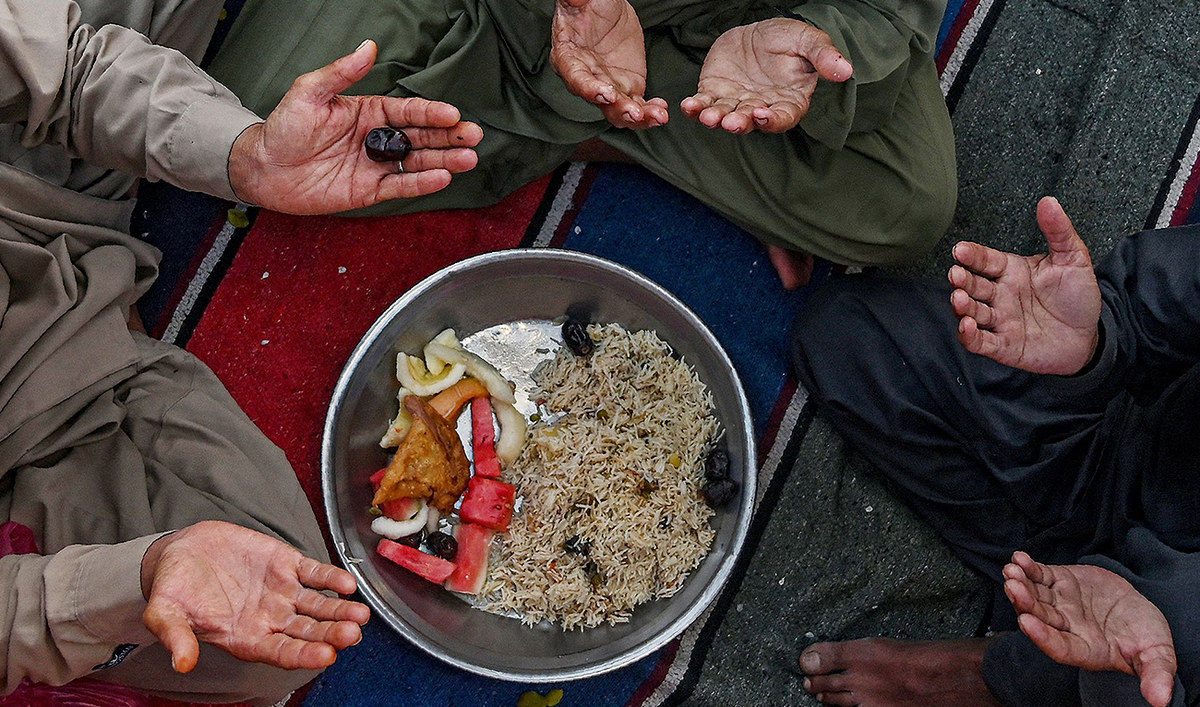


People pray before breaking their fast on the first day of the Islamic holy month of Ramadan at Memon Masjid in Karachi on March 12, 2024. (AFP)

“One platter contains dates, fruits, samosas, chicken rolls and pakoras,” he said. “Water and soft drinks are also served to people, who can choose from different rice dishes as well.”

Around a dozen people were involved in the arrangement, Qadri said.

“Initially, the management used to do it from its own pocket. However, when we need donors now, we ask them to pay the vendors directly,” Qadri said, adding that the mosque did not accept an donations for the iftar.

“Today is my first iftar at this place,” said Dost Muhammad, a resident of Baldia Town who had come to the area for Eid shopping.

“The arrangement was good and I felt totally at home.”
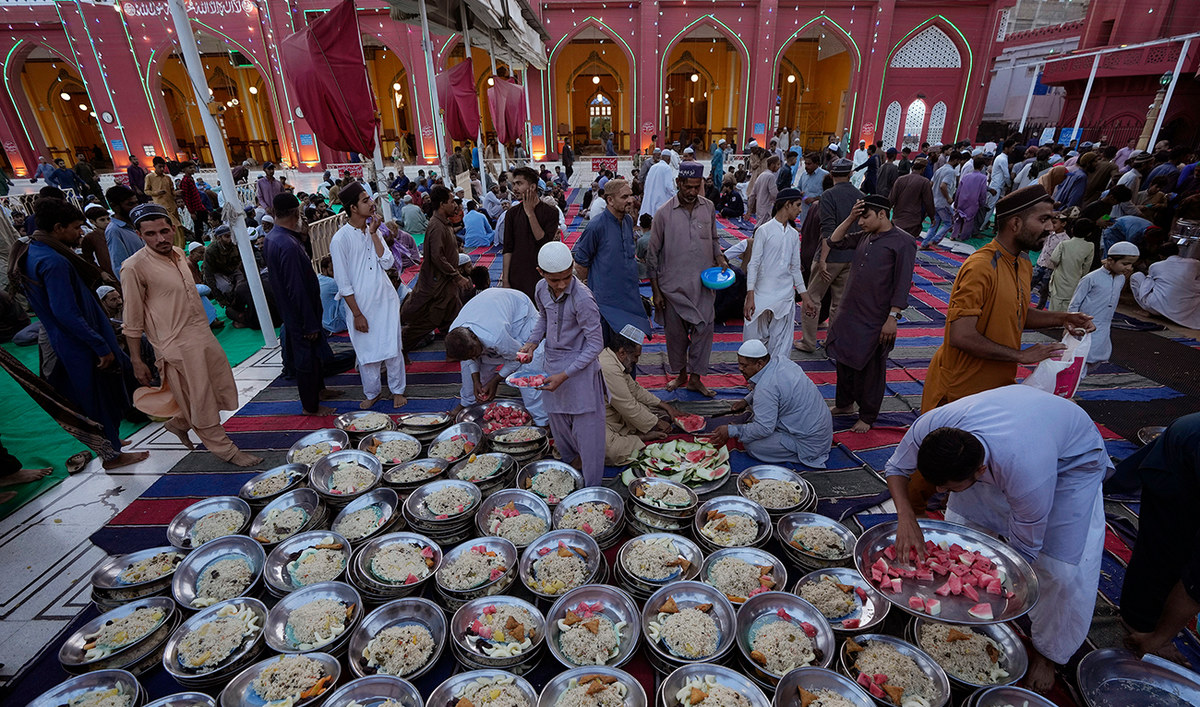


Volunteers distribute food plates among people for breaking their fast during the Muslim’s holy fasting month of Ramadan, at Memon mosque in Karachi on March 12, 2024. (AP)


Pakistan PM reviews internal, regional security after Khamenei killing, Afghanistan strikes

Updated 4 sec ago
Follow

Pakistan PM reviews internal, regional security after Khamenei killing, Afghanistan strikes

  • At least 16 people were killed and dozens more injured in clashes over killing of the Iranian supreme leader
  • The unrest came amid Pakistan’s offensive against Afghan forces, which officials say has killed 415 fighters

ISLAMABAD: Prime Minister Shehbaz Sharif on Sunday convened a high-level meeting to review internal and regional security situation, Sharif’s office said, amid nationwide protests over the killing of Iran’s Supreme Leader Ayatollah Ali Khamenei and Islamabad’s ongoing military operation against Afghan forces.

Protests erupted in several cities across Pakistan on Sunday after the killing of the Iranian supreme leader in US-Israeli joint strikes, with at least 16 people killed and dozens more injured in clashes with law enforcement agencies.

The unrest came amid Pakistan’s ongoing military operation against Afghan forces following a series of tit-for-tat strikes by the neighbors which began after Islamabad hit what it said were Tehreek-e-Taliban Pakistan and Daesh camps in Afghanistan on Feb 21-22.

During Sunday’s meeting, officials briefed PM Sharif and other participants about the country’s internal situation and security arrangements in place to thwart any untoward incident, according to Sharif’s office.

“Pakistan’s role and various measures to establish peace in the region were reviewed at the meeting,” Sharif’s office said. “The situation in Afghanistan was also reviewed in detail at the meeting.”

The development came shortly after Pakistan’s Information Minister Attaullah Tarar said that 415 Afghan Taliban fighters had been killed and more than 580 wounded since the latest phase of hostilities between the neighbors began on Thursday.

Afghan officials earlier said that dozens of Pakistani soldiers had been killed and several Pakistan posts had been captured by their forces. None of the casualty figures or battlefield claims from either side could be independently verified.

Earlier in the day, gunshots and explosions were reported in Kabul. Afghan government spokesperson Zabihullah Mujahid said the sounds were the result of Afghan forces targeting Pakistani aircraft over the capital.

“Air defense attacks were carried out in Kabul against Pakistani aircraft,” Mujahid wrote on X. “Kabul residents should not be concerned.”

KHAMENEI KILLING ‘VIOLATION’ OF INTERNATIONAL LAW

Separately, Sharif said the killing of Khamenei was a “violation” of international law.

“People of Pakistan join the people of Iran in their hour of grief and sorrow and extend the most sincere condolences on the martyrdom [of Khamenei],” he wrote on X.

“Pakistan also expresses concern over violation of the norms of international law.”

EVACUATION OF PAKISTANIS FROM IRAN

At Sunday’s meeting, officials of the foreign ministry also briefed the prime minister on the evacuation of Pakistani citizens from Iran, according to a statement issued from Sharif’s office.

“The evacuation of Pakistani citizens from Iran is being made possible through Azerbaijan,” they were quoted as saying.

Pakistan earlier asked its citizens in Gulf countries to exercise caution, avoid travel and strictly follow official adviseries, amid escalating tensions following the killing of Khamenei.

The foreign ministry shared emergency contact details of Pakistani embassies and consulates for the facilitation of Pakistani nationals abroad.