

UK unveils new extremism definition amid rise in hate crimes against Jews, Muslims

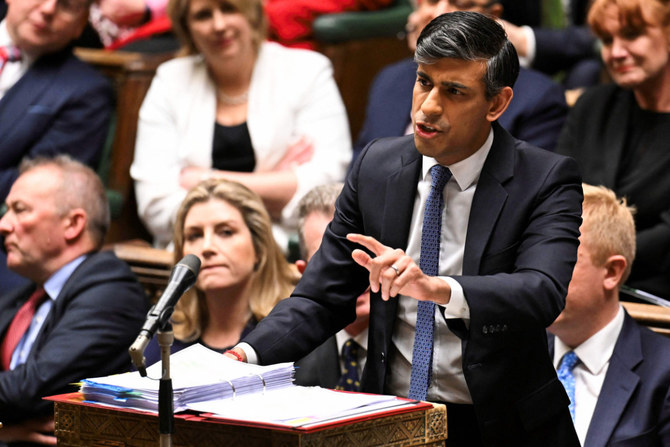
UK Prime Minister Rishi Sunak speaking in the House of Commons in London on March 13, 2024. (UK Parliament handout photo via AFP)
Short Url
Updated 14 March 2024
Follow

UK unveils new extremism definition amid rise in hate crimes against Jews, Muslims

LONDON: Britain unveiled a new definition of extremism on Thursday in response to an eruption of hate crimes against Jews and Muslims since the Oct. 7 Hamas attacks on Israel, although critics said the change risked infringing on freedom of speech.
Earlier this month, Prime Minister Rishi Sunak warned that Britain’s multi-ethnic democracy was being deliberately undermined by both Islamist and far-right extremists, and more needed to be done to tackle the problem.
Antisemitic incidents rose by 147 percent in 2023 to record levels, fueled by the Oct. 7 attacks, according to Community Security Trust, a Jewish safety watchdog. Tell Mama, a group which monitors anti-Muslim incidents, said last month that anti-Muslim hate crimes also had grown by 335 percent since the attacks.

“Today’s measures will ensure that government does not inadvertently provide a platform to those setting out to subvert democracy and deny other people’s fundamental rights,” said Michael Gove, the communities minister who heads the department that produced the new extremism definition.
“This is the first in a series of measures to tackle extremism and protect our democracy,” Gove said.
The new definition states that extremism “is the promotion or advancement of an ideology based on violence, hatred or intolerance,” that aims to destroy fundamental rights and freedoms; or undermine or replace the UK’s liberal parliamentary democracy; or intentionally create an environment for others to achieve those results.
Britain already bans groups which it says are involved in terrorism, and supporting or being a member of these organizations is a criminal offense. The militant Palestinian group Hamas is among the 80 international organizations that are banned.
Groups which will be identified as extremist following a “robust” assessment over the next few weeks will not be subject to any action under criminal laws and will still be permitted to hold demonstrations.

But the government will not provide them with any funding or any other form of engagement. Currently, no groups have been officially defined as extremist using the former definition which has been in place since 2011.
Gove said in an interview on Sunday that some recent large-scale pro-Palestinian marches in central London had been organized by “extremist organizations,” and people might choose not to support such protests if they knew they were giving credence to those groups.
Even before the new definition was announced, critics warned it could be counter-productive.
“The problem with a top-down definition of extremism is that it catches people who (we) don’t want to catch,” said Archbishop of Canterbury Justin Welby, the spiritual head of the Anglican Communion.
“It may accidentally inhibit what we have very preciously in this country, an extraordinarily robust freedom of speech and ability to disagree strongly,” Welby told BBC Radio on Wednesday.
More than 50 survivors or relatives of victims of Islamist attacks in Britain have also signed a letter accusing some politicians of playing into the hands of militants by “equating being Muslim with being an extremist.”


Canada PM Carney says can’t rule out military participation in Iran war

Updated 55 min 12 sec ago
Follow

Canada PM Carney says can’t rule out military participation in Iran war

  • Carney had said the US-Israeli strikes on Iran were “inconsistent with international law”
  • However, he supports the efforts to stop Iran from obtaining a nuclear weapon

CANBERRA, Australia: Canadian Prime Minister Mark Carney said Thursday that he couldn’t rule out his country’s military participation in the escalating war in the Middle East.
Carney’s visit to Australia this week has been overshadowed by expanding war in the Middle East, sparked by a massive US-Israeli strike on Iran that killed its supreme leader, Ayatollah Ali Khamenei.
Speaking alongside local counterpart Anthony Albanese in Canberra, Carney was asked whether there was a situation in which Canada would get involved.
“One can never categorically rule out participation,” he said, while stressing the question was a “hypothetical” one.
“We will stand by our allies,” said Carney, adding that “we will always defend Canadians.”
Carney had said the US-Israeli strikes on Iran were “inconsistent with international law.”
However, he supports the efforts to stop Iran from obtaining a nuclear weapon — a position that Canada takes “with regret” as it represented “another example of the failure of the international order.”
The Canadian leader reiterated on Thursday his call for a “de-escalation” of the conflict.
Carney’s trip is part of a multi-country tour of the Asia-Pacific aimed at reducing reliance on the United States — a hedge against what he has described as a fading US-led global order.
The Australia leg of the tour is aimed at bringing in investment and deepening ties with a like-minded “middle power” partner.

‘Middle power’ rallying cry

On Thursday morning he issued a rallying cry in Australia’s parliament to “middle powers,” urging them to work together in an increasingly hegemonic world order.
Nations like Australia and Canada faced a stark choice — work together to help write the “new rules” of the global order or have great powers do it for them, he said.
“In this brave new world, middle powers cannot simply build higher walls and retreat behind them. We must work together,” he said.
“Great powers can compel, but compulsion comes with costs, both reputational and financial,” the former central banker added.
“Middle powers like Australia and Canada hold this rare convening power because others know we mean what we say and we will match our values with our actions.”
The Canadian leader also said the two countries would together as “strategic collaborators” to pool their vast combined rare earth mineral resources.
And he detailed renewed cooperation in areas from defense to artificial intelligence.
“We know we must work with others who share our values to build solid capabilities,” he told parliament.
Otherwise, he warned, they risked being “caught between the hyperscalers and the hegemons.”
The Canadian leader has frequently clashed with US President Donald Trump, who has repeatedly threatened to annex Canada and slapped swingeing tariffs on the country.
In a speech to political and financial elites at the World Economic Forum in January, Carney warned the US?led global system of governance was enduring “a rupture.”