

Sudan’s army chief vows to push on after advance in embattled capital

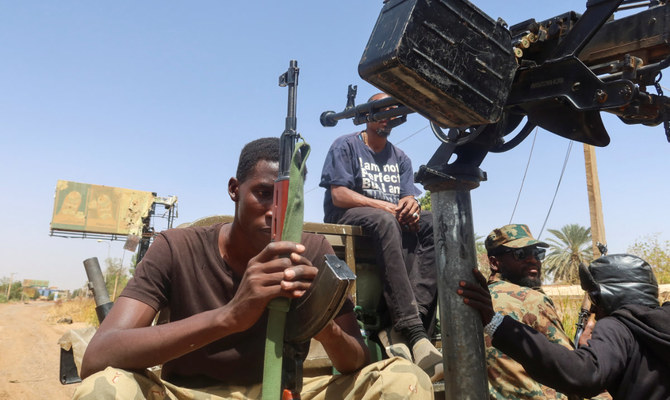
Sudanese soldiers sit on an army vehicle in Omdurman. (Reuters)
Short Url
Updated 13 March 2024
Follow

Sudan’s army chief vows to push on after advance in embattled capital

  • The army has signaled it will not consider international appeals for a ceasefire during Ramadan unless the RSF agrees to a major military withdrawal

DUBAI: The head of Sudan’s army has told troops it will press to take more ground after its most significant advance in an 11-month-old war against the paramilitary Rapid Support Forces, as a charity warned of a rising risk of hunger-linked deaths.

Army forces, which witnesses say have been boosted by recent deployment of drones, took control on Tuesday of the radio and TV headquarters in Omdurman, across the River Nile from Khartoum and part of the wider capital. The RSF, a rival military faction that has had the upper hand in the conflict, had held the area since the first days of the war in April last year.

Though broadcasting from the radio and TV building had stopped, the advance extended the army’s reach across the old center of Omdurman — strategically important because it hosts military bases and has been a transit point for RSF resupplies.

Witnesses said they had seen destroyed RSF vehicles and the bodies of RSF fighters near the broadcast complex on Wednesday.

“Our message to the Rapid Support rebels is that the armed forces and regular military services will go after you everywhere until victory is achieved,” army chief Gen. Abdel Fattah Al-Burhan told troops at the Engineer Corps base in Omdurman late on Tuesday.

The army would continue to fight the RSF in other parts of the capital, and in the western region of Darfur and El Gezira state south of Khartoum — areas where the RSF made swift advances late last year — “until complete victory is achieved,” Al-Burhan said, according to a statement issued on Wednesday.

The army also released a video showing Al-Burhan stopping in a convoy of Land Cruisers with heavily armed guards to break his Ramadan fast with residents on a roadside in Omdurman.

The army has signaled it will not consider international appeals for a ceasefire during Ramadan unless the RSF agrees to a major military withdrawal.

The war, which broke out over the terms of a plan for a political transition from military rule toward free elections, has caused more than 8 million people to flee their homes, creating the world’s biggest displacement crisis.

The number of Sudanese estimated to be facing crisis levels of hunger — one stage before famine — has more than tripled in a year to nearly 5 million. 

Some in Omdurman have struggled to access food, though the army’s recent gains eased the situation in at least one area.

On Wednesday, the international charity Save the Children said that about 220,000 severely malnourished children and over 7,000 new mothers in Sudan could die in the coming months from hunger unless more funding for humanitarian relief is provided.

Relief efforts have been badly hampered by denial of access and looting of aid supplies.

Fighting has also brought down the supply chain within Sudan for foods used to treat severely malnourished children, according to Save the Children.


Syrian church marks Christmas and reaffirms faith months after deadly attack

Updated 15 min 26 sec ago
Follow

Syrian church marks Christmas and reaffirms faith months after deadly attack

  • The June attack was blamed on a Daesh cell, which authorities said had also planned to target a Shiite shrine

DWEIL’A: At a church in Syria where a suicide attack killed 25 people in June, hundreds of worshippers gathered before Christmas to remember those they lost and reaffirm their faith.
With a small detail of security forces standing guard outside, members of Mar Elias Church held Mass on Tuesday evening and lit an image of Christmas tree made of neon lights on the wall of the courtyard outside. The tree was hung with pictures of those who were killed in the attack.
They include three men the congregation hails as heroes for tackling the bomber, potentially averting a much higher death toll in the June 22 attack.
A man opened fire then detonated an explosive vest inside the Greek Orthodox church in Dweil’a on the outskirts of Damascus as it was filled with people praying on a Sunday.
Before he detonated the vest, brothers Boutros and Gergis Bechara and another congregant, Milad Haddad, tackled the shooter and pushed him out of the center of the church, congregants said.
“If it weren’t for the three of them, maybe not one person would remain out of 400 people,” said Imad Haddad, the brother of Milad Haddad, who attended Tuesday’s Christmas tree lighting.
He hasn’t decorated for Christmas or put up a tree at home, but gathering at the church was “is a message of peace and love” and a message that “we are believers and we are strong and we are steadfast in spite of everything,” he said.
Thana Al-Masoud, the widow of Boutros Bechara, recalled searching frantically for her husband after the explosion but she never found him, alive or dead. His body had been ripped apart by the blast.
“There’s no holiday, neither this year nor next year nor the one after it,” she said.
She takes comfort in the belief that her husband and the two other men who confronted the attacker are martyrs for their faith.
“Our Lord chose them to be saints and to spread His word to all the world,” she said. “But the separation is difficult.”
Attack stoked Christian fears
The attack on the church was the first of its kind in Syria in years and came as a new Sunni militant- dominated government in Damascus sought to win the confidence of religious minorities following the ouster of former President Bashar Assad.
Interim President Ahmad Al-Sharaa has struggled to exert authority across the country, even in the ranks of allied groups. There have been several deadly outbreaks of sectarian violence in the country in the past year.
While the new government has condemned attacks on minorities, many accuse it of failing to act to control the armed factions it is trying to absorb into the new state army and security forces.
The June attack was blamed on a Daesh cell, which authorities said had also planned to target a Shiite shrine. Daesh did not claim responsibility for the attack, while a little-known group called Saraya Ansar Al-Sunna said one of its members had carried out the attack. The government said the group was a cover for Daesh.
Christians made up about 10 percent of Syria’s population of 23 million before mass anti-government protests in 2011 were met by a brutal government crackdown and spiraled into a brutal 14-year civil war that saw the rise of IS and other extremist groups.
Hundreds of thousands of Christians fled during the war, during which there were sectarian attacks on Christians including the kidnapping of nuns and priests and destruction of churches. Now many are once again seeking to leave.
Solidifying faith and seeking peace
Since losing her husband in the church attack, Juliette Alkashi feels numb.
The couple had been sweethearts before she left Syria with her mother and brother to emigrate to Venezuela. In 2018, when Emile Bechara asked her to marry him, Alkashi moved back to Syria even though it was still in the midst of a civil war.
“Whatever is going to happen will happen, and I’ve surrendered to it,” she said. “If one goes to pray and dies in the church — whatever God has written is what will be.”
The only thing that matters now, Alkashi said, is that she and her 3-year-old son remain together.
Some congregants said the attack only strengthened their faith.
“I saw a column of smoke rising from the ground to the ceiling, and I heard a voice saying, ‘I will not forsake you and I will not leave you,’” said Hadi Kindarji, who described an intense spiritual experience in the moment of the explosion.
He believes today that even the seemingly senseless violence was part of God’s plan.
“Our God is present, and He was present in the church,” he said.
Yohanna Shehadeh, the priest of Mar Elias church, acknowledged many in the congregation are afraid of more deadly violence.
“Fear is a natural state. I’m not going to tell you there is no fear, and I’m not only talking about the Christians but about all the Syrian people, from all sects,” Shehadeh said.
As Christmas approaches, he said, they are praying for peace.