

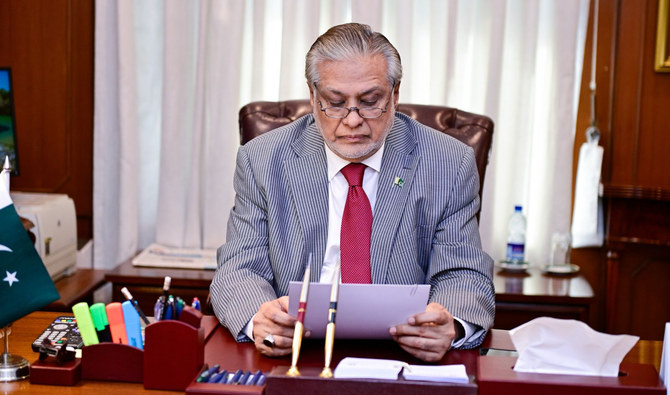

ISLAMABAD: In an indication that negotiating for new loans with the International Monetary Fund and attracting foreign investment will take center stage in Pakistan’s future diplomatic engagements, the country’s new Prime Minister Shehbaz Sharif has appointed four-time ex-finance chief Ishaq Dar as foreign minister.
The most pressing challenge for the new government would be to secure at least $6 billion in loans from the IMF to tide over the economy, which has been battered by surging inflation and slowing growth. The nation also needs to unlock the final $1.1 billion tranche from a $3 billion IMF program that ends next month.
“Economic diplomacy is the need of the hour for sure,” Dar told media after his appointment.
But his critics, and even his political allies, have criticized his handling of the economy in his last tenure as finance minister from September 2022 to August 2023, when inflation spiked as high as 38 percent and interest rates hit 22 percent. Dar has defended himself and attributed the challenges to Pakistan needing to meet tough conditions under its last $6.5 billion IMF bailout program.
Critics are also wary of Dar’s leadership style and refer to his regular and public criticism of the IMF in the middle of talks, which they say hurt negotiations.
“I don’t care if they come, I don’t have to plead before them, I have to look at Pakistan’s matters,” Dar famously said in a TV interview in December 2022, when questioned about the delay in the arrival of an IMF mission to Islamabad for bailout talks for the release of a tranche.
He said the IMF could “not dictate” the government: “If they don’t come then we will manage, no problem.”
But Pakistan struggled for seven months to unlock the remaining tranches of that loan under Dar and ultimately it took intervention by then PM Shehbaz Sharif to secure a new last-ditch new deal for the current $3 billion stand-by arrangement.
Dar is also best known for favoring market intervention to prop up the Pakistani rupee, something the IMF has warned against. His reluctance during the last Nawaz Sharif governmentfollowing 2013 elections to let the rupee weaken to ease current account pressures widely courted criticism from economists, who said the PML-N was making economic decisions with one eye on the general election in 2018.
The implied exchange rate underlying the latest IMF staff report is 305 rupee to the dollar for this fiscal year and 331 per dollar in FY 24/25, levels which are roughly 8 percent and 15 percent weaker than the current exchange rate.
In his new job, Dar will have to handle many delicate foreign relationships, including with China and Gulf countries that are key sources of financing for cash-strapped Pakistan and with which PML-N government have usually had easy ties.
The more difficult challenge will be handling Washington, and prickly neighbors, including arch-rival India, which will go to the polls this year, Taliban-led Afghanistan, which Pakistan accuses of harboring anti-Pakistan militants, and Iran, with which Islamabad exchanged tit-for-tat airstrikes in Januraty, the highest-profile cross-border intrusions in years.
“TRUSTED SHARIF AIDE”
Born on May 13, 1950 in Lahore, Dar qualified as a chartered accountant in the United Kingdom in 1974. He entered politics in the late 1980s with the Pakistan Muslim League-Nawaz (PML-N) of Nawaz Sharif, who would go on to be Pakistan’s prime minister three times. He quickly became an integral part of Nawaz’s close political circle and was handpicked to lead the Pakistan Board of Investment in 1992 with a ministerial status.
Dar was serving as commerce minister when Nawaz’s administration was toppled by Army Chief General (r) Pervez Musharraf in a bloodless coup in October 1999, following which he spent two years in prison on corruption charges where he reportedly confessed to laundering $14.86 million on behalf of his leader. Dar later said the confession was extracted under duress, and has maintained his political influence and trust within the PML-N. In 2004, his son, Ali Dar, married Nawaz’s daughter, Asma Nawaz, in Jeddah, bringing him even closer to the PML-N leader.
After Musharraf’s political exit in 2008, Dar remained a prominent figure in Pakistani politics, was re-elected to the Senate multiple times and received the coveted Nishan-e-Imtiaz award in 2011 for his parliamentary services.
In July 2017, the Supreme Court disqualified Sharif from the office of PM for not declaring a small source of income and ordered a corruption investigation into Sharif, his children and Dar, Sharif’s former accountant.
Dar left for alleged medical treatment in the UK soon after and was declared an absconder by the court when he failed to show up for multiple court hearings in a number of corruption references. Dar and the PML-N said the corruption cases were politically motivated to keep them out of the 2018 general elections, which were won by now jailed ex-PM Imran Khan.
Dar remained in self-exile for five years but returned to Pakistan to take over the finance ministry once again, months after Khan was ousted in a parliamentary vote of no-confidence and Shehbaz Sharif became PM for 16 months, until general election on Feb. 8 this year.
With his party regaining power in the latest national polls, Dar has transitioned to the foreign ministry, suggesting a shift toward leveraging economic diplomacy.


