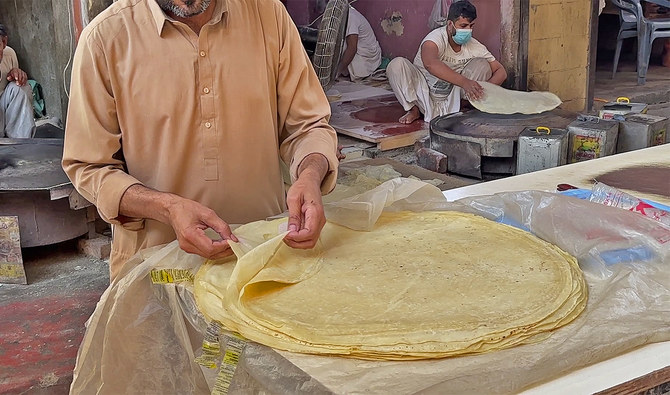

KARACHI: The streets of Ranchore Line, one of the oldest neighborhoods in Pakistan’s commercial hub of Karachi, come alive as the holy month of Ramadan arrives, with the excitement centering around a single commodity: manda pattis.
The sheets, locally called samosa or roll patti, are the pastry used to make spring rolls and samosas, savory, triangular deep-fried snacks that are a staple of Pakistan iftar table spreads throughout Ramadan. Samosas which usually don’t cost more than ten cents a piece, are pastry filled with vegetables like potatoes, onions and peas, or meats like beef and chicken mince or, in its more modern varieties, with cheese, tofu or even Nutella for a sweet twist. They are deep fried and served hot, often with fresh green mint, coriander, or tamarind chutney.
While some people keep store bought samosas and rolls to fry up as a quick snack at iftar, many people prefer to make them from scratch with manda pattis. In Karachi, this means a trip to Qaisar Saleem’s manda shop, the only one in Ranchore Line, which runs round the clock and employs nearly three dozen people to keep pace with increased demand during the holy month of fasting.
“People make them [samosas and rolls] at home, that is why there is a rush of customers here,” Saleem, 45, who has been running the shop for over two decades, told Arab News as he supervised his staff.
“The public wants to make hygienic things, this is why. You know how the stuff available outside [in the market] usually is.”
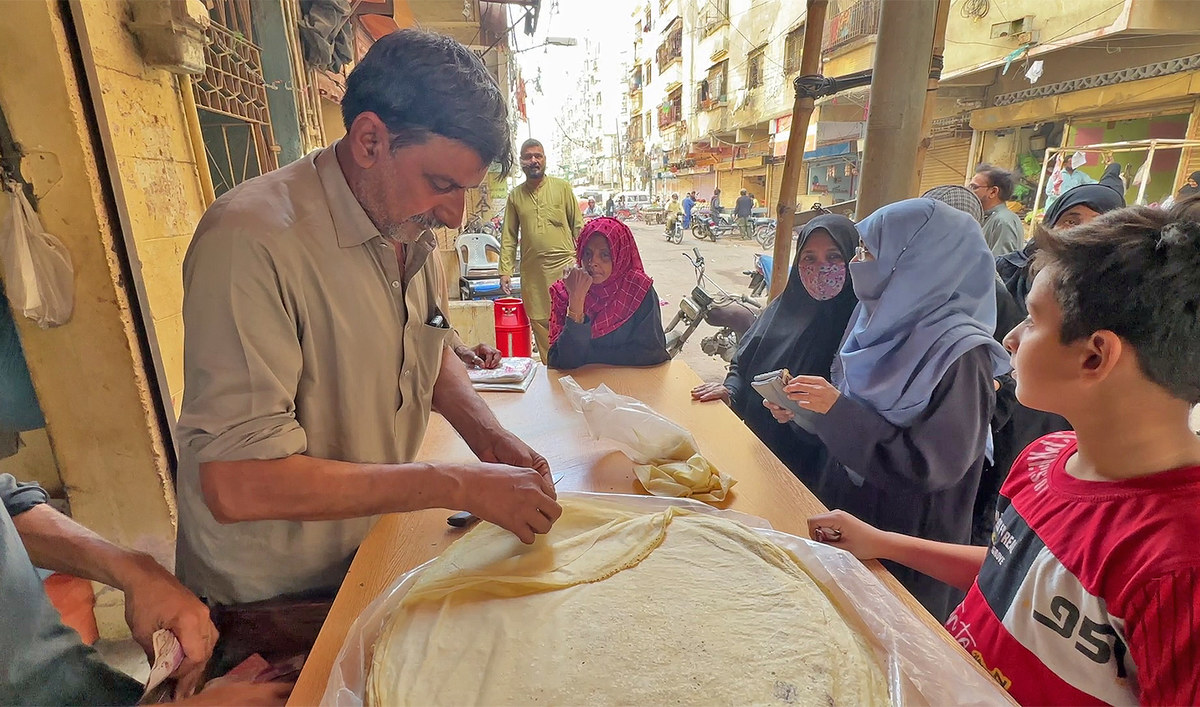
Customers gather outside Qaisar Saleem’s manda shop in Karachi, Pakistan, on March 12, 2024. (AN photo)
The 35 people employed at the shop during Ramadan work 12-hour shifts, “from 7 in the morning to 7 in the evening,” Saleem explained, and use up over 30 bags of flour, 25 kg each, within 24 hours.
Around him, workers made sheets from manda, a mixture of refined wheat flour kneaded with the help of a machine to form a dough that is rolled out by applying oil and then formed into large, circular sheets, which are cut up into triangular and rectangular pieces of pastry to be sold as the outer covering for samosas and rolls.
One large, round manda sheet sells for Rs40, and can be used to make either 12 samosas, eight spring rolls, six patties or 12 wontons.
“GOOD AND HYGIENIC”
Buyers say the manda sheets serve two purposes.
It costs less to make samosas and rolls at home compared to buying packaged varieties and customers can also rest assured that the final product is hygienic.
Pakistan, a nation of over 241 million people, is currently reeling from the impact of inflation that hit a historic high of 38 percent in May last year, but eased to 23.1 percent in February this year, still on the higher side mainly due to the high costs of energy and food.
“The minimum cost of a samosa in the market is Rs40,” buyer Abdul Razak Ghanchi told Arab News. “Making it at home costs only Rs20 or Rs22. Even after frying, it costs around Rs25-26.”
“We buy from here every time [ramadam], after two days, three days, we come here, we get it from here only,” housewife Farkhanda, another customer, said at Saleem’s shop. “These items are good and hygienic. We use them for the whole month.”
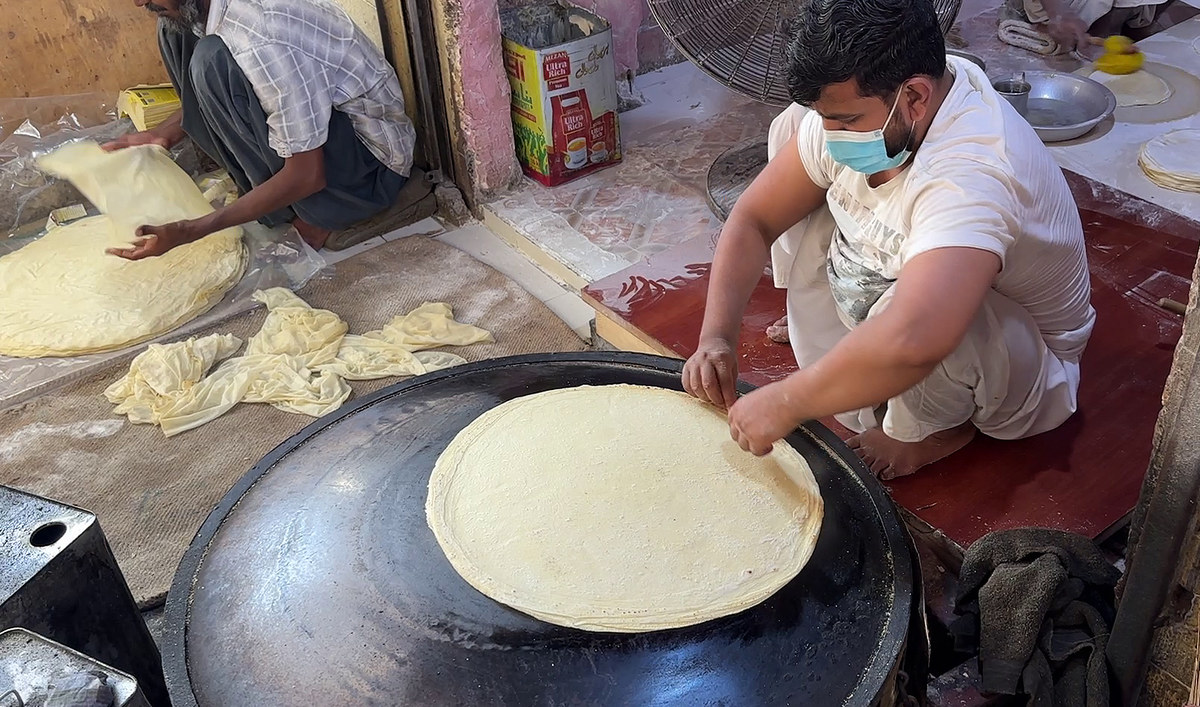
A man cooks manda pattis at a shop in Karachi, Pakistan, on March 12, 2024. (AN photo)
Preparing the items at home also guaranteed quality and cleanliness, Ghanchi added.
“It is reassuring that the item is prepared at home, made with your own hands and is safe to eat, it doesn’t have impurities or any dirty things,” he said.
“The important thing about this is that when we make samosas and rolls at home, we ensure the meat or minced meat we use is clean.”