


NEW DELHI: India has implemented a controversial citizenship law that has been widely criticized for excluding Muslims, a minority community whose concerns have heightened under Prime Minister Narendra Modi’s Hindu nationalist government.
The rules for the law were announced Monday. It establishes a religious test for migrants from every major South Asian faith other than Islam. Critics argue that the law is further evidence that Modi’s government is trying to reshape the country into a Hindu state and marginalize its 200 million Muslims.
WHAT IS THE NEW CITIZENSHIP LAW?
The Citizenship Amendment Act provides a fast track to naturalization for Hindus, Parsis, Sikhs, Buddhists, Jains and Christians who fled to Hindu-majority India from Afghanistan, Bangladesh and Pakistan before Dec. 31, 2014. The law excludes Muslims, who are a majority in all three nations.
It also amends the old law, which prevents illegal migrants from becoming Indian citizens, and marks the first time that India — an officially secular state with a religiously diverse population — has set religious criteria for citizenship.
HIGHLIGHTS
• Scores of Muslims have been lynched by Hindu mobs over allegations of eating beef or smuggling cows, an animal considered holy to Hindus
• Muslim businesses have been boycotted, their localities have been bulldozed and Mosques set on fire
• Some Hindutva leaders have made open calls for genocide against Muslims
The Indian government has said those eligible can apply for Indian citizenship through an online portal.
The implementation of the law has been one of the key poll promises of Modi’s ruling Bharatiya Janata Party in the run-up to the general election, which is scheduled to be held by May.
Modi’s government has dismissed the notion that the law is discriminatory and defended it as a humanitarian gesture. It argues the law is meant only to extend citizenship to religious minorities fleeing persecution and would not be used against Indian citizens.
WHAT MAKES THE LAW SO CONTROVERSIAL?
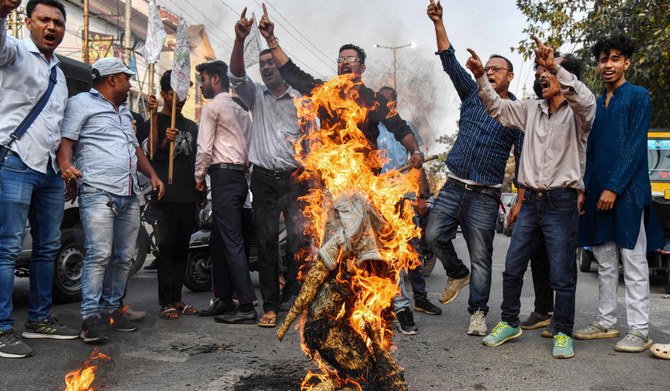
The law was approved by India’s Parliament in 2019, but Modi’s government held off its implementation after deadly protests broke out in New Delhi and elsewhere. Scores were killed during days of clashes.
The nationwide protests in 2019 drew people of all faiths who said the law undermines India’s foundation as a secular nation. Muslims were particularly worried that the government could use the law, combined with a proposed national register of citizens, to marginalize them.
The National Register of Citizens is part of the Modi government’s effort to identify and weed out people it claims came to India illegally. The register has only been implemented in the northeastern state of Assam, but Modi’s party has promised to roll out a similar citizenship verification program nationwide.
Critics and Muslim groups say the new citizenship law will help protect non-Muslims who are excluded from the register, while Muslims could face the threat of deportation or internment.
WHY ARE INDIA’S MUSLIMS WORRIED?
Opponents of the law — including Muslims, opposition parties and rights groups — say it is exclusionary and violates the secular principles enshrined in the constitution. They say faith cannot be made a condition of citizenship.
On Monday, Human rights watchdog Amnesty India said the law “legitimizes discrimination based on religion.”
Some also argue that if the law is aimed at protecting persecuted minorities, then it should have included Muslim religious minorities who have faced persecution in their own countries, including Ahmadis in Pakistan and Rohingyas in Myanmar.
To critics, Modi is pushing a Hindu nationalist agenda that threatens to erode the country’s secular foundation, shrink space for religious minorities, particularly Muslims, and move the country closer to a Hindu nation.
India is home to 200 million Muslims who make up a large minority group in the country of more than 1.4 billion people. They are scattered across almost every part of India and have been targeted in a series of attacks that have taken place since Modi first assumed power in 2014.
Scores of Muslims have been lynched by Hindu mobs over allegations of eating beef or smuggling cows, an animal considered holy to Hindus. Muslim businesses have been boycotted, their localities have been bulldozed and places of worship set on fire. Some open calls have been made for their genocide.
Critics say Modi’s conspicuous silence over anti-Muslim violence has emboldened some of his most extreme supporters and enabled more hate speech against Muslims.
Modi has also increasingly mixed religion with politics in a formula that has resonated deeply with India’s majority Hindu population. In January, he opened a Hindu temple at the site of a demolished mosque in northern Ayodhya city, fulfilling his party’s long-held Hindu nationalist pledge.


