

India’s new citizenship law that excludes Muslims has them worried. Here’s what it says

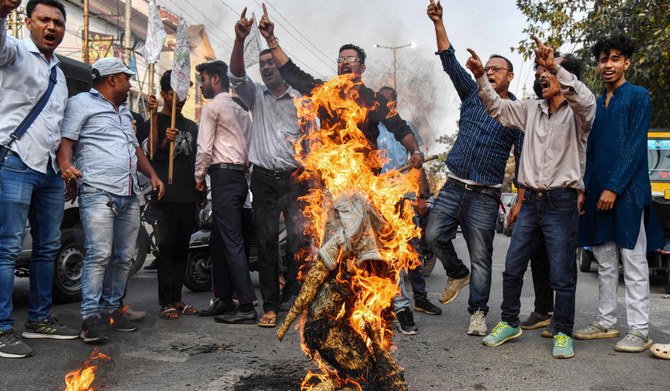
Members of the Asom Jatiyatabadi Yuba Chatra Parishad (AJYCP), a student's organisation, burn the effigy of India's Prime Minister Narendra Modi during a protest against the implementation of the Citizenship Amendment Act (CAA) in Guwahati on March 12, 2024. (AFP)
Short Url
Updated 13 March 2024
Follow

India’s new citizenship law that excludes Muslims has them worried. Here’s what it says

  • Law establishes religious test for migrants from every major South Asian faith other than Islam
  • Critics say Modi trying to reshape India into Hindu state, marginalize 200 million Muslims

NEW DELHI: India has implemented a controversial citizenship law that has been widely criticized for excluding Muslims, a minority community whose concerns have heightened under Prime Minister Narendra Modi’s Hindu nationalist government.
The rules for the law were announced Monday. It establishes a religious test for migrants from every major South Asian faith other than Islam. Critics argue that the law is further evidence that Modi’s government is trying to reshape the country into a Hindu state and marginalize its 200 million Muslims.
WHAT IS THE NEW CITIZENSHIP LAW?
The Citizenship Amendment Act provides a fast track to naturalization for Hindus, Parsis, Sikhs, Buddhists, Jains and Christians who fled to Hindu-majority India from Afghanistan, Bangladesh and Pakistan before Dec. 31, 2014. The law excludes Muslims, who are a majority in all three nations.
It also amends the old law, which prevents illegal migrants from becoming Indian citizens, and marks the first time that India — an officially secular state with a religiously diverse population — has set religious criteria for citizenship.

HIGHLIGHTS

• Scores of Muslims have been lynched by Hindu mobs over allegations of eating beef or smuggling cows, an animal considered holy to Hindus

• Muslim businesses have been boycotted, their localities have been bulldozed and Mosques set on fire

• Some Hindutva leaders have made open calls for genocide against Muslims

The Indian government has said those eligible can apply for Indian citizenship through an online portal.
The implementation of the law has been one of the key poll promises of Modi’s ruling Bharatiya Janata Party in the run-up to the general election, which is scheduled to be held by May.
Modi’s government has dismissed the notion that the law is discriminatory and defended it as a humanitarian gesture. It argues the law is meant only to extend citizenship to religious minorities fleeing persecution and would not be used against Indian citizens.
WHAT MAKES THE LAW SO CONTROVERSIAL?
The law was approved by India’s Parliament in 2019, but Modi’s government held off its implementation after deadly protests broke out in New Delhi and elsewhere. Scores were killed during days of clashes.
The nationwide protests in 2019 drew people of all faiths who said the law undermines India’s foundation as a secular nation. Muslims were particularly worried that the government could use the law, combined with a proposed national register of citizens, to marginalize them.
The National Register of Citizens is part of the Modi government’s effort to identify and weed out people it claims came to India illegally. The register has only been implemented in the northeastern state of Assam, but Modi’s party has promised to roll out a similar citizenship verification program nationwide.
Critics and Muslim groups say the new citizenship law will help protect non-Muslims who are excluded from the register, while Muslims could face the threat of deportation or internment.
WHY ARE INDIA’S MUSLIMS WORRIED?
Opponents of the law — including Muslims, opposition parties and rights groups — say it is exclusionary and violates the secular principles enshrined in the constitution. They say faith cannot be made a condition of citizenship.
On Monday, Human rights watchdog Amnesty India said the law “legitimizes discrimination based on religion.”
Some also argue that if the law is aimed at protecting persecuted minorities, then it should have included Muslim religious minorities who have faced persecution in their own countries, including Ahmadis in Pakistan and Rohingyas in Myanmar.
To critics, Modi is pushing a Hindu nationalist agenda that threatens to erode the country’s secular foundation, shrink space for religious minorities, particularly Muslims, and move the country closer to a Hindu nation.
India is home to 200 million Muslims who make up a large minority group in the country of more than 1.4 billion people. They are scattered across almost every part of India and have been targeted in a series of attacks that have taken place since Modi first assumed power in 2014.
Scores of Muslims have been lynched by Hindu mobs over allegations of eating beef or smuggling cows, an animal considered holy to Hindus. Muslim businesses have been boycotted, their localities have been bulldozed and places of worship set on fire. Some open calls have been made for their genocide.
Critics say Modi’s conspicuous silence over anti-Muslim violence has emboldened some of his most extreme supporters and enabled more hate speech against Muslims.
Modi has also increasingly mixed religion with politics in a formula that has resonated deeply with India’s majority Hindu population. In January, he opened a Hindu temple at the site of a demolished mosque in northern Ayodhya city, fulfilling his party’s long-held Hindu nationalist pledge.


Journalist Don Lemon charged with federal civil rights crimes after covering anti-ICE church protest

Updated 56 min 59 sec ago
Follow

Journalist Don Lemon charged with federal civil rights crimes after covering anti-ICE church protest

  • “Don has been a journalist for 30 years, and his constitutionally protected work in Minneapolis was no different than what he has always done,” his lawyer, Abbe Lowell, said in a statement earlier Friday

LOS ANGELES: Journalist Don Lemon was released from custody Friday after he was arrested and hit with federal civil rights charges over his coverage of an anti-immigration enforcement protest that disrupted a service at a Minnesota church.
Lemon was arrested overnight in Los Angeles, while another independent journalist and two protest participants were arrested in Minnesota. He struck a confident, defiant tone while speaking to reporters after a court appearance in California, declaring: “I will not be silenced.”
“I have spent my entire career covering the news. I will not stop now,” Lemon said. “In fact there is no more important time than right now, this very moment, for a free and independent media that shines a light on the truth and holds those in power accountable.”
The arrests brought sharp criticism from news media advocates and civil rights activists including the Rev. Al Sharpton, who said the Trump administration is taking a “sledgehammer” to “the knees of the First Amendment.”
A grand jury in Minnesota indicted Lemon and others on charges of conspiracy and interfering with the First Amendment rights of worshippers during the Jan. 18 protest at the Cities Church in St. Paul, where a US Immigration and Customs Enforcement official is a pastor.
In court in Los Angeles, Assistant US Attorney Alexander Robbins argued for a $100,000 bond, telling a judge that Lemon “knowingly joined a mob that stormed into a church.” He was released, however, without having to post money and was granted permission to travel to France in June while the case is pending.
Defense attorney Marilyn Bednarski said Lemon plans to plead not guilty and fight the charges in Minnesota.
Lemon, who was fired from CNN in 2023 following a bumpy run as a morning host, has said he has no affiliation to the organization that went into the church and he was there as a solo journalist chronicling protesters.
“Don has been a journalist for 30 years, and his constitutionally protected work in Minneapolis was no different than what he has always done,” his lawyer, Abbe Lowell, said in a statement earlier Friday.
Attorney General Pam Bondi promoted the arrests on social media.
“Make no mistake. Under President Trump’s leadership and this administration, you have the right to worship freely and safely,” Bondi said in a video posted online. “And if I haven’t been clear already, if you violate that sacred right, we are coming after you.”
‘Keep trying’
Since he left CNN, Lemon has joined the legion of journalists who have gone into business for himself, posting regularly on YouTube. He hasn’t hidden his disdain for President Donald Trump. Yet during his online show from the church, he said repeatedly: “I’m not here as an activist. I’m here as a journalist.” He described the scene before him, and interviewed churchgoers and demonstrators.
A magistrate judge last week rejected prosecutors’ initial bid to charge Lemon. Shortly after, he predicted on his show that the administration would try again.
“And guess what,” he said. “Here I am. Keep trying. That’s not going to stop me from being a journalist. That’s not going to diminish my voice. Go ahead, make me into the new Jimmy Kimmel, if you want. Just do it. Because I’m not going anywhere.”
Georgia Fort livestreamed the moments before her arrest, telling viewers that agents were at her door and her First Amendment right as a journalist was being diminished.
A judge released Fort, Trahern Crews and Jamael Lundy on bond, rejecting the Justice Department’s attempt to keep them in custody. Not guilty pleas were entered. Fort’s supporters in the courtroom clapped and whooped.
“It’s a sinister turn of events in this country,” Fort’s attorney, Kevin Riach, said in court.
Discouraging scrutiny

Jane Kirtley, a media law and ethics expert at the University of Minnesota, said the federal laws cited by the government were not intended to apply to reporters gathering news.
The charges against Lemon and Fort, she said, are “pure intimidation and government overreach.”
Some experts and activists said the charges were not only an attack on press freedoms but also a strike against Black Americans who count on Black journalists to bear witness to injustice and oppression.
The National Association of Black Journalists said it was “outraged and deeply alarmed” by Lemon’s arrest. The group called it an effort to “criminalize and threaten press freedom under the guise of law enforcement.”
Crews is a leader of Black Lives Matter Minnesota who has led many protests and actions for racial justice, particularly following George Floyd’s killing in Minneapolis in 2020.
“All the greats have been to jail, MLK, Malcom X — people who stood up for justice get attacked,” Crews told The Associated Press. “We were just practicing our First Amendment rights.”
Protesters charged previously
A prominent civil rights attorney and two other people involved in the protest were arrested last week. Prosecutors have accused them of civil rights violations for disrupting the Cities Church service.
The Justice Department launched an investigation after the group interrupted services by chanting “ICE out” and “Justice for Renee Good,” referring to the 37-year-old mother of three who was fatally shot by an ICE officer in Minneapolis.
Lundy works for the office of Hennepin County Attorney Mary Moriarty and is married to a St. Paul City Council member. Lemon briefly interviewed him as they gathered with protesters preparing to drive to the church on Jan. 18.
“I feel like it’s important that if you’re going to be representing people in office that you are out here with the people,” Lundy told Lemon, adding he believed in “direct action, certainly within the lines of the law.”
Church leaders praise arrests in protest
Cities Church belongs to the Southern Baptist Convention and lists one of its pastors as David Easterwood, who leads ICE’s St. Paul field office.
“We are grateful that the Department of Justice acted swiftly to protect Cities Church so that we can continue to faithfully live out the church’s mission to worship Jesus and make him known,” lead pastor Jonathan Parnell said.