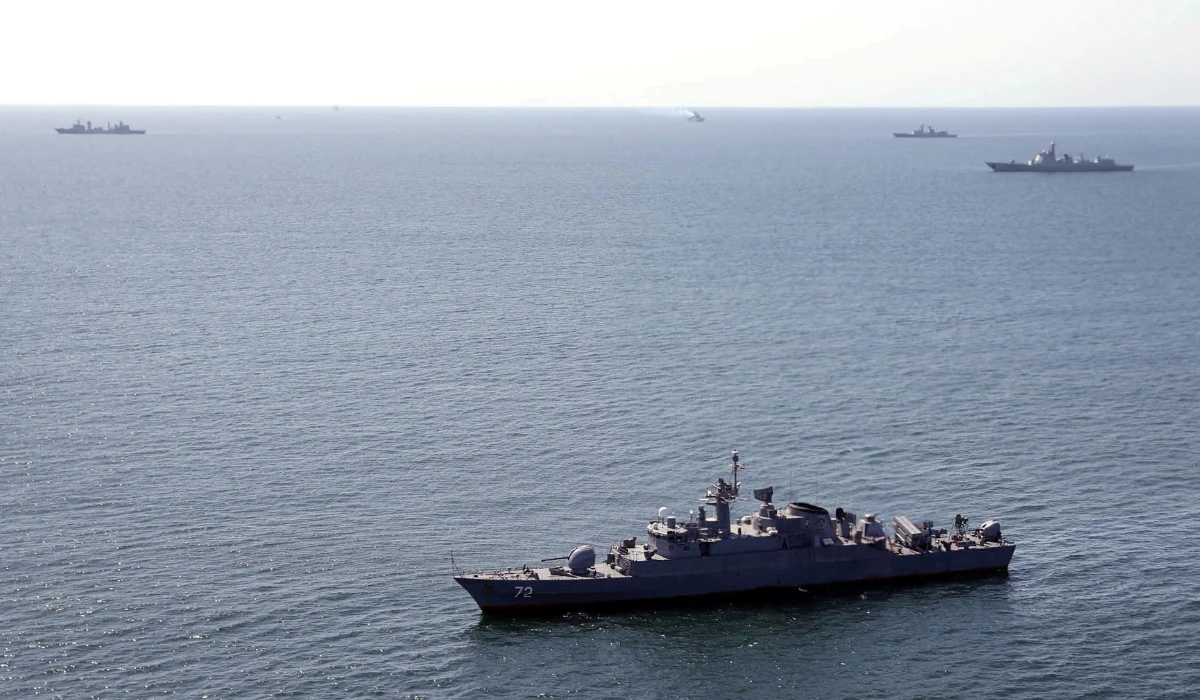
Iran, Russia and China show off their ships in a joint naval drill in the Gulf of Oman

1 / 4
Warships attend the Maritime Security Belt 2024 international naval exercise of Russia, China and Iran in the Gulf of Oman in this handout image obtained on March 12, 2024. (REUTERS)
2 / 4
This handout picture provided by the Iranian Defence Ministry on March 12, 2024 shows naval officers taking part in a ceremony during the "Maritime Security Belt 2024" combined naval exercise between Iran, Russia, and China in the Gulf of Oman. (AFP)
3 / 4
This handout picture provided by the Iranian Defence Ministry on March 12, 2024 shows an Islamic Revolutionary Guard Corps Navy missile corvette at sea during the "Maritime Security Belt 2024" combined naval exercise between Iran, Russia, and China in the Gulf of Oman. (AFP)
4 / 4
This handout picture provided by the Iranian Defence Ministry on March 12, 2024 shows Iranian seamen piloting a speedboat near a Chinese People's Liberation Army Navy (PLAN) type 903A replenishment ship at sea during the "Maritime Security Belt 2024" combined naval exercise between Iran, Russia, and China in the Gulf of Oman. (AFP)
Short Url
Updated 13 March 2024
Follow

Iran, Russia and China show off their ships in a joint naval drill in the Gulf of Oman

  • More than 20 ships, support vessels and combat boats from the three countries, as well as naval helicopters, are involved in the exercise

DUBAI, United Arab Emirates: China, Iran and Russia have begun a joint naval drill in the Gulf of Oman, a crucial waterway near the mouth of the Arabian Gulf, officials said Tuesday.
Footage aired by Chinese state television and a video released by the Russian navy showed the ongoing drill, known as “Marine Security Belt 2024.”
China sent the guided-missile destroyer Urumqi and the guided-missile frigate Linyi to the exercise. Russia’s forces are being led by the Varyag, a Slava-class cruiser.
More than 20 ships, support vessels and combat boats from the three countries, as well as naval helicopters, are involved in the exercise.
A report by Iranian state television quoted the drill’s spokesperson, Adm. Mostafa Tajaddini, as saying the drill will take place in 17,000 square kilometers (6,600 square miles) of water.
Tajaddini added that the three nations’ drill — their fourth since 2019 — was also meant to improve trade, confront “piracy and terrorism, support to humanitarian activities and the exchange of information in the field of rescue,” among other goals.
Iran has stepped up its military cooperation with Beijing and Moscow in response to regional tensions with the United States, including due to supplying military drones to Russia now being used in Moscow’s war on Ukraine.
Azerbaijan, Kazakhstan, Oman, Pakistan and South Africa are observers of the drill.
The Gulf of Oman has seen a series of attacks since 2019 that the US has blamed on Iran, as well as ship seizures by Tehran, since the collapse of its nuclear deal with world powers. A fifth of all oil traded passes through the Strait of Hormuz, the Arabian Gulf’s narrow mouth.


France to rally aid for Lebanon as it warns truce gains remain fragile

Updated 3 sec ago
Follow

France to rally aid for Lebanon as it warns truce gains remain fragile

France said on Friday that Lebanon’s recovery remains precarious despite positive signs following a ceasefire and government transition, and it stood ready to support ​the country’s reconstruction if it continues with reforms.
French Minister for Europe and Foreign Affairs Jean-Noel Barrot, addressing reporters after meetings in Beirut with Lebanese President Joseph Aoun and other top officials, said France was prepared to host a dedicated conference in Paris on reconstruction, but only if reforms continue, legislation is passed ‌and decisions ‌are implemented.
While Lebanon has adopted ‌banking ⁠secrecy ​and ‌bank resolution laws, it must still complete restructuring, reach an IMF agreement and pass a loss-sharing law, Barrot said. He also urged swift action on Hezbollah disarmament and national reconciliation.
Barrot said Lebanon had reached a crucial juncture in implementing the November 2024 truce with Israel, as well as restoring ⁠state authority over weapons and stabilising a shattered financial system.
France, the ‌country’s former colonial power, plans ‍to mobilize international backing for ‍the Lebanese armed forces and internal security forces at ‍a separate conference scheduled for March 5 in Paris.
“Lebanon must work to restore confidence — that of its citizens, businesses, depositors, and the diaspora,” Barrot said.
France’s immediate focus was ensuring respect ​for the ceasefire, which he emphasized “implies that Israel withdraws from Lebanese territory, in accordance with its ⁠commitments, and that civilians are protected from strikes,” alongside implementation by Lebanese authorities of an agreed-upon arms monopoly plan.
Lebanon has pledged to bring all arms in the country under state control, in line with the 2024 agreement that ended a devastating war between Hezbollah and Israel, and has asserted control over areas of the country closest to the border with Israel. But Hezbollah has warned the government that pressing on with efforts to disarm ‌the group throughout the country would trigger chaos and possibly civil war.