India’s new citizenship law that excludes Muslims has them worried. Here’s what it says

1 / 6
Members of the Asom Jatiyatabadi Yuba Chatra Parishad (AJYCP), a student's organisation, burn the effigy of India's Prime Minister Narendra Modi during a protest against the implementation of the Citizenship Amendment Act (CAA) in Guwahati on March 12, 2024. India's interior ministry said March 11 it was enacting a citizenship law that critics say discriminates against Muslims, just weeks before the world's most populous country heads into a general election. (AFP)
2 / 6
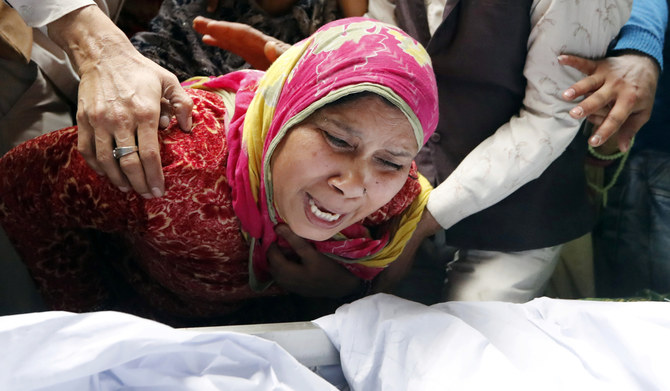
A woman mourns over the body of her son, Hashim Ali, who was wounded on Tuesday in a clash between people demonstrating for and against a new citizenship law, after he succumbed to his injuries, in a riot affected area in New Delhi, India, February 29, 2020. (REUTERS)
3 / 6
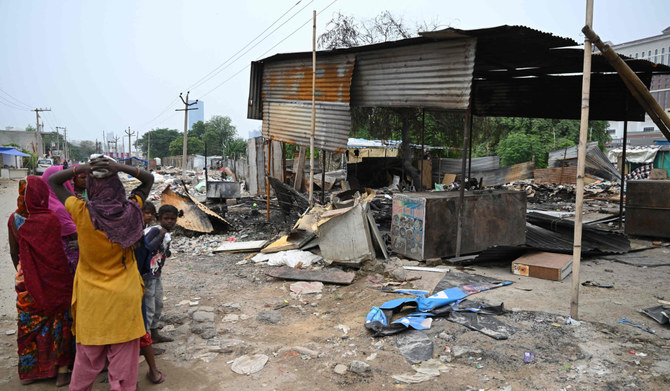
People stand next to a burnt strucutre in Gurugram, Haryana State, on August 4, 2023, following sectarian riots. (AFP)
4 / 6
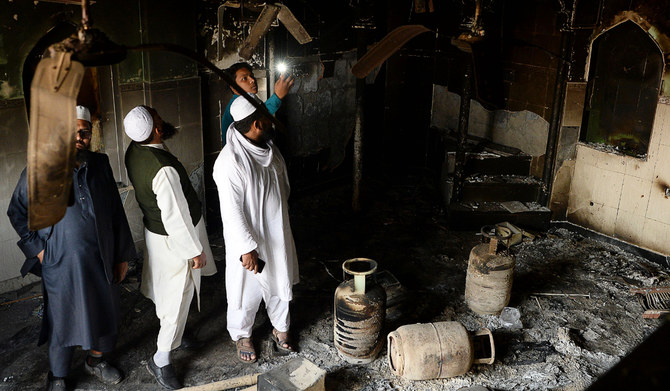
Muslim men check the interiors of a partially burnt mosque in a riot-affected area, in New Delhi on March 1, 2020, after violence broke out in India's capital. (AFP)
5 / 6
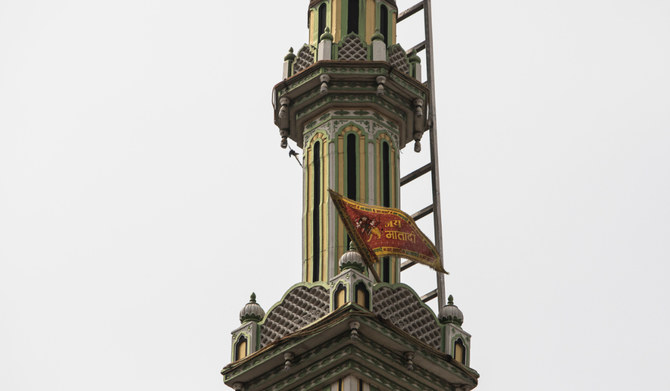
A Hindu religious flag flutters on the minaret of a burnt-out mosque following sectarian riots over India's new citizenship law, at Mustafabad area in New Delhi on February 28, 2020. (AFP)
6 / 6
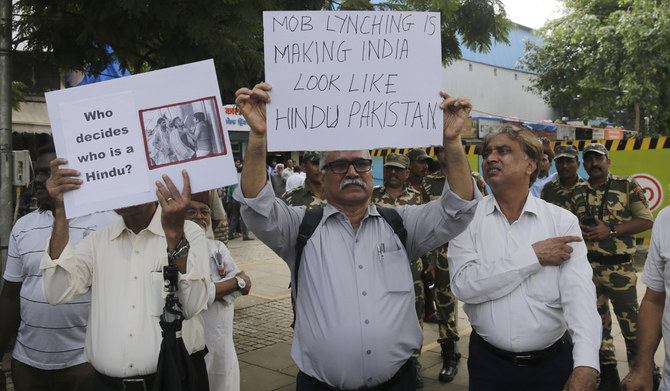
Indian activists hold placards during a protest against the recent attack on scholar and social activist Swami Agnivesh in Mumbai, India, Thursday, July 19, 2018. (AP)
Short Url
Updated 13 March 2024
Follow

India’s new citizenship law that excludes Muslims has them worried. Here’s what it says

  • Modi’s conspicuous silence over anti-Muslim violence has emboldened some of his most extreme supporters and enabled more hate speech against Muslims
  • India is home to 200 million Muslims who make up a large minority group in the country of more than 1.4 billion people

NEW DELHI: India has implemented a controversial citizenship law that has been widely criticized for excluding Muslims, a minority community whose concerns have heightened under Prime Minister Narendra Modi’s Hindu nationalist government.
The rules for the law were announced Monday. It establishes a religious test for migrants from every major South Asian faith other than Islam. Critics argue that the law is further evidence that Modi’s government is trying to reshape the country into a Hindu state and marginalize its 200 million Muslims.
WHAT IS THE NEW CITIZENSHIP LAW?
The Citizenship Amendment Act provides a fast track to naturalization for Hindus, Parsis, Sikhs, Buddhists, Jains and Christians who fled to Hindu-majority India from Afghanistan, Bangladesh and Pakistan before Dec. 31, 2014. The law excludes Muslims, who are a majority in all three nations.
It also amends the old law, which prevents illegal migrants from becoming Indian citizens, and marks the first time that India — an officially secular state with a religiously diverse population — has set religious criteria for citizenship.

HIGHLIGHTS

• Scores of Muslims have been lynched by Hindu mobs over allegations of eating beef or smuggling cows, an animal considered holy to Hindus

• Muslim businesses have been boycotted, their localities have been bulldozed and Mosques set on fire

• Some Hindutva leaders have made open calls for genocide against Muslims

The Indian government has said those eligible can apply for Indian citizenship through an online portal.
The implementation of the law has been one of the key poll promises of Modi’s ruling Bharatiya Janata Party in the run-up to the general election, which is scheduled to be held by May.
Modi’s government has dismissed the notion that the law is discriminatory and defended it as a humanitarian gesture. It argues the law is meant only to extend citizenship to religious minorities fleeing persecution and would not be used against Indian citizens.
WHAT MAKES THE LAW SO CONTROVERSIAL?
The law was approved by India’s Parliament in 2019, but Modi’s government held off its implementation after deadly protests broke out in New Delhi and elsewhere. Scores were killed during days of clashes.
The nationwide protests in 2019 drew people of all faiths who said the law undermines India’s foundation as a secular nation. Muslims were particularly worried that the government could use the law, combined with a proposed national register of citizens, to marginalize them.
The National Register of Citizens is part of the Modi government’s effort to identify and weed out people it claims came to India illegally. The register has only been implemented in the northeastern state of Assam, but Modi’s party has promised to roll out a similar citizenship verification program nationwide.
Critics and Muslim groups say the new citizenship law will help protect non-Muslims who are excluded from the register, while Muslims could face the threat of deportation or internment.
WHY ARE INDIA’S MUSLIMS WORRIED?
Opponents of the law — including Muslims, opposition parties and rights groups — say it is exclusionary and violates the secular principles enshrined in the constitution. They say faith cannot be made a condition of citizenship.
On Monday, Human rights watchdog Amnesty India said the law “legitimizes discrimination based on religion.”
Some also argue that if the law is aimed at protecting persecuted minorities, then it should have included Muslim religious minorities who have faced persecution in their own countries, including Ahmadis in Pakistan and Rohingyas in Myanmar.
To critics, Modi is pushing a Hindu nationalist agenda that threatens to erode the country’s secular foundation, shrink space for religious minorities, particularly Muslims, and move the country closer to a Hindu nation.
India is home to 200 million Muslims who make up a large minority group in the country of more than 1.4 billion people. They are scattered across almost every part of India and have been targeted in a series of attacks that have taken place since Modi first assumed power in 2014.
Scores of Muslims have been lynched by Hindu mobs over allegations of eating beef or smuggling cows, an animal considered holy to Hindus. Muslim businesses have been boycotted, their localities have been bulldozed and places of worship set on fire. Some open calls have been made for their genocide.
Critics say Modi’s conspicuous silence over anti-Muslim violence has emboldened some of his most extreme supporters and enabled more hate speech against Muslims.
Modi has also increasingly mixed religion with politics in a formula that has resonated deeply with India’s majority Hindu population. In January, he opened a Hindu temple at the site of a demolished mosque in northern Ayodhya city, fulfilling his party’s long-held Hindu nationalist pledge.


Italian fashion designer Valentino dead at 93

Updated 10 min 30 sec ago
Follow

Italian fashion designer Valentino dead at 93

ROME: Valentino Garavani, the jet-set Italian designer whose high-glamor gowns — often in his trademark shade of “Valentino red” — were fashion show staples for nearly half a century, has died at home in Rome, his foundation announced Monday. He was 93.
“Valentino Garavani was not only a constant guide and inspiration for all of us, but a true source of light, creativity and vision,″ the foundation said in a statement posted on social media.
His body will repose at the foundation’s headquarters in Rome on Wednesday and Thursday. The funeral will be held Friday at the Basilica Santa Maria degli Angeli e dei Martiri in Rome’s Piazza della Repubblica.
Universally known by his first name, Valentino was adored by generations of royals, first ladies and movie stars, from Jackie Kennedy Onassis to Julia Roberts and Queen Rania of Jordan, who swore the designer always made them look and feel their best.
“I know what women want,” he once remarked. “They want to be beautiful.”
Never one for edginess or statement dressing, Valentino made precious few fashion faux-pas throughout his nearly half-century-long career, which stretched from his early days in Rome in the 1960s through to his retirement in 2008.
His fail-safe designs made Valentino the king of the red carpet, the go-to man for A-listers’ awards ceremony needs. His sumptuous gowns have graced countless Academy Awards, notably in 2001, when Roberts wore a vintage black and white column to accept her best actress statue. Cate Blanchett also wore Valentino — a one-shouldered number in butter-yellow silk — when she won the Oscar for best supporting actress in 2004.
Valentino was also behind the long-sleeved lace dress Jacqueline Kennedy wore for her wedding to Greek shipping magnate Aristotle Onassis in 1968. Kennedy and Valentino were close friends for decades, and for a spell the one-time US first lady wore almost exclusively Valentino.
He was also close to Diana, Princess of Wales, who often donned his sumptuous gowns.
Beyond his signature orange-tinged shade of red, other Valentino trademarks included bows, ruffles, lace and embroidery; in short, feminine, flirty embellishments that added to the dresses’ beauty and hence to that of the wearers.
Perpetually tanned and always impeccably dressed, Valentino shared the lifestyle of his jet-set patrons. In addition to his 152-foot (46-meter) yacht and an art collection including works by Picasso and Miro, the couturier owned a 17th-century chateau near Paris with a garden said to boast more than a million roses.
Valentino and his longtime partner Giancarlo Giammetti flitted among their homes — which also included places in New York, London, Rome, Capri and Gstaad, Switzerland — traveling with their pack of pugs. The pair regularly received A-list friends and patrons, including Madonna and Gwyneth Paltrow.
“When I see somebody and unfortunately she’s relaxed and running around in jogging trousers and without any makeup ... I feel very sorry,” the designer told RTL television in a 2007 interview. “For me, woman is like a beautiful, beautiful flower bouquet. She has always to be sensational, always to please, always to be perfect, always to please the husband, the lover, everybody. Because we are born to show ourselves always at our best.”
Valentino was born into a well-off family in the northern Italian town of Voghera on May 11, 1932. He said it was his childhood love of cinema that set him down the fashion path.
“I was crazy for silver screen, I was crazy for beauty, to see all those movie stars being sensation, well dressed, being always perfect,” he explained in the 2007 television interview.
After studying fashion in Milan and Paris, he spent much of the 1950s working for established Paris-based designer Jean Desses and later Guy Laroche before striking out on his own. He founded the house of Valentino on Rome’s Via Condotti in 1959.
From the beginning, Giammetti was by his side, handling the business aspect while Valentino used his natural charm to build a client base among the world’s rich and fabulous.
After some early financial setbacks — Valentino’s tastes were always lavish, and the company spent with abandon — the brand took off.
Early fans included Italian screen sirens Gina Lollobrigida and Sophia Loren, as well as Hollywood stars Elizabeth Taylor and Audrey Hepburn. Legendary American Vogue editor-in-chief Diana Vreeland also took the young designer under her wing.
Over the years, Valentino’s empire expanded as the designer added ready-to-wear, menswear and accessories lines to his stable. Valentino and Giammetti sold the label to an Italian holding company for an estimated $300 million in 1998. Valentino would remain in a design role for another decade.
In 2007, the couturier feted his 45th anniversary in fashion with a 3-day-long blowout in Rome, capped with a grand ball in the Villa Borghese gallery.
Valentino retired in 2008 and was briefly replaced by fellow Italian Alessandra Facchinetti, who had stepped into Tom Ford’s shoes at Gucci before being sacked after two seasons.
Facchinetti’s tenure at Valentino proved equally short. As early as her first show for the label, rumors swirled that she was already on her way out, and just about one year after she was hired, Facchinetti was indeed replaced by two longtime accessories designers at the brand, Maria Grazia Chiuri and Pier Paolo Piccioli.
Chiuri left to helm Dior in 2016, and Piccioli continued to lead the house through a golden period that drew on the launch of the Rockstud pump with Chiuri and his own signature color, a shade of fuchsia called Pink PP. He left the house in 2024, later joining Balenciaga, and has been replaced by Alessandro Michele, who revived Gucci’s stars with romantic, genderless styles.
Valentino is owned by Qatar’s Mayhoola, which controls a 70 percent stake, and the French luxury conglomerate Kering, which owns 30 percent with an option to take full control in 2028 or 2029. Richard Bellini was named CEO last September.
Valentino has been the subject of several retrospectives, including one at the Musee des Arts Decoratifs, which is housed in a wing of Paris’ Louvre Museum. He was also the subject of a hit 2008 documentary, “Valentino: The Last Emperor,” that chronicled the end of his career in fashion.
In 2011, Valentino and Giammetti launched what they called a “virtual museum,” a free desktop application that allows viewers to feast their eyes on about 300 of the designer’s iconic pieces.