

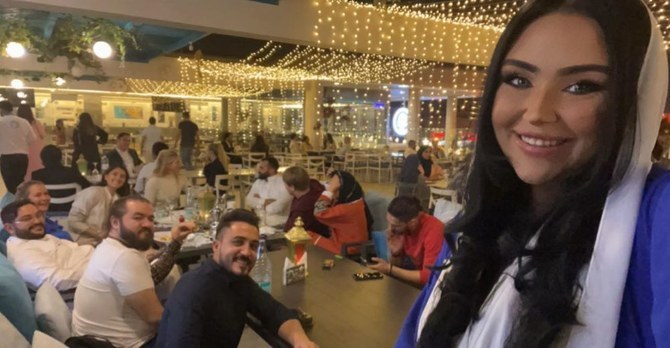

RIYADH: The vibrant community of Muslim expatriates in Saudi Arabia celebrates Ramadan with traditions and customs they have adopted since moving to the Kingdom and calling it their home.
One way is through the communities they have formed, such as the Ramadan Iftar Club, a gathering at which the faithful break the fast together in a potluck style.
The iftar club was started in Riyadh by Hana Nemec, an American Muslim working as a marketing and communications executive.
“I began the Ramadan Iftar Club with very humble beginnings in 2015 when I arrived in the Kingdom,” Nemec told Arab News.
“At the time, I would meet expats that were not aware of Ramadan and its traditions and because I … was alone here in the Kingdom, I wanted to introduce them to the generosity that I experienced when I converted to Islam,” she said.
Nemec converted to Islam when she was a 20-year-old college student in the US. She said she felt overwhelmed by the generosity and hospitality of the community.
“Many people who did not even know me invited me to their homes to celebrate Ramadan and break (the) fast with them,” she explained.
The spirit of generosity and community she experienced as a Muslim inspired her to host others during the holy month, emphasizing the importance of inclusivity.
“I know how it felt to be the odd one out, and when I moved to Saudi Arabia in 2015, I had to build that community all over again,” she said. “But this time, God put me in a position to be the one doing the inviting instead of receiving invitations.”
The iftar club has grown from its humble beginnings, with three guests in her house, to 200 people in a larger venue.
Nemec underlined the iftar gathering’s core values of faith, generosity and understanding in the spirit of Ramadan.
For Muslim expatriates in Saudi Arabia, Ramadan is not just a time of reflection and prayer, but also one of gathering and celebrating as a community, sharing meals together at sunrise and sunset.
Nemec said that having people over for food, visiting friends and their families, and making time to connect with the community is a very dear part of Ramadan to her.
“On the other side, it is a time for me to connect with my Creator, to show my ultimate gratitude for this incredible life He has willed upon me in Saudi Arabia … which I could never have imagined nor deserved. (I) count my blessings over and over again.”
The Kingdom’s capital, Riyadh, has become a diverse city that houses expatriates from around the world.
Sandra Ospina is a Latin American from the US and is the head of learning and innovation and vice principal at SEK International School in Riyadh. She described her Ramadan experience since moving to the Kingdom in 2017.
“I have celebrated Ramadan in various ways. When I first moved to Saudi my family was away, so creating a close community of friends where we invited each other for potlucks or the famous iftar tent visits was a tradition,” Ospina told Arab News.
“Now I am with family, so we cook together, and we like to invite friends and prepare meals to give to workers,” she said.
As a part of her Ramadan traditions, Ospina visits the mosque with her family and takes the time to create a calendar of good deeds to help others.
When asked what her most memorable moment of Ramadan in Saudi Arabia was Ospina said: “For me, a memorable occasion as an educator has been seeing the happiness of children when they first accomplish fasting a whole day. They are so happy and proud, that has been so moving for me.”
Andrew Long, who is originally from England, has lived in Saudi Arabia for eight years.
“I came to the Kingdom at the end of 2015 for a project with the Ministry of Interior and I never left. Now I am principal security consultant at WSP,” he said.
Long told Arab News that he celebrates Ramadan with his family and Saudi neighbors.
“Half of my family is Saudi, since my spouse is from the Kingdom, so I spend lots of time with her family, either at home or at our diwaniya (a place for gathering). Our neighbors sometimes bring around food they have made for iftar and we do the same.”
He said that for iftar, he and his family prefer not to overindulge. “We break our fast with water, dates and gishta, then we pray maghrib.” Afterwards, he said, “we would generally have soup and samosa.”
As a part of Ramadan tradition, he said that every Friday the men gather in the diwaniyah, and each brings one or two dishes to share.
Long told Arab News that during the COVID-19 pandemic he was introduced to MBC Ramadan. “(I) never missed an episode of ‘Al-Asouf’ and then ‘Sikkat Safar,’” he said.


