

Gaza medical staff tortured by Israeli soldiers in hospital raid: BBC investigation

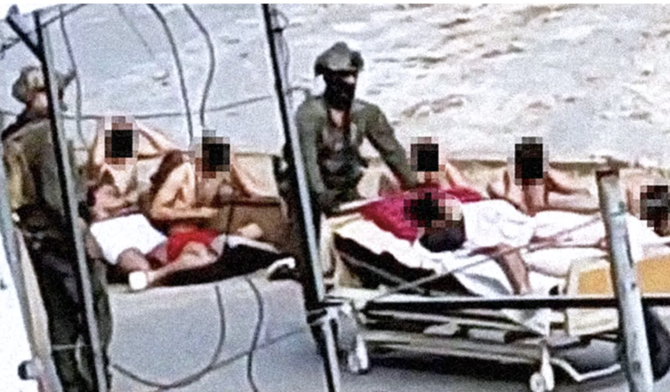
BBC received footage secretly filmed in the hospital when the medics were detained on Feb. 16. (BBC)
Short Url
Updated 12 March 2024
Follow

Gaza medical staff tortured by Israeli soldiers in hospital raid: BBC investigation

  • Doctor recalls being taken to the toilet, beaten, and had muzzled dogs set on him.
  • "I was standing with my hands raised above my head and my face looking down for three hours," he says

LONDON: Palestinian medical staff in Gaza have reported to the BBC their experiences of being blindfolded, detained, stripped, and repeatedly beaten by Israeli soldiers following a raid on their hospital in February.

On Feb. 15, Israel Defense Forces raided the Nasser hospital in the southern city of Khan Younis, one of the few in the Gaza Strip that was still functioning at the time.

The BBC received footage secretly filmed in the hospital when the medics were detained on Feb. 16.

It shows a row of men, stripped down to their underwear, kneeling with their hands bound behind their heads outside the emergency department.

Over several weeks, the BBC conducted investigations into the incident, interviewing a range of hospital staff and displaced individuals residing in the hospital’s courtyard, and corroborating the details of the accounts.

Those released from detention, along with other medical staff, shared with the BBC that the maternity ward, known as Mubarak, was repurposed as an interrogation and abuse site by the IDF.

Dr. Ahmed Abu Sabha, a hospital doctor, described being taken to the location, which he likened to “a torture place.”

He said: “They put me on a chair, and it was like a gallows. I heard sounds of ropes, so I thought I was going to be executed.

“After that they broke a bottle and it (the glass) cut my leg and they left it to bleed. Then they started bringing doctor after doctor in and started putting them next to each other. I was hearing their names and their voices.”

Abu Sabha added that he spent a week in detention. His account closely resembled that of two other medics who preferred to remain anonymous for fear of repercussions.

All three detainees interviewed by the BBC said that they were crammed into military vehicles and beaten while being transported in large groups. Soldiers beat them with sticks, hoses, rifle buttstocks, and fists, they added.

One of the medics who wished to remain anonymous said: “We were naked. Just wearing boxers. They piled us on top of each other. And they took us out of Gaza. All along the way we were being hit and sworn at and humiliated. And they poured cold water on us.”

Abu Sabha said: “They took us to a patch of ground covered in gravel, forced us to kneel down, and our eyes were blindfolded. There was a pit in the ground, and we thought they would execute us and bury us here. We all started prayers.”

The two other detainees who were released claimed that they were given medical checks but no medication at some point. One claimed that instead of receiving treatment for an injury, an IDF soldier struck him where he was injured.

Abu Sabha told the BBC the men were routinely punished for “infractions.” He said: “At one point, the blindfold moved down a bit and my hands were handcuffed from behind and I could not fix it.

“They took me out for punishment. I was standing with my hands raised above my head and my face looking down for three hours.

Then, he (a soldier) asked me to come to him. When I did, he kept hitting my hand until it was broken.”

He was later taken to the toilet, beaten, and had muzzled dogs set on him.

The next day, an Israeli doctor fitted him with a cast, which soldiers then drew a Star of David on, he added. The cast was later changed by a doctor in Gaza, and Ahmed wore it during his BBC interview.

The BBC verified that after his capture, Abu Sabha had an X-ray and received treatment for a broken hand at a field hospital in Gaza, where he arrived in a cast with a Star of David drawn on it.

None of the medics were formally charged, though interrogation seemed to center on the potential presence of hostages or Hamas militants within the hospital premises.

One of the released detainees claimed that two days after being interrogated, IDF officers informed him that there was no evidence, and he would be released.

“I asked him, ‘who will compensate me for all the beatings and humiliation I’ve been through, that you did to me, while I knew that I wasn’t involved in anything?’ He started muttering, ‘I don’t have anything on you. No charges.’”

Abu Sabha told the BBC he was never interrogated during his eight days of detention.

The three medics we spoke with said they were blindfolded and transported back to Gaza after being released.

According to a humanitarian law expert, the footage and testimony of the medical staff interviewed by the BBC were “extremely concerning.” He said that some of the accounts provided to the BBC “very clearly cross over into the category of cruel and inhumane treatment.”

Dr. Lawrence Hill-Cawthorne, co-director of the University of Bristol’s Centre for International Law, said: “It goes against what has for a long time been a very fundamental idea in the law that applies in armed conflict, which is that hospitals and medical staff are protected.”


Lebanon approves financial gap draft law despite opposition from Hezbollah and Lebanese Forces

Lebanon's Prime Minister Nawaf Salam speaking during a press conference after a cabinet session in Beirut on December 26, 2025.
Updated 26 December 2025
Follow

Lebanon approves financial gap draft law despite opposition from Hezbollah and Lebanese Forces

  • Legislation aims to address the fate of billions of dollars in deposits that have been inaccessible to Lebanese citizens during the country’s financial meltdown

BEIRUT: Lebanon’s Cabinet on Friday approved a controversial draft law to regulate financial recovery and return frozen bank deposits to citizens. The move is seen as a key step in long-delayed economic reforms demanded by the International Monetary Fund.

The decision, which passed with 13 ministers voting in favor and nine against, came after marathon discussions over the so-called “financial gap” or deposit recovery bill, stalled for years since the banking crisis erupted in 2019. The ministers of culture and foreign affairs were absent from the session.

The legislation aims to address the fate of billions of dollars in deposits that have been inaccessible to Lebanese citizens during the country’s financial meltdown.

The vote was opposed by three ministers from the Lebanese Forces Party, three ministers from Hezbollah and the Amal Movement, as well as the minister of youth and sports, Nora Bayrakdarian, the minister of communications, Charles Al-Hajj, and the minister of justice, Adel Nassar.

Finance Minister Yassin Jaber broke ranks with his Hezbollah and Amal allies, voting in favor of the bill. He described his decision as being in line with “Lebanon’s supreme financial interest and its obligations to the IMF and the international community.”

The draft law triggered fierce backlash from depositors who reject any suggestion they shoulder responsibility for the financial collapse. It has also drawn strong criticism from the Association of Banks and parliamentary blocs, fueling fears the law will face intense political wrangling in Parliament ahead of elections scheduled in six months.

Prime Minister Nawaf Salam confirmed the Cabinet had approved the bill and referred it to Parliament for debate and amendments before final ratification. Addressing public concerns, he emphasized that the law includes provisions for forensic auditing and accountability.

“Depositors with accounts under $100,000 will be repaid in full with interest and without any deductions,” Salam said. “Large depositors will also receive their first $100,000 in full, and the remainder will be issued as negotiable bonds backed by the assets of the Central Bank, valued at around $50 billion.”

He said further that bondholders will receive an initial 2 percent payout after the first tranche of repayments is completed.

The law also includes a clause requiring criminal accountability. “Anyone who smuggled funds abroad or benefited from unjustified profits will be fined 30 percent,” Salam said.

He emphasized that Lebanon’s gold reserves will remain untouched. “A clear provision reaffirms the 1986 law barring the sale or mortgaging of gold without parliamentary approval,” he said, dismissing speculation about using the reserves to cover financial losses.

Salam admitted that the law was not perfect but called it “a fair step toward restoring rights.”

“The banking sector’s credibility has been severely damaged. This law aims to revive it by valuing assets, recapitalizing banks, and ending Lebanon’s dangerous reliance on a cash economy,” he said. “Each day of delay further erodes people’s rights.”

While the Association of Banks did not release an immediate response after the vote, it previously argued during discussions that the law would destroy remaining deposits. Bank representatives said lenders would struggle to secure more than $20 billion to cover the initial repayment tier and accused the state of absolving itself of responsibility while effectively granting amnesty for decades of financial mismanagement and corruption.

The law’s fate now rests with Parliament, where political competition ahead of the 2025 elections could complicate or delay its passage.

Lebanon’s banking sector has been at the heart of the country’s economic collapse, with informal capital controls locking depositors out of their savings and trust in state institutions plunging. International donors, including the IMF, have made reforms to the sector a key condition for any financial assistance.