
LONDON: Palestinian medical staff in Gaza have reported to the BBC their experiences of being blindfolded, detained, stripped, and repeatedly beaten by Israeli soldiers following a raid on their hospital in February.
On Feb. 15, Israel Defense Forces raided the Nasser hospital in the southern city of Khan Younis, one of the few in the Gaza Strip that was still functioning at the time.
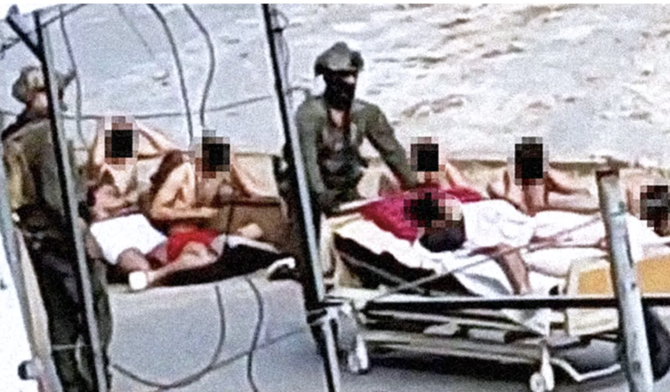
The BBC received footage secretly filmed in the hospital when the medics were detained on Feb. 16.
It shows a row of men, stripped down to their underwear, kneeling with their hands bound behind their heads outside the emergency department.
Over several weeks, the BBC conducted investigations into the incident, interviewing a range of hospital staff and displaced individuals residing in the hospital’s courtyard, and corroborating the details of the accounts.
Those released from detention, along with other medical staff, shared with the BBC that the maternity ward, known as Mubarak, was repurposed as an interrogation and abuse site by the IDF.
Dr. Ahmed Abu Sabha, a hospital doctor, described being taken to the location, which he likened to “a torture place.”
He said: “They put me on a chair, and it was like a gallows. I heard sounds of ropes, so I thought I was going to be executed.
“After that they broke a bottle and it (the glass) cut my leg and they left it to bleed. Then they started bringing doctor after doctor in and started putting them next to each other. I was hearing their names and their voices.”
Abu Sabha added that he spent a week in detention. His account closely resembled that of two other medics who preferred to remain anonymous for fear of repercussions.
All three detainees interviewed by the BBC said that they were crammed into military vehicles and beaten while being transported in large groups. Soldiers beat them with sticks, hoses, rifle buttstocks, and fists, they added.
One of the medics who wished to remain anonymous said: “We were naked. Just wearing boxers. They piled us on top of each other. And they took us out of Gaza. All along the way we were being hit and sworn at and humiliated. And they poured cold water on us.”
Abu Sabha said: “They took us to a patch of ground covered in gravel, forced us to kneel down, and our eyes were blindfolded. There was a pit in the ground, and we thought they would execute us and bury us here. We all started prayers.”
The two other detainees who were released claimed that they were given medical checks but no medication at some point. One claimed that instead of receiving treatment for an injury, an IDF soldier struck him where he was injured.
Abu Sabha told the BBC the men were routinely punished for “infractions.” He said: “At one point, the blindfold moved down a bit and my hands were handcuffed from behind and I could not fix it.
“They took me out for punishment. I was standing with my hands raised above my head and my face looking down for three hours.
Then, he (a soldier) asked me to come to him. When I did, he kept hitting my hand until it was broken.”
He was later taken to the toilet, beaten, and had muzzled dogs set on him.
The next day, an Israeli doctor fitted him with a cast, which soldiers then drew a Star of David on, he added. The cast was later changed by a doctor in Gaza, and Ahmed wore it during his BBC interview.
The BBC verified that after his capture, Abu Sabha had an X-ray and received treatment for a broken hand at a field hospital in Gaza, where he arrived in a cast with a Star of David drawn on it.
None of the medics were formally charged, though interrogation seemed to center on the potential presence of hostages or Hamas militants within the hospital premises.
One of the released detainees claimed that two days after being interrogated, IDF officers informed him that there was no evidence, and he would be released.
“I asked him, ‘who will compensate me for all the beatings and humiliation I’ve been through, that you did to me, while I knew that I wasn’t involved in anything?’ He started muttering, ‘I don’t have anything on you. No charges.’”
Abu Sabha told the BBC he was never interrogated during his eight days of detention.
The three medics we spoke with said they were blindfolded and transported back to Gaza after being released.
According to a humanitarian law expert, the footage and testimony of the medical staff interviewed by the BBC were “extremely concerning.” He said that some of the accounts provided to the BBC “very clearly cross over into the category of cruel and inhumane treatment.”
Dr. Lawrence Hill-Cawthorne, co-director of the University of Bristol’s Centre for International Law, said: “It goes against what has for a long time been a very fundamental idea in the law that applies in armed conflict, which is that hospitals and medical staff are protected.”