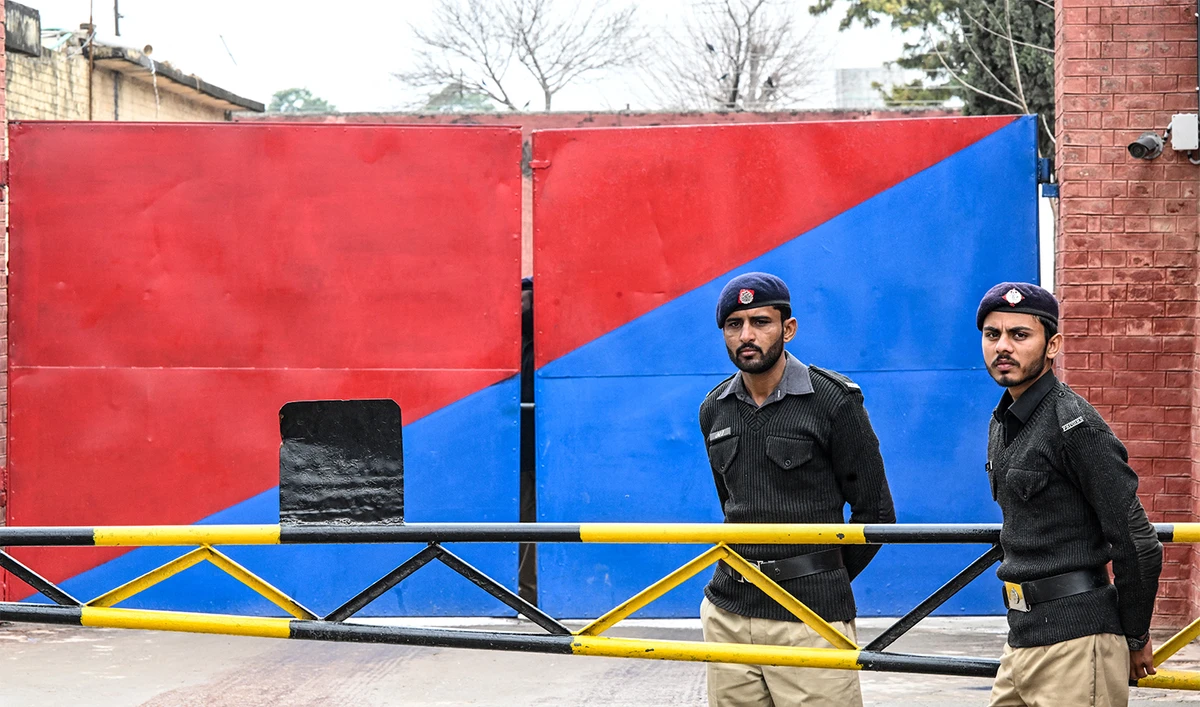
ISLAMABAD: The Punjab provincial administration on Tuesday imposed a two-week blanket ban on visits and meetings at Adiala Jail, Rawalpindi, due to security concerns, prompting condemnation from the opposition Pakistan Tehreek-e-Insaf (PTI) party that said its incarcerated leader and former prime minister Imran Khan should be exempt from the restriction.
The development comes just days after the government announced it had foiled a militant attack on the prison by arresting three individuals with heavy weaponry who were taken to an undisclosed location.
A senior police official, quoted in the statement, mentioned that, along with automatic assault weapons, hand grenades and improvised explosive devices, the militants also possessed maps of the jail.
“On the basis of the threat alerts shared by the different intelligence and security agencies of the country, the Internal Security Wing of the Home Department Punjab has conveyed that there exist different types of threats to security of Adiala jail as some anti state terrorist groups supported by the enemies of Pakistan have planned to conduct targeted attacks thereof,” said the Punjab Home Department in a letter to the Inspector General of Prisons in the province.
“As a security measure against the aforementioned attacks,” the letter written by the section officer added, “I have been conveyed to request you to stop the public visits/ meetings/ interviews within the Adiala Jail immediately for two weeks.”
Reacting to the development, the top PTI leaders conducted a news conference, describing the development as an attempt to isolate Khan by keeping the media and his party colleagues away from him.
“This needs to be investigated and we should get access by all means to meet with him tomorrow,” Barrister Gohar Khan, the new PTI chairman, told the journalists. “Imran Khan is not an ordinary prisoner. Therefore, he should be exempt from such a blanket ban on meetings with him.”
Leader of the opposition in the National Assembly Omar Ayub Khan said the government was violating court orders that specifically mentioned that Khan could meet his family, lawyers and party leaders.
He specifically blamed Prime Minister Shehbaz Sharif, Interior Minister Mohsin Naqvi and Punjab Chief Minister Maryam Nawaz for deliberately imposing the restriction.
Khan has been behind bars since his conviction in a graft case in August last year, and since then, he has been subjected to prison trials on various charges at Adiala Jail, being found guilty of divulging state secrets and engaging in an illicit marriage.
Ex-PM Khan’s party cries foul as Punjab government enforces jail visit ban
https://arab.news/2e69m
Ex-PM Khan’s party cries foul as Punjab government enforces jail visit ban
- Punjab Home Department says it received threat alerts from security agencies about possible attack on Adiala jail
- PTI says the government trying to further isolate jailed Imran Khan by keeping him away from media and party leaders
UN says 270,000 Afghans have returned from Iran, Pakistan this year
- UNHCR says 110,000 Afghans returned from Iran while 160,000 returned from Pakistan since start of 2026
- Return numbers seem to have risen since Gulf war erupted on Feb. 28, says UNHCR official in Afghanistan
GENEVA: Some 270,000 Afghans have returned to their country from Pakistan and Iran so far this year, the UN said Tuesday, warning that the escalating Middle East war risked pushing the numbers higher.
UNHCR, the United Nations’ refugee agency, said that 110,000 Afghans had returned from Iran and another 160,000 had returned from Pakistan since the start of 2026.
And the numbers seem to have risen since the Middle East erupted on February 28, with the United States and Israel unleashing a barrage of strikes on Iran, and Tehran responding with drone and missile strikes on Israeli and US interests across the region.
Since then, there have been some 1,700 returns from Iran to Afghanistan each day, Arafat Jamal, UNHCR’s representative in Afghanistan, told reporters in Geneva.
Speaking from Islam Qala, on the Afghan-Iranian border, he said the situation there was “deceptively calm.”
“Returns are orderly but freighted with tension and apprehension,” he said, adding that with the hostilities elsewhere escalating, “I do fear there is more to come.”
“We are preparing for massive returns.”
He pointed out that Afghanistan was “facing the ramifications of what is happening with Iran,” while clashes have erupted along the Afghan border with Pakistan.
The new Middle East war, he warned, was “layering itself on top of an existing war on another frontier,” Jamal said.
UNHCR highlighted that the latest crises came after returns to Afghanistan had already been “exceptionally high” in recent years.
More than five million Afghans had returned from neighboring countries in the past two years, including 1.9 million returning from Iran last year alone.
Jamal warned that “many Afghan families are now facing cycles of displacement: first forced to flee Afghanistan, later displaced again inside Iran due to conflict, and now returning once more to Afghanistan.”
“And upon return in Afghanistan, the triply-displaced enter a spiral of precarity and uncertainty.”
Returns from Pakistan had meanwhile stabilized in recent weeks, as the main crossing point at Torkham remained closed due to the tensions there, Jamal said.
But he warned that “movements could increase sharply once the border reopens.”
UNHCR and the UN children’s agency UNICEF said Tuesday they were working to strengthen their capacity to operate at the borders and within Afghanistan.
But “given the scale of returns and the financial constraints facing humanitarian operations, additional support will be needed if arrivals increase,” UNHCR said, without specifying the amount needed.


