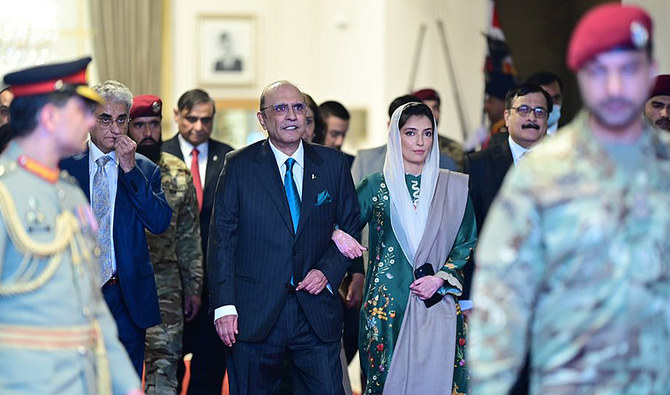

ISLAMABAD: In a rare move, Aseefa Bhutto-Zardari, daughter of President Asif Ali Zardari, has been named as the first lady of Pakistan by her Pakistan Peoples Party, which is part of the ruling coalition in the South Asian country.
Zardari, who previously served as president from 2008 till 2013, took oath on Sunday for a second term as Pakistan president. His election to the presidency was part of a power sharing formula between his PPP, of which he is co-chairman, and the Pakistan Muslim League-Nawaz (PML-N) of three-time former prime minister Nawaz Sharif, whose younger brother Shehbaz Sharif is the new premier,
While the position of first lady remained vacant during Zardari’s first tenure following the assassination of his wife and ex-PM Benazir Bhutto, his daughter has been named as the first lady this time by his party.
“First lady with the President,” the PPP said in an X post on Sunday, with a picture of Zardari with Aseefa after the former’s oath-taking in Islamabad.
There has not yet been an official announcement of the appointment.
Aseefa, 31, has been an active figure in Zardari’s PPP party, often accompanying his father and brother to rallies, campaigns and other events. She was actively involved in the PPP’s electoral campaign in the run-up to the February 8 polls and was seen leading various rallies in a bid to seek support for her brother Bilawal Bhutto Zardari, the party’s then-candidate for the prime minister’s post. Additionally, her high-profile role as polio eradication ambassador in Pakistan has helped her become a more familiar face in Pakistan.
Naming a woman other than the wife of the president or prime minister as the first lady has never happened in Pakistan since its independence from Britain in 1947.
The position of the first lady remained vacant during the brief tenure of Muhammad Ali Jinnah, the founder of Pakistan, as the first governor general of the South Asian country. Jinnah’s second wife, Rattanbai, died in 1929 and he never remarried.
The post also remained vacant during the tenures of Yahya Khan, former president and chief martial law administrator, and ex-PM Huseyn Shaheed Suhrawardy. Khan never married, while Suhrawardy’s first wife had died and he had divorced his second wife before becoming prime minister in 1956.
While it may be a first in Pakistan, several women in the United States (US), who were not wives of the president, have served as the first lady, when the president was a bachelor, widower, or when his wife was unable to discharge duties of the first lady.
In such cases, the position was filled by a female relative of the president, such as Thomas Jefferson’s daughter Martha Jefferson Randolph, Andrew Jackson’s daughter-in-law Sarah Yorke Jackson and his wife’s niece Emily Donelson, Zachary Taylor’s daughter Mary Elizabeth Bliss, Benjamin Harrison’s daughter Mary Harrison McKee, James Buchanan’s niece Harriet Lane, and Grover Cleveland’s sister Rose Cleveland.