

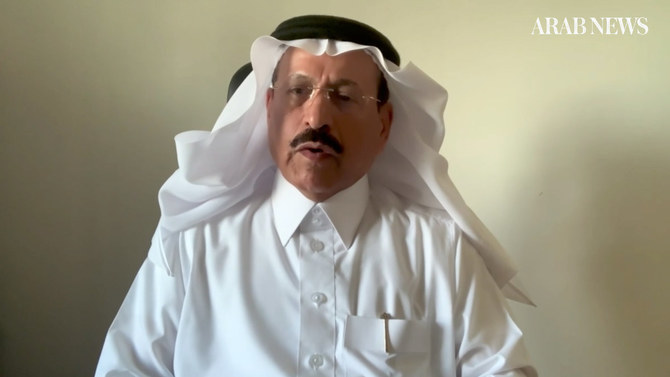

DUBAI: A veteran Saudi diplomat and keen observer of Pakistani politics says that what he sees today makes him “very optimistic” about the country’s future under the leadership of Shehbaz Sharif, the new prime minister.
Appearing on “Frankly Speaking,” the weekly Arab News current affairs show, Dr. Ali Awadh Asseri also expressed hope that the 2024 election outcome would cement the already strong relationship between Pakistan and Saudi Arabia.
Sharif was elected Pakistan’s prime minister for the second time on March 3 after securing 201 votes in the newly formed parliament. Elections were held last month amid runaway inflation, high unemployment, energy shortages and a rise in the cost of essential items.
“Shehbaz Sharif is a very well-experienced individual who was chief minister of the Punjab, which is the biggest province in Pakistan. So, he has the experience and also he seems to have selected so far a really good professional team,” said Asseri, who served as Saudi Arabia’s ambassador to Pakistan from 2001 to 2009.
Guiding Pakistan through its economic woes will be no easy task. The country is saddled with more than $270 billion in foreign and domestic debts, according to a February report by the Islamabad-based think tank Tabadlab.
Compounding Pakistan’s woes were a series of floods in 2022, which the World Bank estimated resulted in more than $30 billion in damage and economic losses from which the country has yet to recover.
Asseri considers Sharif the best politician to lead Pakistan under the circumstances because of “his experience, his patriotism, his loyalty to his country and his acceptance to most people.
“I would say for the time being, what I know of his experience, Sharif’s personality, his loyalty to his country, this leads me to always repeat my optimism and prayers for them to succeed,” he told Katie Jensen, the host of “Frankly Speaking.”
He added: “Pakistan, hopefully, will pick up and deal with its own economy. I think that was the slogan during the election.”
Sharif has ordered an immediate launch of talks with the IMF regarding an Extended Fund Facility program that would provide financial assistance and a longer repayment period.
The IMF has provided 22 loans to Pakistan since the inception of the country, which avoided defaulting on loan repayments and secured a $3 billion Stand-by Arrangement loan from the fund last year.
“I think Pakistan will get help from the IMF. The government is a credible government, a professional government, so I think their bargaining with the IMF will not be as difficult as it has been in the past without a government,” Asseri said.
“They are experienced; they know what to do. ... What I see is great progress in the selection of professional ministers. Relevance is very important when you put a minister in the seat. Hopefully, everything will be better than it is today.”
Asseri highlighted the need for Sharif to take a multifaceted approach to economic recovery, including enhanced exploitation of resources, industrialization and development of strong international trade and investment.
“There are a lot of resources in Pakistan that have not been touched at all. (For instance), manufacturing. One of the best industrial cities I have seen is called Sialkot, where the FIFA football is produced,” Asseri said.
“They have products. They have surgical equipment. So, if they could focus on those and upgrade those factors, then attract investment, whether from Saudi Arabia or the GCC countries, that would help a great deal.”
Sharif’s re-election came after years of political turmoil, which began in 2022 when Imran Khan was removed from office and jailed on corruption charges. That year, Pakistan Muslim League Nawaz — headed by Nawaz Sharif, a former prime minister — joined forces with the Pakistan People’s Party to oust Khan as prime minister and install Shehbaz Sharif as his successor.
Khan and his followers say the people’s mandate was stolen in the Feb. 8 election. Candidates backed by him did remarkably well, securing about 93 seats, even though he was hit by a number of criminal charges and disqualified from holding any kind of public office.
Asked if the elections were fair and transparent, Asseri said: “I spent nine years in Pakistan and every election you would have the same slogan from the opposition. The point here is, who’s going to help Pakistan?
“Obviously, the opposition will always have something to say against the government, whether it’s Imran Khan or all the others.”
Asseri believes fighting corruption and building good governance are necessary to restore the trust of the Pakistani people in their leaders and officials.
A Gallup survey conducted last month revealed that about 70 percent of Pakistanis are mistrustful of their country’s elections, with 88 percent of the population believing that corruption is widespread in Pakistan.
“I think the governance in the past was not as good and professional as it should have been,” he said.
“The Pakistani people know exactly what can help them to pick up their economy. Their currency has lost a lot of value in the last three or four years. The answer (to these problems) is to have good governance and what we see today leads me to be very optimistic.”
Asseri also expressed hope that the election outcome will bring about an even stronger relationship between Pakistan and Saudi Arabia — one previously cemented and continuously strengthened by a shared faith.
“With Pakistan, the (foundation) of the relationship is our strong (faith). And Pakistanis are a very conservative Muslim society,” he said.
Recalling a time when one of the imams of the Grand Mosque in Makkah visited Pakistan, “500,000 people prayed behind him, even outside the mosque in Islamabad,” Asseri said: “That should reflect their love and affection toward the holy places and toward Saudi Arabia.”
He added: “Saudi Arabia and Pakistan really enjoy a great relationship, ever since before even Pakistan was Pakistan, since 1943. King Abdulaziz and his sons went to Karachi when they had floods to help Pakistan. And their relationship grows with every leadership: It’s a people-to-people relationship.”
During the devastating 2022 floods, Saudi Arabia’s King Salman Humanitarian Aid and Relief Center sent large quantities of aid, by air, to the worst-hit regions in Pakistan.
As heavy rainfall this week causes catastrophic floods in Pakistan’s southwest, KSrelief has once again arranged for humanitarian aid deliveries — consisting of 873 tons of aid including 9,000 food packages and 9,000 shelter kits — to support more than 63,000 flood victims.
“Saudi Arabia has never let Pakistan down in its time of need,” Asseri said, noting that Crown Prince Mohammed bin Salman has visited Pakistan several times “because he knows how important Pakistan is and how important our relationship is.”
Going forward, the Saudi-Pakistan relationship may bring great economic benefits to both countries, he said.
Referring to the Saudi sovereign wealth fund, he said: “We have the Public Investment Fund. It could really go to Pakistan and invest in great factories and upgrade them to produce more.
“There are many areas now with the leadership, the dynamic Saudi leadership we have, and the strategy, the economic strategy that we have. I think we can help Pakistan more and they will help themselves also.”
Asked what advice he would give to Sharif from a Saudi perspective, Asseri was forthright: “Look into the economy to find the corruption. Try to upgrade the industrial cities because they have really good materials. Attract investment from everywhere. The economy is the answer to help Pakistanis and Pakistan.”
Asseri also reflected on the longtime animosity between Pakistan and its neighbor, India. Previously, he has written about the potential benefits of cooperation between the two countries. Now, he says, improved relations are still possible.
“What is needed is to reduce the tension between the two countries to allow — because there are families in Pakistan, families in India, who are relatives. (What is needed is to) ease access and travel between Pakistan and India, to ease business deals between Pakistan and India.
“This would, hopefully, lead to a very constructive discussion between both countries, and, ultimately, hopefully, would lead to peace and stability in both countries.”
Asseri has “no doubt” that Saudi Arabia and the UAE could play a pivotal role in mediating relations between Pakistan and India.
Both Saudi Arabia and the UAE “enjoy a very good relationship with both countries, India and Pakistan,” he added.
“It’s a process. It cannot really be done in a short time. The process ultimately leads to a good compromise; a good solution between both countries.”


