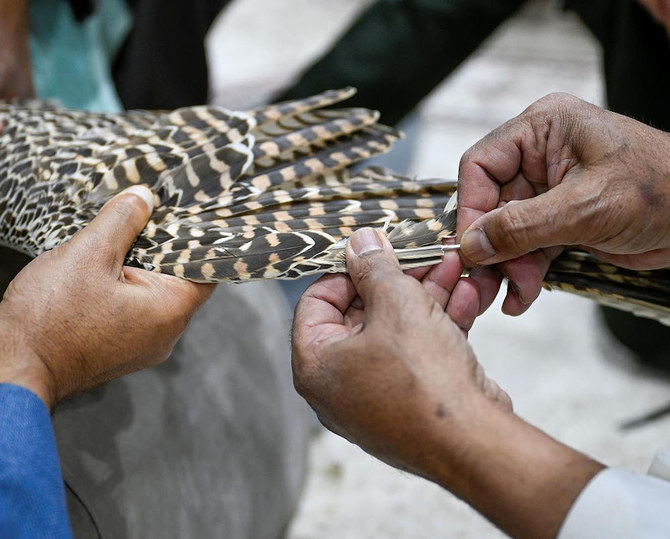
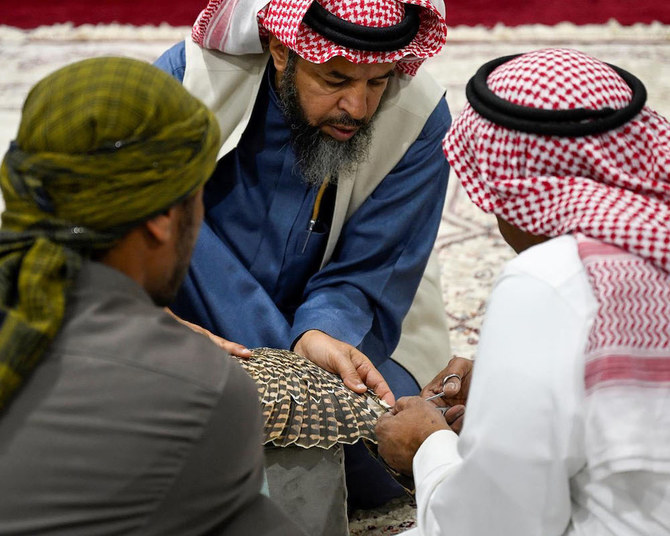
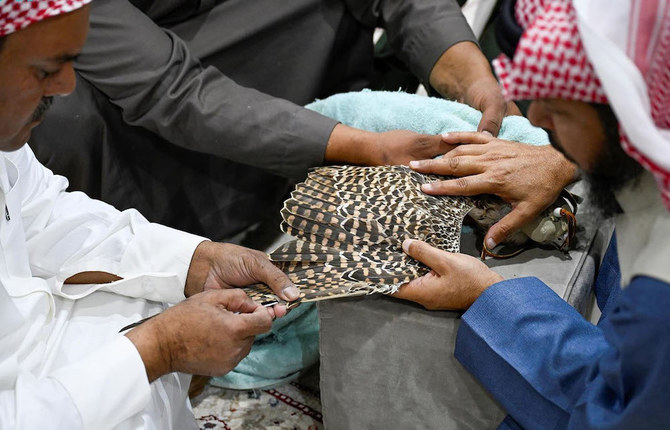
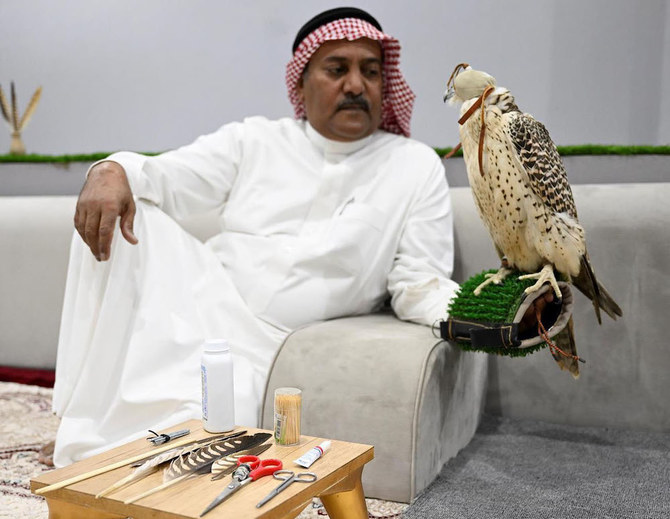
The meticulous craft is commonly used on birds of prey, particularly falcons, to replace a damaged feather with a healthy one
Updated 10 March 2024
Arab News
RIYADH: In the heart of Taif, the unique and time-honored tradition of feather imping, or mending, is thriving.
Known locally as tawseer, the meticulous craft is commonly used on birds of prey, particularly falcons, to replace a damaged feather with a healthy one, the Saudi Press Agency reported.
It involves the insertion of a donor feather, obtained either from the bird’s previous molting, or from another bird of the same or different species.
After a hunting or training season, falcons may suffer broken or damaged feathers. Skilled craftsmen, who have inherited their knowledge from generations past, step in to mend the falcon’s feathers using specialized tools and techniques.
According to imping expert Masoud Al-Juaid, the process is delicate, requiring a keen eye and a steady hand.
Skilled craftsmen, he said, can complete the task in just four or five minutes, using simple tools such as wooden skewers, copper wire, adhesive glue, and white powder or wood ash. The latter helps to stabilize the newly added feather and prevent it from affecting the falcon’s flight.
Imping is not merely an aesthetic practice; it is essential to maintaining the falcon’s balance and flight capabilities. A broken or damaged feather can disrupt the bird’s aerodynamics, leading to difficulty in flying or even injury.
A falcon’s wing consists of 22 feathers: 10 primary feathers, on the outer edge, and 12 secondary feathers on the inner edge. The molting and growth of each feather takes between three to eight weeks, depending on its length, according to the SPA report.
The art of tawseer requires a deep understanding of falcon anatomy, feather types, and the intricate process of feather replacement. It is testament to the rich cultural heritage of falconry in Saudi Arabia, and the dedication of its practitioners to preserving this tradition.
Saudi Railway Co. CEO speaks to media on future transport plans
Updated 21 January 2026
Nada Hameed
JEDDAH: Saudi Railway Co. CEO Bashar Al-Malik announced that a new railway linking Riyadh and Jeddah is planned to be completed in phases by 2034.
In an interview with Rotana Khalejia broadcaster Abdullah Al-Mudaifer, Al-Malik discussed the Kingdom’s rail network, its history, and major current and future projects.
He confirmed that the Riyadh-Jeddah line forms part of the Saudi Landbridge project, one of the most ambitious transport initiatives in the Kingdom.
Minister of Transport and Logistics Saleh Al-Jasser had said in an interview in 2022 that the Landbridge is being developed with an international consortium led by a Chinese company. He estimated the project could be completed within five to seven years.
According to Al-Jasser, the route, cost, and seven logistics hubs have already been identified. The railway will extend from Yanbu to King Abdullah Economic City, then to Jeddah and Riyadh, before linking with the Eastern Railway and the Northern Railway.
The project includes upgrading the existing Riyadh–Eastern Province line to meet modern technical standards. The total cost could reach SR100 billion ($26.67 billion), making it a transformative project for the Kingdom’s logistics sector.
Al-Malik said contracts have not yet been signed, emphasizing that the railway company will proceed only once an agreement is reached that fully meets Saudi Arabia’s needs and ambitions. A ministerial committee has been formed to oversee the project, which is scheduled for completion by 2034.
The railway project connecting Riyadh and Jeddah will be implemented in phases and is expected to be completed before 2034. (X/@almodifer)
Al-Malik also highlighted the proposed Riyadh-Doha railway, describing it as the region’s first high-speed rail link between two neighboring countries.
The 785 km network will serve Riyadh, Hofuf, Dammam, and Doha, with five stations in total, including two in the Qatari capital. Trains are expected to operate at speeds of at least 300 kph.
He added that Saudi Arabia aims to increase rail’s share of transport to 30 percent following completion of the Landbridge and future GCC-wide rail connections.
Under the National Transport and Logistics Strategy, railways are receiving the largest share of investment through 2030.
After a long pause in railway development after the opening of the Riyadh-Dammam line in 1950, the Kingdom now operates about 4,000 km of railways and plans to add at least 2,000 km more.
Currently, SAR trains serve ports in Dammam, Ras Al-Khair, Jubail (commercial and industrial), and the Riyadh Dry Port. Future plans include extending rail connections to Jeddah Islamic Port, King Abdullah Economic City Port, and Yanbu Port.
Al-Malik said up to 10 additional trains could be added to the Northern Railway, which currently operates six trains and is considered among the world’s most advanced rail routes. The tender is expected in the third quarter of this year.
Discussing the Haramain High-Speed Railway, Al-Malik described it as “a unique, passenger-only system” connecting Islam’s two holiest cities.
The service operates at speeds of up to 300 kph, making it one of the world’s 10 fastest trains. It runs 35 trains and links Makkah with stations in Jeddah, King Abdulaziz International Airport, King Abdullah Economic City, and Madinah.
Responding to user feedback, Al-Malik said the railway company will launch a new unified mobile application before the end of the year, providing a single platform for all intercity train services in the Kingdom.
He also highlighted training programs for high-speed train drivers, noting strong participation from Saudi women — a rare trend globally — and praising their outstanding performance.