

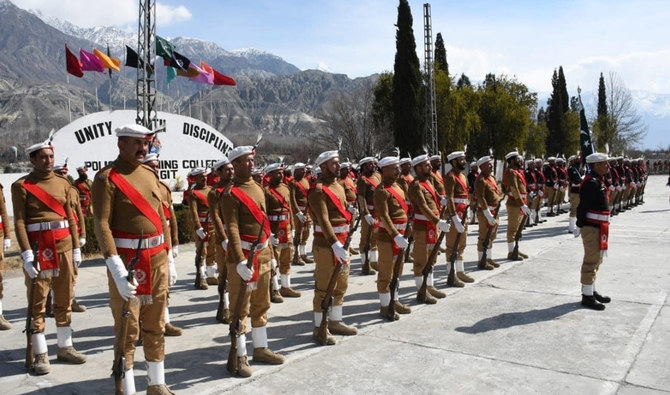

KHAPLU: The first batch of a force formed to protect forests and wildlife in Pakistan’s northern Gilgit-Baltistan (GB) region graduated from a police training college this week, officials confirmed.
Gilgit-Baltistan, once known as Northern Areas, used to be a part of Jammu and Kashmir, but has been under Pakistani control since shortly after Pakistan’s independence in 1947. Pakistan and India claim all of the disputed Kashmir territory since their independence in 1947 and have fought two of their three wars over the region.
Only one percent of land in GB, which forms Pakistan’s only road link to China, has been used for agriculture, as per the United Nations Development Programme (UNDP) and the GB agriculture department.
Fifty-two percent of the remaining land, nearly 72,000 square kilometers of administrative territory, consists of rangelands while forests take up four percent. The remaining portion comprises mountains and barren land.
Fifty cadets of GB’s new Forest & Wildlife Force formally graduated during a parade ceremony at the Police Training College in Gilgit on Saturday.
“There were no proper forces in GB to protect forests and wildlife, and only chowkidars (guards) and forest guards were responsible for protecting the forest and wildlife,” Zafar Waqar Taj, secretary for forests, parks and wildlife in GB, told Arab News over the phone.
Taj said every year, the department aimed to train 200 cadets so that it could get a force of over 800 trained members within the next four years.
“Now with the help of the provincial government, we will raise forces of 850 people [within the next four years] in which forest guards, foresters, range forest officers, game watchers and supervisors will be trained,” Taj said.
He said members of the unit were taught the criminal procedure code, Forest and Wildlife Act and various wildlife rules. They were also equipped with IT skills and taught how to use weapons, he said.
“The basic objective of this [unit] is to stop illegal cutting of forest trees, illegal transportation of timber or to stop illegal poaching or hunting,” he said.
The mountainous region is also home to various types of animals, which include the Astore Markhor, Ibex Ladakh Urial and the bharal or the blue sheep, famous for trophy hunting.
Demand for wood in Pakistan, a nation of about 241 million people, is three times higher than its potential sustainable supply, according to the most recent National Forest Policy published in 2015.
The country loses an estimated 27,000 hectares (66,700 acres) of trees per year, mainly in private and community-owned natural forests, the policy states.
To halt illegal logging in GB in 2021, Pakistan brought in the paramilitary Frontier Constabulary (FC) force to stop organized groups from cutting trees and shifting them to other parts of the country.
“Currently four platoons of FC are protecting our forests,” Taj said. “However, after four years, we will get our own trained forces, then we will be in a position to protect the forests and wildlife. Then, the FC will be sent back.”
Faizullah Faraq, a spokesperson for the GB government, said the unit has been trained by police.
“Now these trained forces will protect the forest and wildlife of GB in a better way,” Faraq told Arab News. “And protection of the forest and wildlife is the top priority of the GB government.”
Graduates of the program were ecstatic at passing out.
“The duration of the training was for four months, and today we passed out and we feel very happy now that we are trained,” Khush Hal Khan, a game watcher for the Forests and Wildlife Department, told Arab News.
Nasrullah, another participant who identified himself by his first name only, told Arab News he was “very happy” to be a part of the new force.
“Earlier, we didn’t know how to use a weapon,” Nasrullah told Arab News. “Now, after this training, we know how to use it. So, we will perform our duties vigilantly,” he added.


