

Another top donor says it will resume funding the UN agency for Palestinians as Gaza hunger grows

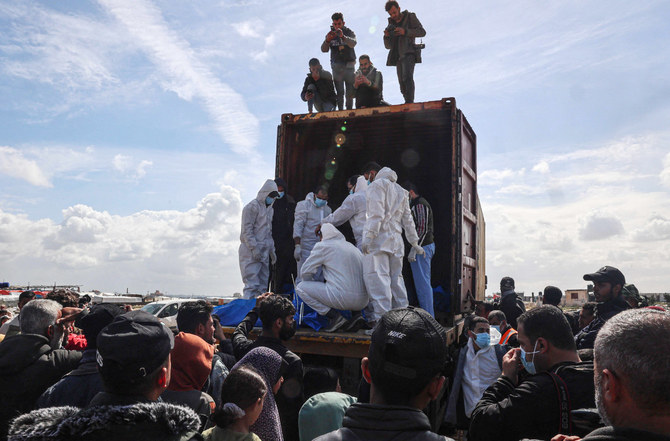
Mourners watch as medical personnel transport the bodies of 47 Palestinians, that were taken and later released by Israel, during a mass funeral in Rafah in the southern Gaza Strip on March 7, 2024, amid ongoing battles between Israel and the militant group Hamas. (AFP)
Short Url
Updated 10 March 2024
Follow

Another top donor says it will resume funding the UN agency for Palestinians as Gaza hunger grows

  • Overall, the ministry said, at least 30,878 Palestinians have been killed since the war began

JERUSALEM: Another top donor to the UN agency aiding Palestinians said Saturday that it would resume funding, weeks after more than a dozen countries halted hundreds of millions of dollars in support in response to Israeli allegations against the organization.
Sweden’s reversal came as a ship bearing tons of humanitarian aid was making preparations to leave Cyprus for Gaza after international donors launched a sea corridor to supply the besieged territory facing widespread hunger after five months of war.
Sweden’s decision followed similar ones by the European Union and Canada as the UN agency known as UNRWA warns that it could collapse and leave Gaza’s already desperate population of more than 2 million people with even less medical and other assistance.
“The humanitarian situation in Gaza is devastating and the needs are acute,” development minister Johan Forssell said in Sweden’s announcement, adding that UNRWA had agreed to increased transparency and stricter oversight and controls. Sweden will give UNRWA half of the $38 million funding it promised for this year, with more to come.
Israel had accused 12 of UNRWA’s thousands of employees of participating in the Oct. 7 Hamas attacks on Israel that killed 1,200 people and took about 250 others hostage. Countries including the United States quickly suspended funding to UNRWA worth about $450 million, almost half its budget for the year. The UN has launched investigations, and UNRWA has been agreeing to outside audits to win back donor support.
On the eve of Ramadan, hungry Gaza residents scrambled for packages of food supplies dropped by US and Jordanian military planes — a method of delivery that humanitarian groups have called deeply inadequate compared to deliveries by ground. But the daily number of aid trucks entering Gaza since the war has been far below the 500 that entered before Oct. 7 because of Israeli restrictions and security issues.
People dashed through devastated neighborhoods of Gaza City as the parachuting aid descended. “I have orphans, I want to feed them!” one woman cried.
“The issue of aid is brutal and no one accepts it,” said another resident, Momen Mahra, claiming that most of the airdropped aid falls into the sea. “We want better methods.”
The US military said that its planes on Saturday airdropped more than 41,000 “meal equivalents” and 23,000 bottles of water into northern Gaza, the hardest part of the enclave to access.
The Health Ministry in Gaza said that two more people, including a 2-month-old infant, had died as a result of malnutrition, raising the total number of people who died from hunger to 25. Ministry spokesperson Ashraf Al-Qidra said the toll included only people brought to hospitals.
Overall, the ministry said, at least 30,878 Palestinians have been killed since the war began. It doesn’t differentiate between civilians and combatants in its tallies, but says women and children make up two-thirds of the dead. The ministry is part of the Hamas-run government, and its figures from previous wars have largely matched those of the UN and independent experts.
The opening of the sea delivery corridor, along with the airdrops, showed increasing frustration with Gaza’s humanitarian crisis and a new international willingness to work around Israeli restrictions. The sea corridor is backed by the EU together with the United States, the United Arab Emirates and other involved countries, and the European Commission has said that UN agencies and the Red Cross will also play a role.
The ship belonging to Spain’s Open Arms aid group was expected to make a pilot voyage to test the corridor as early as this weekend. The ship has been waiting at Cyprus’s port of Larnaca for permission. Israel has said it welcomed the maritime corridor, but cautioned that it would need security checks.
Open Arms founder Oscar Camps told The Associated Press that the ship pulling a barge with 200 tons of rice and flour would take two to three days to arrive at an undisclosed location where the group World Central Kitchen was constructing a pier to receive it. The group has 60 food kitchens throughout Gaza to distribute aid, he said.
US President Joe Biden has announced a plan to build a temporary pier in Gaza to help deliver aid, underscoring how the US has to go around Israel, its main Middle East ally and the top recipient of US military aid. Israel accuses Hamas of commandeering some aid deliveries.
United States officials said it will likely be weeks before the Gaza pier is operational. The executive director of the US arm of medical charity Doctors Without Borders, Avril Benoit, in a statement criticized the US plan as a “glaring distraction from the real problem: Israel’s indiscriminate and disproportionate military campaign and punishing siege.”
Sigrid Kaag, the UN senior humanitarian and reconstruction coordinator for Gaza, has said air and sea deliveries can’t make up for a shortage of supply routes on land.
Meanwhile, efforts to reach a ceasefire before Ramadan appeared stalled. Hamas said Thursday that its delegation had left Cairo until next week.
International mediators had hoped to alleviate some of the immediate crisis with a six-week ceasefire, which would have seen Hamas release some of the Israeli hostages it’s holding, Israel release some Palestinian prisoners and aid groups be given access for a major influx of assistance into Gaza.
Palestinian militants are believed to be holding around 100 hostages and the remains of 30 others captured during the Oct. 7 attack. Several dozen hostages were freed in a weeklong November truce.


More than half the US threatened with ice, snow and cold in massive winter storm

Updated 57 min 2 sec ago
Follow

More than half the US threatened with ice, snow and cold in massive winter storm

  • Forecasters warned that the damage, especially in areas pounded by ice, could rival a hurricane
  • At least 177 million people were under watches or warnings for ice and snow and more than 200 million were under cold weather adviseries or warnings

WASHINGTON: It was too cold for school in Chicago and other Midwestern cities Friday as a huge, dayslong winter storm began to crank up that could bring snow, sleet, ice and bone-chilling temperatures as well as extensive power outages to about half the US population from Texas to New England.
Forecasters warned that the damage, especially in areas pounded by ice, could rival a hurricane. Airlines canceled thousands of flights, churches moved Sunday services online and the Grand Ole Opry in Nashville, Tennessee, decided to hold its Saturday night radio performance without fans. Carnival parades in Louisiana were canceled or rescheduled.
At least 177 million people were under watches or warnings for ice and snow and more than 200 million were under cold weather adviseries or warnings. In many places, those overlapped. Utility companies braced for power outages because ice-coated trees and power lines can keep falling long after a storm has passed.
“It’s going to be a big storm,” Maricela Resendiz said as she picked up chicken, eggs and pizzas at a Dallas store to get her, her 5-year-old son and her boyfriend through the weekend. Her plans: “Staying in, just being out of the way.”
Ice, snow and sleet could begin falling later Friday in Texas and Oklahoma. The storm was expected to slide into the South with freezing rain and sleet. Then it will move into the Northeast, dumping about a foot (30 centimeters) of snow from Washington, D.C., through New York and Boston, the National Weather Service predicted.
Arctic air is the first piece to fall in place

Arctic air that spilled down from Canada prompted schools throughout the Midwest to cancel classes Friday. With wind chills predicted to be as low as minus 40 degrees Fahrenheit (minus 40 Celsius) frostbite could set in within 10 minutes, making it too dangerous to walk to school or wait for the bus.
In Bismarck, North Dakota, where the wind chill was minus 41 Fahrenheit (minus 41 Celsius), Colin Cross cleaned out an empty unit for the apartment complex where he works.
“I’ve been here awhile and my brain stopped working,” said Cross, bundled up in long johns, two long-sleeved shirts, a jacket, hat, hood, gloves and boots.
Nationwide, more than 1,000 flights were delayed or canceled Friday, with well over half of them in Dallas, according to the flight tracking website FlightAware. About 2,300 Saturday flights were canceled.
In Oklahoma, Department of Transportation workers pretreated roads with salt brine while the Highway Patrol canceled troopers’ days off.
The federal government put nearly 30 search and rescue teams on standby. Officials have more than 7 million meals, 600,000 blankets and 300 generators placed throughout the area the storm was expected to cross, according to the Federal Emergency Management Agency.
Ice could take down power line
s and pipes could freeze

Once ice and snow end, the frigid air from the north will head south and east. It will take a while to thaw out, an especially dangerous prospect because ice can add hundreds of pounds to power lines and branches and make them more susceptible to snapping, especially if it’s windy.
In at least 11 Southern states from Texas to Virginia, a majority of homes are heated by electricity, according to the US Census Bureau.
A severe cold snap five years ago took down much of the power grid in Texas, leaving millions without power for days and resulting in hundreds of deaths. Gov. Greg Abbott said Thursday that won’t happen again, and utility companies were bringing in thousands of employees to help keep the power on.
Pipes are also at risk.
In Atlanta, where temperatures could dip to 10 degrees Fahrenheit (minus 12 Celsius) and stay below freezing for 36 hours, M. Cary & Daughters Plumbing co-owner Melissa Cary ordered all the pipe and repair supplies she could get. She said her daily calls could go from about 40 to several hundred.
“We’re out there; we can’t feel our fingers, our toes; we’re soaking wet,” Cary said. “I keep the hot chocolate and soup coming.”
Northeast prepares for heavy snow
The Northeast could see its heaviest snow in years.
Boston declared a cold emergency through the weekend, and Connecticut was working with neighboring New York and Massachusetts in case travel restrictions are needed on major highways.
Connecticut Gov. Ned Lamont urged people to go grocery shopping now and “stay home on Sunday.”
Philadelphia announced schools would be closed Monday. Superintendent Tony B. Watlington Sr. told students, “It’s also appropriate to have one or two very safe snowball fights.”
People are hunkering down
Stephen McDonald, who hasn’t had a home in three years, was hoping to get out of the cold in Jackson, Mississippi. But the Shower Power homeless shelter was adding spray foam insulation and ceiling heaters, keeping it closed until Saturday.
Friday night’s forecast called for lows near freezing. “Your hands get frozen solid, and they hurt real bad,” said McDonald,. “It’s not good.”
At the University of Georgia in Athens, sophomore Eden England was staying on campus to ride out the weather with her friends, even as the school encouraged students to leave dorms and go home because of concerns about losing power.
“I was texting my parents and we kind of just realized that whether I’m here or at home, it’s going to suck either way,” England said. “So I’d rather be with my friends, kind of struggling together if anything happens.”