Biden tells Israel not to use aid as ‘bargaining chip,’ pushes truce deal

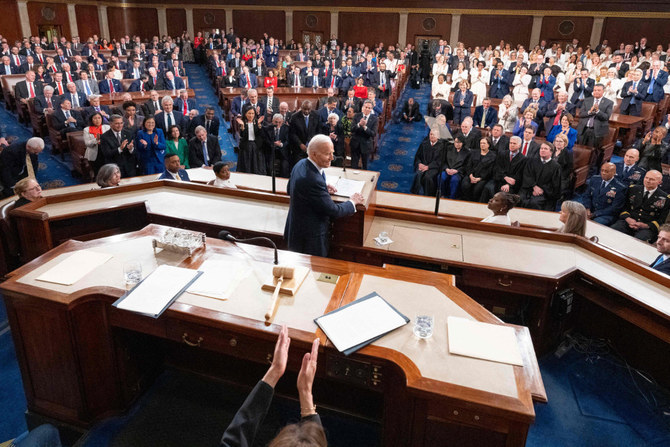
US Vice President Kamala Harris (bottom) applauds as US President Joe Biden delivers the State of the Union address in the House Chamber of the US Capitol in Washington, DC, on March 7, 2024. (POOL / AFP)
Short Url
Updated 08 March 2024
Follow

Biden tells Israel not to use aid as ‘bargaining chip,’ pushes truce deal

  • The US president lays out plan to set up temporary pier in the Mediterranean to bring aid into Gaza
  • Reiterates support for creation of Palestinian state, opposed by Netanyahu’s hard-right government

WASHINGTON: US President Joe Biden warned Israel that it cannot use aid as a “bargaining chip” as he issued a call for an immediate, temporary ceasefire with Hamas in the bloody Gaza war.
“To the leadership of Israel I say this — Humanitarian assistance cannot be a secondary consideration or a bargaining chip. Protecting and saving innocent lives has to be a priority,” Biden said in his annual State of the Union address.
Biden laid out a plan, announced by officials earlier in the day, to set up a temporary pier in the Mediterranean to bring aid into Gaza, where the United Nations has warned of the risk of famine.
Biden again said that Israel was justified in attacking Hamas, which controls the Gaza Strip, over the massive attack on October 7 and said that the militants “could end this conflict today” by releasing hostages.
But he called the impact on Gaza “heartbreaking.”
“I’ve been working nonstop to establish an immediate ceasefire that would last for six weeks,” he said.
The deal would “get the hostages home and ease the intolerable humanitarian crisis, and build toward something more enduring.”
Biden also reiterated his support for creation of a Palestinian state, a long-term goal opposed by Israeli Prime Minister Benjamin Netanyahu’s hard-right government.
“As we look to the future, the only real solution is a two-state solution,” Biden said.
“I say this as a lifelong supporter of Israel. My entire career, no one has a stronger record with Israel. I challenge any of you here.


Germany closer to US than China despite recent tensions, foreign minister says

Updated 3 sec ago
Follow

Germany closer to US than China despite recent tensions, foreign minister says

  • Germany is “not in equidistance” from the United States and China, and will always be closer ​to Washington despite recent tensions, German foreign minister Johann Wadephul said
SINGAPORE: Germany is “not in equidistance” from the United States and China, and will always be closer ​to Washington despite recent tensions, German foreign minister Johann Wadephul said in Singapore on Monday. At a lecture hosted by the International Institute for Strategic Studies, Wadephul said the United States remains the most important partner for Europe and Germany and that Europe remains dependent on it for its security, despite issues ‌that are currently “alienating” ‌Washington from the region. Trump administration ‌officials ⁠have ​been ‌critical of European countries for failing to meet NATO spending targets and for being too dependent on the United States for their own defense.
“Running with open arms to President Xi and saying all our problems vanished in this very moment and we are only heading ⁠to become your big partner, this would be the wrong answer,” ‌he said, referring to Chinese President ‍Xi Jinping. Western nations, such ‍as Canada and the United Kingdom have been striking ‍trade deals with China, defying US criticism.
Trump’s insistence that Washington should take control over Greenland has shaken transatlantic relations and accelerated European efforts to reduce its dependence on ​the United States, even as Trump last week withdrew his threat to impose additional tariffs and ruled ⁠out taking Greenland by force.
But Wadephul said Europe’s united response to US claims on Greenland shows that it can be successful at defending its interests as long as it defines its red lines clearly.
Wadephul also said that the European Union’s network of free trade agreements is an “important building block for rules-based free trade in times of increased protectionism and fragmentation.” The European Union is working to “swiftly conclude” more free trade agreements in ‌the Asia-Pacific region, including with Malaysia, Thailand, the Philippines and Australia, he said.