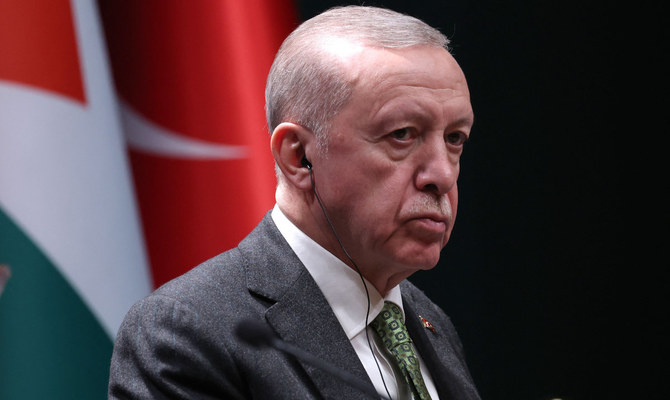
ANKARA: Turkiye President Recep Tayyip Erdogan said Tuesday that Israeli settlers were one of the main obstacles to resolving the Israeli-Palestinian conflict.
“One of the biggest obstacles to a solution are the actions of the usurpers, called settlers, who have invaded and stolen land that belonged to Palestinians,” Erdogan said during a press conference with visiting Palestinian president Mahmud Abbas.
Erdogan, a vocal advocate of the Palestinian cause, also called for unrestrained access to the Al-Aqsa mosque in Jerusalem during the Islamic fasting month of Ramadan, due to start this year on March 10 or 11.
“The demands of radical Israeli politicians to restrict the entry of Muslims... are totally absurd,” he said. “The consequences of such a move would undoubtedly be serious.”
“We’re about to start the month of Ramadan,” Abbas said. “It is well known that extremist settlers go to Al-Aqsa and carry out attacks there.”
Israel said Tuesday that it would allow as many Muslim worshippers to access the Al-Aqsa mosque during the first week of Ramadan as in previous years, and would assess the situation every week.
Every year, tens of thousands of Muslim worshippers perform Ramadan prayers at the Al-Aqsa mosque compound. The site, known as Temple Mount to Jews, is holy to both Jews and Muslims.
Ramadan comes this year as Israel wages a relentless military campaign in the Gaza Strip in response to a deadly attack by Hamas in Israel on October 7.
Israel’s far-right National Security Minister Itamar Ben Gvir had recently said that Palestinian residents of the West Bank “should not be allowed” entry to Jerusalem to pray during Ramadan.
Ben Gvir leads a hard-right party advocating Jewish control of the compound.
Days later, the United States called on Israel to allow Muslims to worship at Al-Aqsa.
Abbas is in Turkiye for talks about the Gaza war and reconciliation efforts between Palestinian factions.

Erdogan says Israeli settlers major obstacle to peace
Short Url
https://arab.news/nsra6
Erdogan says Israeli settlers major obstacle to peace
- Abbas is in Turkiye for talks about the Gaza war and reconciliation efforts between Palestinian factions
New Riyadh Air route to boost Dubai airport’s growth projection
- World’s busiest travel hub adding more routes to Saudi Arabia
- Dubai Airports forecasts 99.5 million passengers in 2026
DUBAI: Dubai International Airport (DXB), the world’s busiest travel hub, is expected to handle close to 100 million passengers this year, its operator said on Wednesday, building on a record performance in 2025.
Dubai Airports forecasts 99.5 million passengers in 2026, it said in a statement, as demand strengthens across several major markets.
DXB handled 95.2 million passengers last year, up 3.1 percent from 2024. India, Saudi Arabia and Britain remained among its largest markets, while China, Egypt and Italy recorded double-digit growth.
“We’ve had some pretty good growing markets … and those, I think, are the markets where there’s going to be considerable potential,” Dubai Airports CEO Paul Griffiths said in an interview, mentioning countries including China and Russia.
“We’re adding more routes to Saudi Arabia,” he said, adding that Riyadh Air, which is owned by the kingdom’s sovereign wealth fund and commenced operations last year, will start operating a route to and from DXB “over the next few months.”
Dubai, home to the world’s tallest tower and palm-shaped islands, is the Middle East’s biggest tourism and trade hub. It is also a key connecting point for flights between Europe and Asia, and last year welcomed 19.6 million international overnight visitors, according to government data.
DXB had its busiest day, month, quarter and year on record in 2025, operating “at the edge of physical capacity,” Dubai Airports said.
Griffiths said investment to roll out advanced hand baggage screening machines was helping to smooth the flow of traffic.
To meet rising demand and a fast-growing population, the emirate has announced a major $35 billion expansion at its second airport, Al Maktoum International, also operated by Dubai Airports.
That airport reported 30 percent growth in flights over the last year and handled 1.4 million passengers.
The expansion is designed to allow it to handle 150 million passengers per year over the next decade, before reaching an annual capacity of 260 million passengers when complete.
Dubai Airports forecasts 99.5 million passengers in 2026, it said in a statement, as demand strengthens across several major markets.
DXB handled 95.2 million passengers last year, up 3.1 percent from 2024. India, Saudi Arabia and Britain remained among its largest markets, while China, Egypt and Italy recorded double-digit growth.
“We’ve had some pretty good growing markets … and those, I think, are the markets where there’s going to be considerable potential,” Dubai Airports CEO Paul Griffiths said in an interview, mentioning countries including China and Russia.
“We’re adding more routes to Saudi Arabia,” he said, adding that Riyadh Air, which is owned by the kingdom’s sovereign wealth fund and commenced operations last year, will start operating a route to and from DXB “over the next few months.”
Dubai, home to the world’s tallest tower and palm-shaped islands, is the Middle East’s biggest tourism and trade hub. It is also a key connecting point for flights between Europe and Asia, and last year welcomed 19.6 million international overnight visitors, according to government data.
DXB had its busiest day, month, quarter and year on record in 2025, operating “at the edge of physical capacity,” Dubai Airports said.
Griffiths said investment to roll out advanced hand baggage screening machines was helping to smooth the flow of traffic.
To meet rising demand and a fast-growing population, the emirate has announced a major $35 billion expansion at its second airport, Al Maktoum International, also operated by Dubai Airports.
That airport reported 30 percent growth in flights over the last year and handled 1.4 million passengers.
The expansion is designed to allow it to handle 150 million passengers per year over the next decade, before reaching an annual capacity of 260 million passengers when complete.
© 2026 SAUDI RESEARCH & PUBLISHING COMPANY, All Rights Reserved And subject to Terms of Use Agreement.


