

PM Sharif announces up to Rs2 million compensation for Balochistan rain, flood victims

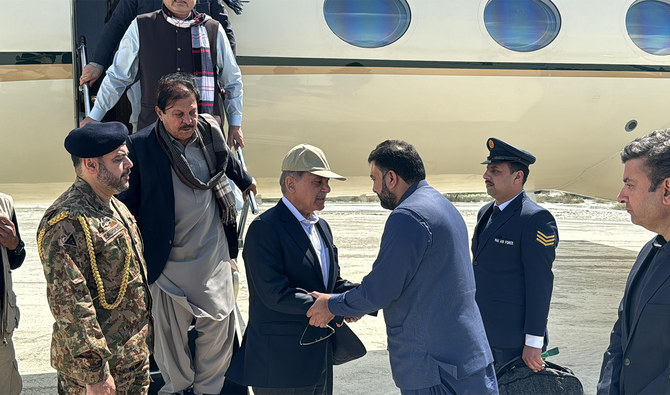
Pakistan Prime Minister Shehbaz Sharif (second left) shakes hand with Balochistan’s newly elected Chief Minister Sarfaraz Bugti as he arrives in Gwadar, Pakistan, on March 5, 2024 to inspect relief operations. (Government of Pakistan)
Short Url
Updated 05 March 2024
Follow

PM Sharif announces up to Rs2 million compensation for Balochistan rain, flood victims

  • Torrential rains in Gwadar, Kharan and Kech districts triggered floods, destroyed several homes over the past week
  • PM Sharif distributed relief goods among affected people in Gwadar as he inspected relief activities in the port city

ISLAMABAD: Pakistan’s newly elected Prime Minister Shehbaz Sharif on Tuesday announced up to Rs2 million compensation for families of individuals who lost their lives in last week’s torrential rains and floods in the southwestern Balochistan province.
The prime minister made the announcement while speaking to media along with provincial officials, after he inspected relief activities in the southwestern port city of Gwadar, which has been severely battered by floods triggered by heavy rains over the past week.
Streets and neighborhoods in the deep-sea port city as well as Kharan and Kech districts remain inundated with floodwater after last week’s downpours destroyed nearly a hundred homes and forced authorities to launch operations to rescue thousands of stranded people.
Sharif said torrential rains that began on Feb. 26 had killed five people in Balochistan and wreaked destruction in Gwadar and other parts of the province, with several others injured in rain-related incidents.
“I have decided that those who lost their loved ones [due to the storms] they would be given Rs2 million ($7,155) per head, while Rs500,000 ($1,788) will be issued to those who have been injured,” Sharif said.
“My elders, brothers and sisters, this is not a favor on you, this is the duty of the newly elected government,” he told flood-affectees.
According to a report by the Provincial Disaster Management Authority (PDMA) issued on Monday, 97 houses have been destroyed in Balochistan’s Kharan, Kech and Gwadar districts due to last week’s heavy rains.
The prime minister said the government had distributed cheques of Rs750,000 ($2,683) among people whose homes were completely destroyed by the floods, while those whose houses were partially damaged were given Rs350,000 ($1,252).
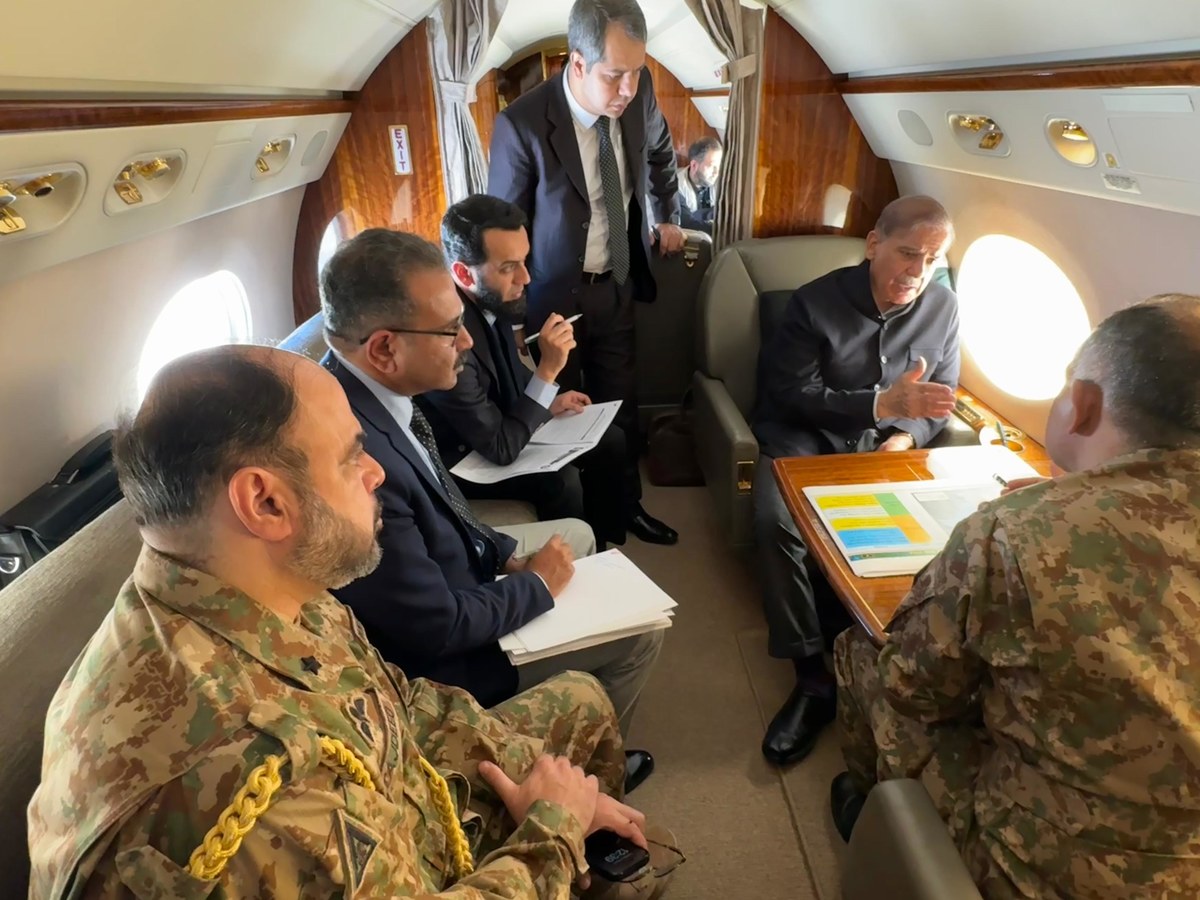


Pakistan's Prime Minister Muhammad Shehbaz Sharif receives a briefing from chairman of the country's National Disaster Management Authority, Chairman Lt. General Inam Haider Malik, on his way to Gwadar, Pakistan, on March 5, 2024. (Government of Pakistan)

Flanked by Balochistan’s newly elected Chief Minister Sarfaraz Bugti, Sharif said he had arrived in Gwadar to express solidarity with the affected people and to assure them that the government would pay for the losses incurred by them.
The prime minister announced that 7,000 bags of food would be sent to Gwadar daily, starting Wednesday.
“I would request my brother [CM Bugti] to distribute them in an efficient way,” Sharif said. “And this process of providing food will continue till the people do not return to their homes.”
Separately, the prime minister distributed relief goods among the affected people.
Other parts of the country also remain affected by heavy rains and snowfall. Pakistani officials said on Monday that at least 36 people had been killed and dozens injured in five days as heavy rains and snowfall battered Pakistan’s northwestern Khyber Pakhtunkhwa province and the northern Gilgit-Baltistan region.
In Balochistan, heavy snowfall brought daily life to a standstill in Quetta and other northern parts of the southwestern province, with main highways and inter-provincial roads blocked since Saturday, disconnecting the province from other parts of the country.
Large swathes of Pakistan were submerged in 2022 due to extremely heavy monsoon rains and melting glaciers, a phenomenon linked to climate change that damaged crops and infrastructure and killed at least 1,700 people and affected over 30 million.
The South Asian country consistently ranks among one of the most adversely affected countries from the effects of climate change.


Pakistan, global crypto exchange discuss modernizing digital payments, creating job prospects 

Updated 8 sec ago
Follow

Pakistan, global crypto exchange discuss modernizing digital payments, creating job prospects 

  • Pakistani officials, Binance team discuss coordination between Islamabad, local banks and global exchanges
  • Pakistan has attempted to tap into growing crypto market to curb illicit transactions, improve oversight

ISLAMABAD: Pakistan’s finance officials and the team of a global cryptocurrency exchange on Friday held discussions aimed at modernizing the country’s digital payments system and building local talent pipelines to meet rising demand for blockchain and Web3 skills, the finance ministry said.

The development took place during a high-level meeting between Finance Minister Muhammad Aurangzeb, Pakistan Virtual Assets Regulatory Authority (PVARA) Chairman Bilal bin Saqib, domestic bank presidents and a Binance team led by Global CEO Richard Teng. The meeting was held to advance work on Pakistan’s National Digital Asset Framework, a regulatory setup to govern Pakistan’s digital assets.

Pakistan has been moving to regulate its fast-growing crypto and digital assets market by bringing virtual asset service providers (VASPs) under a formal licensing regime. Officials say the push is aimed at curbing illicit transactions, improving oversight, and encouraging innovation in blockchain-based financial services.

“Participants reviewed opportunities to modernize Pakistan’s digital payments landscape, noting that blockchain-based systems could significantly reduce costs from the country’s $38 billion annual remittance flows,” the finance ministry said in a statement. 

“Discussions also emphasized building local talent pipelines to meet rising global demand for blockchain and Web3 skills, creating high-value employment prospects for Pakistani youth.”

Blockchain is a type of digital database that is shared, transparent and tamper-resistant. Instead of being stored on one computer, the data is kept on a distributed network of computers, making it very hard to alter or hack.

Web3 refers to the next generation of the Internet built using blockchain, focusing on giving users more control over their data, identity and digital assets rather than big tech companies controlling it.

Participants of the meeting also discussed sovereign debt tokenization, which is the process of converting a country’s debt such as government bonds, into digital tokens on a blockchain, the ministry said. 

Aurangzeb called for close coordination between the government, domestic banks and global exchanges to modernize Pakistan’s payment landscape.

Participants of the meeting also discussed considering a “time-bound amnesty” to encourage users to move assets onto regulated platforms, stressing the need for stronger verifications and a risk-mitigation system.

Pakistan has attempted in recent months to tap into the country’s growing crypto market, crack down on money laundering and terror financing, and promote responsible innovation — a move analysts say could bring an estimated $25 billion in virtual assets into the tax net.

In September, Islamabad invited international crypto exchanges and other VASPs to apply for licenses to operate in the country, a step aimed at formalizing and regulating its fast-growing digital market.