

Sweden arms exports rose 18 percent in 2023 with Pakistan among top destinations

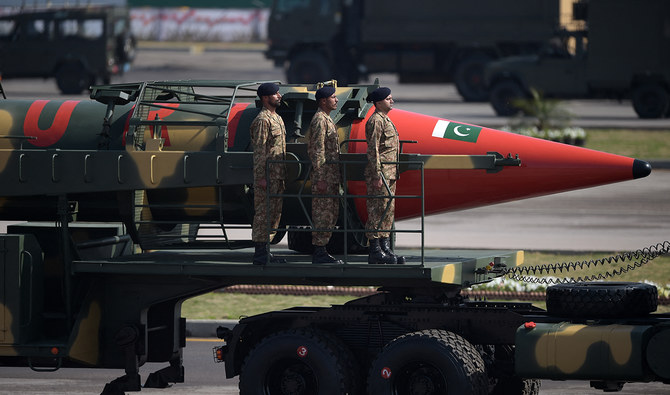
Pakistani military personnel stand beside a Ghauri nuclear-capable missile during a Pakistan Day military parade in Islamabad on March 23, 2017. (AFP/File)
Short Url
Updated 04 March 2024
Follow

Sweden arms exports rose 18 percent in 2023 with Pakistan among top destinations

  • Sweden has a growing defense industry with Saab making the Gripen fighter jet, the Global Eye surveillance aircraft and anti-tank weapons
  • Top 10 destinations for Swedish arms exports includes the United States, Brazil, Pakistan, the United Kingdom, Germany, India and Norway

STOCKHOLM: Sweden’s arms exports rose 18 percent in 2023 to reach 1.6 billion euros as the Russia-Ukraine war drove a search for weaponry, a government agency said Monday.

Most of the exports went to European Union countries and 39 countries which Sweden cooperates with, the Swedish Inspectorate for Strategic Products (ISP) said in a statement.

Sweden has a growing defense industry with Saab making the Gripen fighter jet, the Global Eye surveillance aircraft and anti-tank weapons.

“The degradation of the security situation and the continuing rearmament in the world means that the Swedish defense industry can expect many orders for a long time,” said ISP director general Carl Johan Wieslander in a statement.

“Swedish military equipment is attracting great interest, particularly in Ukraine,” he added.

Turkiye also benefited from Swedish arms, according to ISP, with exports in 2023 worth four million Kronor (356,000 euros).

In 2019, Stockholm introduced restrictions on arms sales to Ankara in response to Turkiye’s military incursion into Syria.

The embargo was lifted following negotiations between the two countries during Sweden’s NATO accession process.

“The resumption of arms exports to Turkiye clearly shows that Sweden places greater importance to NATO membership than to respecting human rights, democracy and international law,” said the peace and disarmament NGO Svenska Freds in a statement.

“The arms industry wants to present itself as a contributor to freedom and democracy, but Swedish arms companies also export (their products) to undemocratic regimes, countries that violate human rights and international law,” the NGO added.

People in these countries “pay a high price” for flourishing arms industry, it said.

The top 10 destinations for Swedish arms exports are the United States, Brazil, Pakistan, the United Kingdom, Germany, India, Norway, France and the Czech Republic.


Pakistan’s deputy PM says country seeks to convert $1 billion UAE deposit into investment

Updated 17 sec ago
Follow

Pakistan’s deputy PM says country seeks to convert $1 billion UAE deposit into investment

  • Ishaq Dar says the UAE will acquire shares in Pakistani companies using the amount, with transaction to be completed by March 31
  • The UAE’s remaining $2 billion in deposits, part of funds used to shore up Pakistan’s foreign reserves, are due for rollover in January

ISLAMABAD: Pakistan is seeking to convert part of its financial support from the United Arab Emirates into long-term investment to reduce external debt, Deputy Prime Minister Ishaq Dar said on Saturday, following talks with UAE President Sheikh Mohamed bin Zayed Al Nahyan during his visit to Islamabad.

Dar said Pakistan was engaged with the UAE on converting $1 billion in deposits into equity investment, potentially involving stakes in companies linked to the Fauji Fertilizer Group, a move that would end Pakistan’s repayment obligation on that portion of the funds.

The UAE has been one of Pakistan’s key financial backers in recent years, providing $3 billion in deposits to the central bank as part of a broader effort to stabilize the country’s external finances and unlock support from the International Monetary Fund.

Speaking at a year-end briefing, Dar said Pakistan had already begun discussions with the UAE on rolling over the first $1 billion tranche, but Islamabad now wanted to replace short-term borrowing with investment.

“They will be acquiring some shares, and this liability will end,” Dar said, adding that discussions were under way for the transaction to be completed by March 31.

Dar said the Fauji Foundation Group was taking the lead in the process, with plans for partial disinvestment by Fauji-linked and other companies to facilitate the deal.

He added that Pakistan also raised the issue of a separate $2 billion rollover due in January during talks with the UAE leadership, saying Islamabad had conveyed that converting debt into investment would be preferable to repeated rollovers.

The issue was discussed during Al Nahyan’s visit, which Dar described as cordial, adding that the UAE had expressed willingness to expand its investment footprint in Pakistan.

Pakistan has relied on repeated rollovers of deposits from friendly countries to manage its balance-of-payments pressures, a practice economists say provides short-term relief but adds to debt vulnerabilities unless replaced with foreign direct investment.

The country acquired $5 billion from Saudi Arabia and $4 billion from China, which, along with the UAE, helped shore up its foreign reserves and meet IMF conditions at a time when its external account was under severe pressure.

Dar said Pakistan was now focused on shifting from temporary financing toward longer-term capital inflows to stabilize its economy and reduce reliance on external borrowing.