

Ancient astronomical device reveals ties between Muslims, Jews in medieval Europe

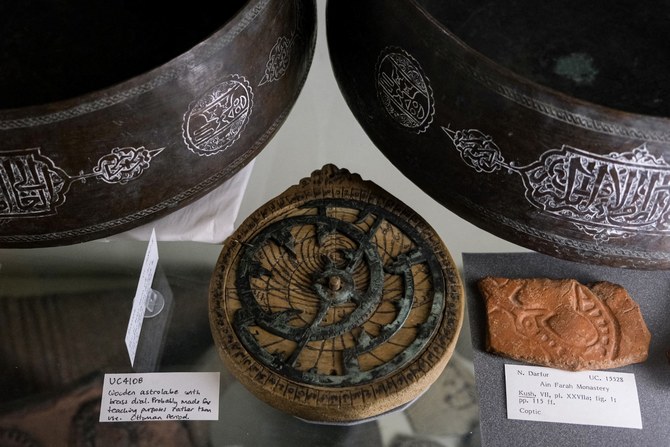
A file photo of an astrolabe from the Ottoman period displayed the Petrie Museum of Egyptian Archaeology at University College London (AFP)
Short Url
Updated 04 March 2024
Follow

Ancient astronomical device reveals ties between Muslims, Jews in medieval Europe

  • Astrolabe is believed to have been produced in 11th-century Al-Andalus
  • Historian discovers hidden Arabic, Hebrew, Western etchings after chance online encounter

London: A reappraisal of an ancient astronomical device in Italy has sparked new interest in the medieval interaction between Muslim and Jewish scientists, The Times reported on Monday.

The astrolabe, an instrument once used by astronomers to measure time and distance based on the position of stars, has been on display at a museum in Verona for decades.

But a historian’s chance online encounter with the device, long thought to be a fake, has opened new theories about social and scientific interactions between the Islamic and Jewish faiths in medieval Europe.

Federica Gigante from Cambridge University came across an image of the astrolabe in an online post, and traveled to the museum to investigate the object.

The device is believed to have been produced in Al-Andalus, the Muslim-ruled kingdom of the Iberian Peninsula that encompassed much of modern-day Spain and Portugal.

At the museum, Gigante held the astrolabe in the sunlight and discovered a series of hidden Arabic, Hebrew and modern Western etchings.

She said: “The museum didn’t know what it was and thought it might be fake. It’s now the single most important object in their collection.”

The device is said to be from 11th-century Toledo, during a period known as the Convivencia, or Coexistence, when members of all three Abrahamic faiths lived in relative harmony.

The first markings on the astrolabe are in Arabic and denote the times of Muslim prayers in Toledo and Cordoba.

A brass plate later added to the device allowed the user of the astrolabe to determine prayer times in North Africa.

Further Arabic etchings contain two Jewish names, suggesting that the device was later used by Sephardic Arabic-speaking communities in Al-Andalus.

Hebrew text is also inscribed on the astrolabe, implying that “at a certain point the object left Spain or North Africa and circulated among the Jewish diaspora in Italy,” Gigante said.

Further Hebrew etchings translate the Arabic terms for the astrological signs Scorpio, Sagittarius, Capricorn, Aquarius, Pisces and Aries.

Gigante believes that the astrolabe may have reached Italy in the 12th century. Once in medieval Verona, Western numerals are believed to have been added to the device by a Latin or Italian speaker.

A 17th-century Veronese nobleman, Ludovico Moscardo, is thought to have obtained the astrolabe, before it was passed to the prominent aristocratic Miniscalschi family which, in 1990, founded the museum where the device remains today.

Gigante said: “The Verona astrolabe stands out, attesting to the contacts and exchanges between Arabs, Jews and Europeans in the medieval and early modern periods.”


Georges Chakra presents new couture collection in Paris

Updated 28 January 2026
Follow

Georges Chakra presents new couture collection in Paris

  • Chakra introduces ‘new Parisienne attitude’
  • Top Arab designers also have shows in city

DUBAI: Lebanese designer Georges Chakra has presented his Spring/Summer 2026 couture collection at Paris Haute Couture Week, offering a contemporary interpretation of the house’s established design codes through refined silhouettes and detailed craftsmanship.

Drawing on the heritage of the maison, the collection revisited classic elements of elegance while introducing what the designer described in an Instagram post as a “new Parisienne attitude.”

Soft pastels, ivory and metallic tones defined the palette, moving between pale blue, blush, lavender and gold across the runway.

The show featured a range of sculpted looks, with structured bodices balanced by feathered appliques, floral embroidery and layers of sheer tulle.

Strapless gowns with petal-like embellishments appeared alongside column dresses finished with subtle shimmer, while ruffled sleeves, organza capes and sheer overlays created volume and movement.

White gowns formed a central part of the collection, ranging from minimal silhouettes with clean lines to more elaborate designs incorporating veils, hats and lattice-style embroidery.

Soft pastels, ivory and metallic tones defined the palette. (Getty Images)

Sequins, hand-applied florals and intricate beading appeared throughout the collection. The show concluded with a bridal look featuring sheer embroidery and floral detailing.

After beginning his career in Beirut, where he initially worked at his home studio following his graduation from an institution in Canada, Chakra founded his fashion house in 1985.

He later expanded his atelier to Paris, debuting on the Haute Couture Week calendar in 2002, and has since built an international reputation for couture and eveningwear, dressing a wide range of regional and global figures for major red-carpet appearances.

His designs have been worn by celebrities including Nicki Minaj, Rihanna, Beyonce, Cara Delevingne, Tyra Banks, Jennifer Lopez, Helen Mirren, Molly Sims and Andra Day.

Chakra was among several Arab designers featured during Paris Haute Couture Week this season.

Georges Hobeika and Tony Ward had already presented their Spring/Summer 2026 couture collections earlier in the week, while Elie Saab, Zuhair Murad, Ashi Studio and Rami Al-Ali are scheduled to show later on the official calendar.