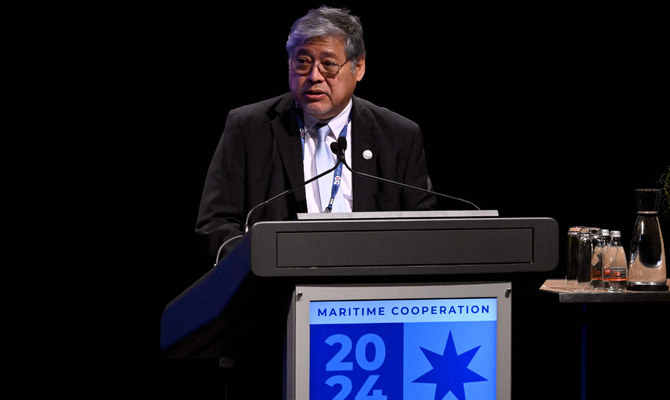
MELBOURNE: Philippine foreign minister Enrique Manalo told AFP on Monday that his country wants to solve maritime disputes with China peacefully — but delivered a simple message to Beijing: “stop harassing us.”
Speaking on the sidelines of an ASEAN-Australia summit in Melbourne, Manalo defended his government’s policy of publicizing Chinese maneuvers in contested maritime territory — including the recent passage of warships near Scarborough Shoal.
“It’s merely trying to inform the people of what’s going on,” Manalo said. “And some countries or one country at least has some difficulty with that.”
“But our simple explanation is if you would stop harassing us and, and perhaps performing other actions, there wouldn’t be any news to report.”
China claims almost the entire South China Sea as its territory, brushing aside claims from a host of Southeast Asian nations.
Scarborough Shoal — a triangular chain of reefs and rocks in the disputed South China Sea — has been a flashpoint between the countries since China seized it from the Philippines in 2012.
Philippine governments have tried to rally international and regional support to their cause — with mixed results.
“The Philippines is committed to a peaceful resolution of disputes through diplomatic means, or peaceful means,” Manalo said, while insisting “this will not be done at the expense of our national interest.”
“We are reaching out to partners in like-minded countries with similar issues and similar concerns.”
But Manalo acknowledged there were was at least a small question mark over support from the Philippines’ most important security partner — the United States.
The two countries are treaty allies, meaning Washington has formally pledged to come to Manila’s defense in the event of a military conflict.
Ask about the November election — which will pit incumbent Joe Biden against Republican firebrand Donal Trump, he said it was a topic of frequent debate behind closed doors.
“Every country in the world is probably thinking of that, of course. The United States is a major, it’s a treaty ally of the Philippines. So obviously, any differences or changes in US policy from existing policies would most likely have some kind of effect.”
“At this stage it’s fairly difficult to assess how it would happen, or what would happen,” he said.
“But all I can say is we are, of course, carefully monitoring the election season in the United States, but I’ve had talks with many of my other colleagues from other countries, and I think everybody is doing the same.”
“So certainly all eyes will be riveted on that election this year.”


![]()

Philippines foreign minister urges China: ‘stop harassing us’
Short Url
https://arab.news/nqdhk
Philippines foreign minister urges China: ‘stop harassing us’
- China claims almost the entire South China Sea as its territory, brushing aside claims from a host of Southeast Asian nations


Latest updates


© 2026 SAUDI RESEARCH & PUBLISHING COMPANY, All Rights Reserved And subject to Terms of Use Agreement.