

Limiting Gaza protests ‘risks terror attacks,’ warns former UK police chief

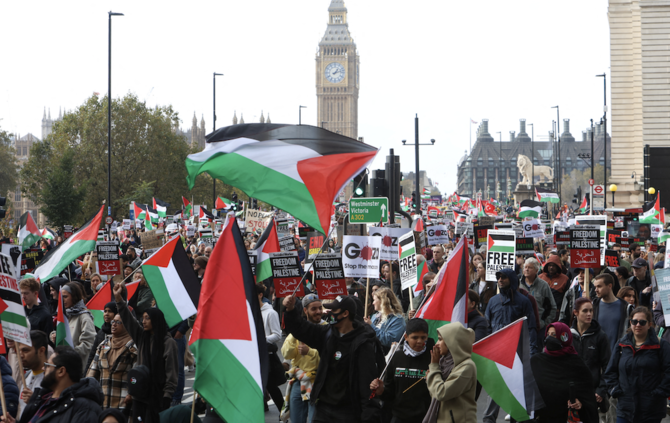
Limiting or banning pro-Palestine protests in the UK will increase the likelihood of terror attacks in the country, a former police chief has said. (Reuters/File Photo)
Short Url
Updated 02 March 2024
Follow

Limiting Gaza protests ‘risks terror attacks,’ warns former UK police chief

  • Demonstrations a ‘vent’ for people ‘vulnerable to extremist messages,’ Neil Basu says
  • New video shows police knocking 71-year-old woman to the ground during London protest

LONDON: Limiting or banning pro-Palestine protests in the UK will increase the likelihood of terror attacks in the country, a former police chief has said.

The former head of the UK’s anti-terror police network, Neil Basu, warned that any move to prevent people from voicing their opinions on the Israel-Hamas war would “fuel more extremism,” The Times reported.

Basu added that protesters on the fringes of the Palestine supporter movement would “look somewhere else” to voice their anger.

His comments come amid a growing divide in responses to the large-scale protest marches across the UK, which have taken place fortnightly since the outbreak of violence in Gaza in October last year.

Prime Minister Rishi Sunak, speaking outside Downing Street on Friday, said that the demonstrations have “descended into intimidation, threats and planned acts of violence.”

He added: “On too many occasions recently, our streets have been hijacked by small groups who are hostile to our values and have no respect for our democratic traditions.”

Home Secretary James Cleverly earlier this week urged pro-Palestine demonstrators to end their marches because they had “made their point” and were unduly consuming police resources.

However, Basu hit back against calls to prohibit the marches, arguing that they served as a “vent” for people “who are vulnerable to extremist messages.”

He said: “I don’t think they’re mob rule. It would be dangerous to describe them in such provocative language that is designed to have them stopped.”

Politicians and policing figures have also warned of a growing risk to MPs, after several claimed they had been “intimidated” by protesters.

On Friday, about 30 demonstrators gathered outside the residence of the Israeli ambassador to the UK in North London, demanding her arrest over alleged support for war crimes.

Matt Twist, a senior public order officer with London’s Met Police, claimed that the force would be “quick in its response” to people attempting to intimidate MPs.

He added: “Of course, we’re worried about MP’s security. Anyone watching social media would see the number of threats that MPs get, which is utterly horrid and unacceptable.”

Further controversy erupted in the capital on Saturday after a 71-year-old “legal observer” was revealed to have been knocked to the ground by a group of police officers during a Gaza ceasefire protest in early January.

Lesley Wertheimer was seen wearing a high-visibility jacket in a newly released video of the incident, seen by The Guardian.

The pensioner and beekeeper, who has monitored the policing of protests since 1990, fell flat on the ground after being knocked over by a column of advancing police officers, the video shows.

She said: “No person should be charged, knocked over and harmed by the police and then have to rely on strangers helping them.

“Legal observers are there to do a piece of work as the police are there to do a piece of work. The police cannot target us. They have no right to try to intimidate us.”

Wertheimer said she had no memory of the aftermath of the incident, and believes that she lost consciousness as a result of the fall.

The 71-year-old was helped by nearby pedestrians and doctors who had attended the march, before limping to a nearby emergency department.

Two weeks ago, she submitted a complaint to the Met Police, which said it was investigating the incident.

Eva Roszykiewicz, Wertheimer’s solicitor, said it was “shocking” not only that “officers knocked into Lesley, causing her to fall over, but also that none of the other officers stopped to check on her.”

She added: “Whether you are a legal observer or a member of the public, that is scary.”


Rohingya refugees hope new leaders can pave a path home

Updated 29 December 2025
Follow

Rohingya refugees hope new leaders can pave a path home

  • Some 1.7 million Rohingya Muslims displaced in Myanmar's military crackdown live in squalid camps in Cox’s Bazar, Bangladesh

COX’S BAZAR, Bangladesh: Rohingya refugees living in squalid camps in Bangladesh have elected a leadership council, hoping it can improve conditions and revive efforts to secure their return home to Myanmar.
Spread over 8,000 acres in Cox’s Bazar in Bangladesh, the camps are home to 1.7 million members of the stateless group, many of whom fled a 2017 military crackdown that is now subject to a genocide probe at the UN court.
In July, the refugees held their first elections since their influx began eight years ago, resulting in the formation of the United Council of Rohang (UCR).
“They are working to take us home,” said Khairul Islam, 37, who back home had a thriving timber business.
The new council has brought him a glimmer of hope amid an uncertain future.
“We can hardly breathe in these cramped camp rooms... all our family members live in a single room,” he said.
“It’s unbearably hot inside. Back in Myanmar, we didn’t even need a ceiling fan. In summer, we used to sit under tall trees,” Islam said, his eyes welling up.
More than 3,000 voters from across 33 refugee camps cast their ballots to elect an executive committee and five rotating presidents to focus on human rights, education and health.
Addressing a gathering at one of the camps, UCR president Mohammad Sayed Ullah urged refugees not to forget the violence that forced the mostly Muslim group to flee Myanmar’s Rakhine state.
“Never forget that we left our parents’ graves behind. Our women died on the way here. They were tortured and killed... and some drowned at sea,” said Sayed Ullah, dressed in a white full-sleeved shirt and lungi.
“We must prepare ourselves to return home,” he said, prompting members of the audience to nod in agreement.

A seat at the table 

“UCR wants to emerge as the voice of the Rohingyas on the negotiation table,” Sayed Ullah later told AFP.
“It’s about us, yet we were nowhere as stakeholders.”
The council is not the first attempt to organize Rohingya refugees.
Several groups emerged after 2017, including the Arakan Rohingya Society for Peace and Human Rights, once led by prominent activist Mohib Ullah.
But he was murdered in 2021.
And even before that, many organizations were shut down after a major 2019 rally, when the Rohingya said they would go home only with full rights and safety guarantees.
“Some newspapers misrepresented us, claiming we wanted to stay permanently in Bangladesh,” Sayed Ullah said.
“Many organizers were detained. The hardest blow was the assassination of Mohib Ullah.”
But trust is slowly building up again among the Rohingya crammed in the camps in Cox’s Bazar.
“Of course we will return home,” said 18-year-old Mosharraf, who fled the town of Buthidaung with his family.
“UCR will negotiate for better education. If we are better educated, we can build global consensus for our return,” he told AFP.

Security threats 

Many refugees have started approaching the body with complaints against local Rohingya leaders, reflecting a slow but noticeable shift in attitudes.
On a recent sunny morning, an AFP reporter saw more than a dozen Rohingya waiting outside the UCR office with complaints.
Some said they were tortured while others reported losing small amounts of gold they had carried while fleeing their homes.
Analysts say it remains unclear whether the new council can genuinely represent the Rohingya or if it ultimately serves the interests of Bangladeshi authorities.
“The UCR ‘elections’ appear to have been closely controlled by the authorities,” said Thomas Kean, senior consultant at the International Crisis Group.
Security threats also loom large, undermining efforts to forge political dialogue.
Armed groups like the Arakan Rohingya Salvation Army and Rohingya Solidarity Organization continue to operate in the camps.
A report by campaign group Fortify Rights said at least 65 Rohingyas were killed in 2024.
“Violence and killings in the Rohingya camps need to stop, and those responsible must be held to account,” the report quoted activist John Quinley as saying.