

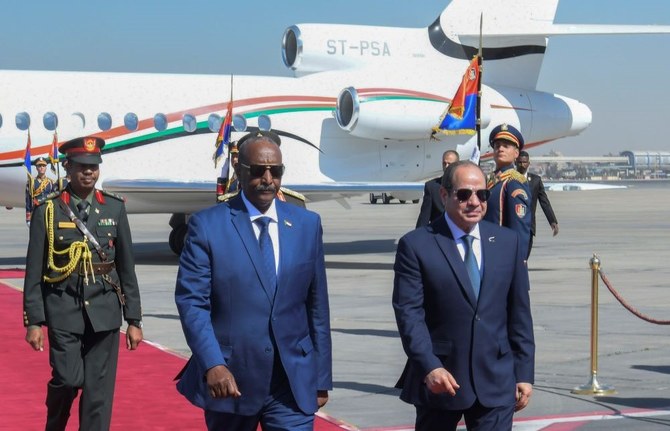
El-Sisi, Al-Burhan discuss developments in Sudan

Abdel Fattah El-Sisi, right, meets Gen. Abdel Fattah Al-Burhan, Chairman of the Transitional Sovereignty Council of Sudan, upon his arrival at Cairo airport, Egypt, Feb. 29, 2024. (AP Photo)
Short Url
Updated 29 February 2024
Follow

El-Sisi, Al-Burhan discuss developments in Sudan

  • Al-Burhan said that Egypt’s role in hosting Sudanese citizens and mitigating the crisis provided evidence of its continued friendship
  • El-Sisi and Al-Burhan agreed on the necessity of an immediate ceasefire in Gaza

CAIRO: Egypt’s President Abdel Fattah El-Sisi on Thursday received Gen. Abdel Fattah Al-Burhan, president of the Transitional Sovereignty Council of Sudan, at Cairo International Airport.

An official reception ceremony took place at Al-Ittihadiya Palace, at which the national anthems were played and guards of honor inspected.

The meeting focused on recent developments in Sudan and efforts to resolve its crisis.

The main goal is to restore stability while ensuring sovereignty, unity, and cohesion of the Sudanese state and its institutions.

The meeting was an attempt to meet the Sudanese people’s desire for safety and stability.

Ahmed Fahmy, the presidential spokesman, said that El-Sisi focused on the solid historic relations between the two countries, emphasizing Egypt’s support in enhancing cooperation.

The president stressed Egypt’s commitment to Sudan’s security and offered full support to achieve political, security, and economic stability.

He affirmed Egypt’s commitment to supporting Sudan’s unity and resolving ongoing conflicts.

He added that the two countries shared a close relationship, which made it necessary to ensure national security.

The president spoke of Egypt’s ongoing role in helping to alleviate the humanitarian impact of the current crisis within Sudan.

Al-Burhan expressed his country’s appreciation for Egypt’s support. He highlighted the long-standing ties between the two countries, while saying that Egypt’s role in hosting Sudanese citizens and mitigating the crisis provided evidence of its continued friendship.

The parties also discussed the situation in Gaza and regional issues of mutual concern.

El-Sisi and Al-Burhan agreed on the necessity of an immediate ceasefire and the urgent need to ensure the delivery of humanitarian aid to Gaza.

They also agreed to continue consultations and coordination to help benefit the populations of Egypt and Sudan.

The Sudanese leader made an official visit to Egypt in August last year, his first following the start of his country’s conflict in April. Al-Burhan and El-Sisi met in the city of Alamein in northern Egypt.


Jailed Turkish Kurd leader calls on government to broker deal for Syrian Kurds

Updated 7 sec ago
Follow

Jailed Turkish Kurd leader calls on government to broker deal for Syrian Kurds

  • Clashes between Syrian forces and the SDF have cast doubt over a deal to integrate the group’s fighters into the army
ANKARA: Jailed Turkish Kurd leader Abdullah Ocalan said Tuesday that it was “crucial” for Turkiye’s government to broker a peace deal between the Kurdish-led Syrian Democratic Forces (SDF) and the Damascus government.
Clashes between Syrian forces and the SDF have cast doubt over a deal to integrate the group’s fighters into the army, which was due to take effect by the end of the year.
Ocalan, founder of the Kurdistan Workers’ Party (PKK) militant group, called on Turkiye to help ensure implementation of the deal announced in March between the SDF and the Syrian government, led by former jihadist Ahmed Al-Sharaa, whose forces ousted longtime ruler Bashar Assad last year.
“It is essential for Turkiye to play a role of facilitator, constructively and aimed at dialogue,” he said in a message released by Turkiye’s pro-Kurdish DEM party.
“This is crucial for both regional peace and to strengthen its own internal peace,” Ocalan, who has been jailed for 26 years, added.
“The fundamental demand made in the agreement signed on March 10 between the SDF and the government in Damascus is for a democratic political model permitting (Syria’s) peoples to govern together,” he added.
“This approach also includes the principle of democratic integration, negotiable with the central authorities. The implementation of the March 10 agreement will facilitate and accelerate that process.”
The backbone of the US-backed SDF is the YPG, a Kurdish militant group seen by Turkiye as an extension of the PKK.
Turkiye and Syria both face long-running unrest in their Kurdish-majority regions, which span their shared border.
In Turkiye, the PKK agreed this year at Ocalan’s urging to end its four-decade armed struggle.
In Syria, Sharaa has agreed to merge the Kurds’ semi-autonomous administration into the central government, but deadly clashes and a series of differences have held up implementation of the deal.
The SDF is calling for a decentralized government, which Sharaa rejects.
Turkish Foreign Minister Hakan Fidan, whose country sees Kurdish fighters across the border as a threat, urged the SDF last week not to be an “obstacle” to stability.
Syrian Kurdish leader Mazloum Abdi said Thursday that “all efforts” were being made to prevent the collapse of talks.