DUBAI: Iran holds a parliamentary election on Friday seen as a test of the clerical establishment’s popularity at a time of growing dissent over an array of political, social and economic crises.
The vote will be the first formal gauge of public opinion after anti-government protests in 2022-23 spiralled into some of the worst political turmoil since the 1979 Islamic Revolution.
Critics from inside and outside the ruling elite, including politicians and former lawmakers, say the legitimacy of Iran’s theocratic system could be at stake due to economic struggles and a lack of electoral options for a mostly young population chafing at political and social restrictions.
Iran’s top authority, Supreme Leader Ayatollah Ali Khamenei, has called voting a religious duty. He accused the country’s “enemies” — a term he normally uses for the United States and Israel — of trying to create despair among Iranian voters.
The commander of the country’s elite Revolutionary Guards, Hossein Salami, said on Wednesday that “each vote is like a missile launched at the enemy’s heart.”
But Iranians still have painful memories of the handling of nationwide unrest sparked by the death in custody of a young Iranian-Kurdish woman in 2022, which was quelled by a violent state crackdown involving mass detentions and even executions.
Economic hardships pose another challenge. Many analysts say that millions have lost hope that Iran’s ruling clerics can resolve an economic crisis fomented by a combination of US sanctions, mismanagement and corruption.
While establishment supporters will likely vote for hard-line candidates, widespread public anger at worsening living standards and pervasive graft may keep many Iranians at home.
Prices for basic goods like bread, meat, dairy and rice have skyrocketed in past months. The official inflation rate stands at about 40 percent. Analysts and insiders put it at over 50 percent.
The US 2018 withdrawal from Iran’s 2015 nuclear deal with six world powers, and its reimposition of sanctions, have hit Iran’s economy hard. Efforts to revive the pact have failed.
Reformists shun ‘meaningless’ vote
Iranian activists and opposition groups are distributing the Twitter hashtags #VOTENoVote widely on social media, arguing that a high turnout will legitimize the Islamic Republic.
With heavyweight moderates and conservatives staying out of Friday’s race and reformists calling it an “unfree and unfair election,” the vote will pit hard-liners and low-key conservatives against each other, all proclaiming loyalty to Iran’s Islamic revolutionary ideals.
The interior ministry said 15,200 candidates will run for the 290-seat parliament, with a vetting body called the Guardian Council approving 75 percent of initially registered hopefuls.
The unelected Guardian Council, made up of six clerics and six legal experts generally within Khamenei’s orbit, has the authority to scrutinize laws and election candidates.
Ballots will mostly be counted manually, so the final result may not be announced for three days, although partial results may appear sooner.
On the same day, Iranians also vote for the Assembly of Experts, which appoints and can dismiss the supreme leader. The 88-member clerical body rarely intervenes directly in policy but is expected to help choose the 84-year-old Khamenei’s successor.
Parliament has no major influence on foreign policy or Iran’s nuclear agenda. These are determined by Khamenei who holds the utmost authority in the country’s unique dual system of clerical and republican rule.
Polling has projected turnover of about 41 percent, while former lawmaker Mahmoud Sadeghi said on Monday that surveys showed the participation could be as low as 27 percent, significantly lower than 42 percent in a 2020 parliamentary vote.
Discredited after years of failed attempts at widening political and social freedoms, the pro-reform opposition suffered further unpopularity in 2022 when protesters scorned its mantra of gradual change.
The Reform Front coalition has said it will not take part in the “meaningless” election but has not boycotted the vote.


![]()

Iran election seen as legitimacy test for rulers as dissent grows
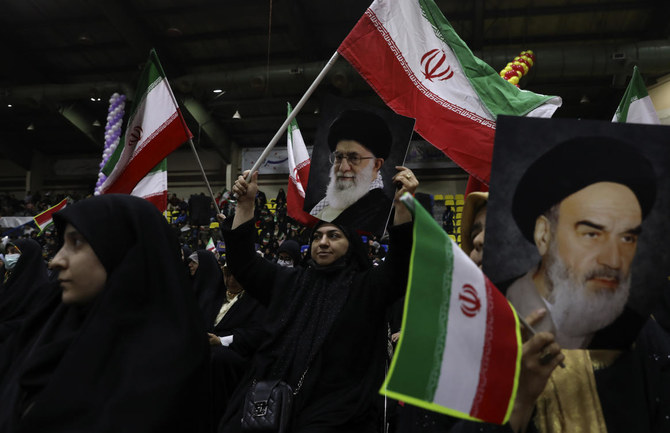
Iran election seen as legitimacy test for rulers as dissent grows
- Iran’s Supreme Leader Ayatollah Ali Khamenei called voting a religious duty
- Parliament has no major influence on foreign policy or Iran’s nuclear agenda
Latest updates


© 2026 SAUDI RESEARCH & PUBLISHING COMPANY, All Rights Reserved And subject to Terms of Use Agreement.