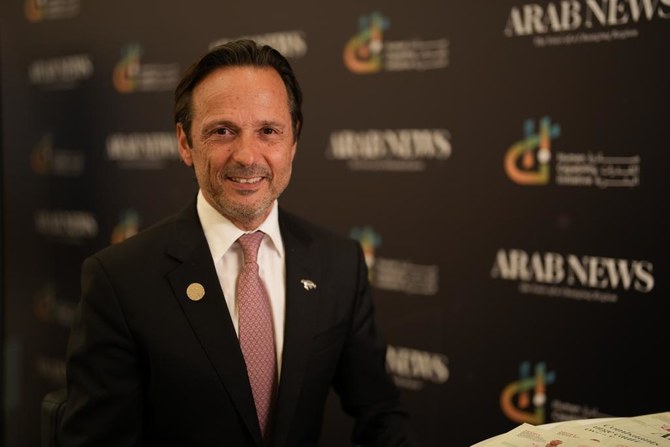

RIYADH: Young Saudis will soon receive further qualifications in terms of technical specializations as the Red Sea National Academy launches, according to the group CEO.
In an interview with Arab News on the sidelines of the Human Capability Initiative in Riyadh, John Pagano explained that as the entity advances tourism destinations in the Red Sea and Amaala, there will be a requirement for additional participants within the industry to meet the demands of the labor market.
This aligns with the Saudi Vision 2030 goal of ensuring that the Kingdom’s citizens have the capabilities to compete globally by instilling values, developing basic and future skills, and enhancing knowledge.
“The industry needs 1.2 million new participants to help deliver this new industry, this new, exciting and important industry from an economic point of view, from a diversification point of view,” Pagano said.
“We’ve decided that we need to provide the opportunities to train and upskill these young Saudis in an environment that is relevant to where they’re going to ultimately work,” the CEO added.
He went on to say that the initiative will work on training a couple of thousand students per year, all of whom will ultimately graduate and get jobs within the Red Sea and Amaala projects.
In terms of location, Pagano disclosed that the newly inaugurated academy will reside in Al-Wajh, which sits between the Red Sea and Amaala.
“It’ll become a hub for not only our training but also as a community center, where we’re going to continue to provide English language courses for the local population to, again, give them opportunities to find new jobs within this new burgeoning industry,” the CEO said.
He clarified that the group will often bring in specialist providers to conduct the training. In some cases, the group will be doing the training directly themselves.
“Our preference and our priority would be to give local community residents, you know, a priority if they’re interested in are willing to take on, you know, that burden of going through the training. But ultimately, it’s open for all nationalities that will ultimately work within the destination,” Pagano noted.
Speaking during a session titled “Developing Human Capabilities – The Power of Tourism,” the CEO explained how the entity plans to propel the local community further.
“Our first class of vocational students, 430 of them, graduated last July. Almost 40 percent of them came from our local communities on the West Coast and that’s because we aim to benefit those communities where opportunities for advancement have historically been scarce,” he clarified.
“Our program in airport services is the first of its kind in the nation. We’re also the first in the country to provide vocational training and tourism security. We already have 400 students enrolled and they’re on track to graduate next year, again in time for opening up our resorts,” he also underlined.
“In total, more than 1,300 talents are either studying in our programs or have already graduated from them. And these numbers will add up quickly. By 2030, we expect to have graduated 10,000 vocational students,” Pagano said in his speech.
With regards to the performance of the group in general, the CEO highlighted during the interview with Arab News that: “Last year and into the beginning of this year has been a pivotal, momentous period for us, a milestone.”
This comes as Red Sea has recently opened its first two resorts, including The Six Senses Southern Dunes and the Saint Regis Red Sea Resort. By the end of this year, the group intends to launch four additional resorts, he disclosed.
“Meanwhile, we’re busy working on 19 other resorts, 11 at Red Sea and eight at Amaala, all of which are going to open next year,” Pagano revealed.
In terms of operations, the CEO said: “We’re open for business today. The airport is running. So, we have eight flights a week in and out of the Red Sea direct.”
That said, the destination is currently receiving guests regularly from the local and regional market, including Europeans as well, he added.
“So, we’re in that capacity-building mode where people are now starting to learn about the destination,” Pagano concluded.
HCI is the first-ever global cooperative platform designed to unify international efforts and enrich the global dialogue on the challenges and opportunities for developing human capabilities.
According to the HCI website, the two-day event will explore opportunities in various areas, including skill development, the future of work, education, talent, and technology.
It will bring together policymakers, thought leaders, investors, and entrepreneurs to catalyze international collaboration. It also caters to participants who want to maximize resilience, explore opportunities, and promote innovative policy design and solutions.