

Brazil urges ‘new globalization’ at G20 meet overshadowed by Ukraine

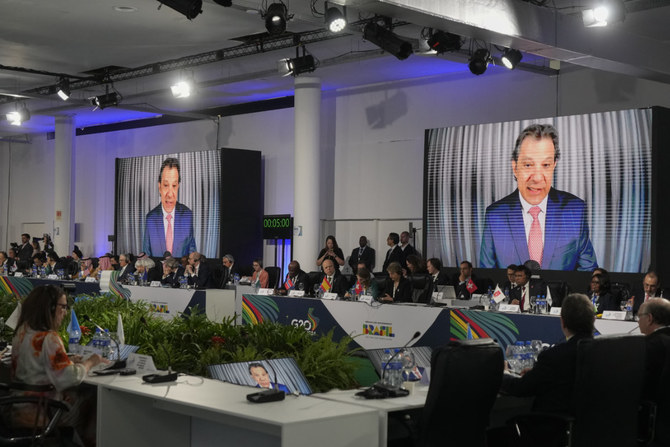
Brazilian Finance Minister Fernando Haddad is projected on a screen as he addresses the G20 Finance Ministers and Central Bank Governors meetings in Sao Paulo, Brazil, on Feb. 28, 2024. (AP Photo)
Short Url
Updated 29 February 2024
Follow

Brazil urges ‘new globalization’ at G20 meet overshadowed by Ukraine

  • FM Haddad: We need to create incentives to ensure international capital flows are no longer decided by immediate profit but by social and environmental principles
  • Founded in 1999, the G20 accounts for more than 80 percent of global GDP, three-quarters of world trade, and two-thirds of the world’s population

SAO PAULO: Brazil called for a “new globalization” to address poverty and climate change as finance ministers from the world’s top economies met Wednesday, but the Ukraine and Gaza wars risked overshadowing the plea.

“It is time to redefine globalization,” Brazilian Finance Minister Fernando Haddad told his counterparts from the Group of 20 leading economies, opening their first meeting of the year in Sao Paulo.
“We need to create incentives to ensure international capital flows are no longer decided by immediate profit but by social and environmental principles,” said Haddad, who gave his speech remotely after coming down with Covid-19.
The meeting, which follows one by foreign ministers in Rio de Janeiro last week, will lay the economic policy groundwork for the annual G20 leaders’ summit, to be held in Rio in November.
Brazilian officials said they were working on a compact final statement that would steer clear of divisive issues such as the Ukraine and Gaza wars.
“We know the world is going through a tense geopolitical moment,” said finance ministry executive secretary Dario Durigan.
But “there’s consensus on the economic issues,” he told journalists. “The whole world speaks the same economic language.”

Brazilian President Luiz Inacio Lula da Silva wants to use the rotating G20 presidency this year to push issues like the fights against poverty and climate change, reducing the crushing debt burdens of low-income nations, and giving developing countries more say at institutions like the United Nations.
International Monetary Fund chief Kristalina Georgieva called for bolder climate action, urging countries to accelerate emissions cuts, end fossil fuel subsidies — which reached an estimated $1.3 trillion worldwide last year — and massively mobilize climate financing.
“The climate crisis is already upon us, and we have to admit we have been a bit slow to address it,” she said at a panel discussion on the sidelines of the meeting.
Also on the agenda: increasing taxes on corporations and the super-rich.
“We need to ensure the billionaires of the world pay their fair share of taxes,” said Haddad.
French Finance Minister Bruno Le Maire backed that call, telling journalists that Paris is pushing to “accelerate” international negotiations on a minimum tax on the ultra-wealthy.
However, Durigan said the issue was unlikely to make it into the final statement.

Even before the meeting opened, the conflict in Ukraine took center stage.
The Group of Seven countries — Britain, Canada, France, Germany, Italy, Japan and the United States, plus the European Union — held their own meeting on the sidelines to discuss shoring up Western support for Kyiv.
Officials said the meeting — attended remotely by Ukrainian Finance Minister Serhiy Marchenko — focused on proposals to seize an estimated $397 billion in Russian assets frozen by the West.
US Treasury Secretary Janet Yellen said Tuesday the issue was “urgent.”
But there were divisions among G7 members.
“I want to be very clear: We don’t have the legal basis for seizing the Russian assets now. We need to work further... The G7 must act abiding by the rule of law,” said France’s Le Maire.
Ukraine has warned it is in dire need of more military and financial assistance, with a fresh $60 billion US package stalled in Congress.
The war in Gaza was also a recurring theme, amid fears Israel’s offensive against Palestinian militant group Hamas could spiral into a wider war, with potentially catastrophic effects for the global economy.
Both conflicts could overshadow Brazil’s bid to use the G20 to amplify the voice of the global south.
“It’s a very tricky global context at the moment,” said Julia Thomson, an analyst at Eurasia Group.
“The international agenda will probably hinder part of Brazil’s ability to advance on some of the broader themes” of its G20 presidency, she told AFP.
Founded in 1999, the G20 accounts for more than 80 percent of global gross domestic product (GDP), three-quarters of world trade, and two-thirds of the world’s population.
It has 21 members: 19 of the world’s biggest economies, plus the EU and, participating as a member for the first time this year, the African Union.


Greenland prepares next generation for mining future

Updated 8 sec ago
Follow

Greenland prepares next generation for mining future

SISIMIUT: At the Greenland School of Minerals and Petroleum, a dozen students in hi-viz vests and helmets are out for the day learning to operate bulldozers, dump trucks, excavators and other equipment.
The Greenlandic government is counting on this generation to help fulfill its dream of a lucrative mining future for the vast Arctic territory coveted by US President Donald Trump.
Founded in 2008, the school, based in El-Sisimiut in the southwest of the island, offers students from across Greenland a three-year post-secondary vocational training.
Apart from their practical classes, the students, aged 18 to 35, also learn the basics of geology, rock mechanics, maths and English.
Teacher Kim Heilmann keeps a watchful eye on his students as they learn to maneuver the heavy equipment.
“I want them to know it’s possible to mine in Greenland if you do it the right way,” he told AFP.
“But mostly the challenge is to make them motivated about mining,” he added.
The remote location of Greenland’s two operational mines, and the ensuing isolation, puts many people off, the school’s director Emilie Olsen Skjelsager said.
A Danish autonomous territory, Greenland gained control over its raw materials and minerals in 2009.
The local government relies heavily on Danish subsidies to complement its revenues from fishing, and is hoping that mining and tourism will bring it financial independence in the future so that it can someday cut ties with Denmark.
“The school was created because there is hope for more activities in mining, but also to have more skilled workers in Greenland for heavy machine operating and drilling and blasting, and exploration services,” Olsen Skjelsager said.
By the end of their studies, some of the students — “a small number, maybe up to five” — will go on to work in the mines.
The rest will work on construction sites.

- Lack of skills -

Greenland is home to 57,000 people, and has historically relied on foreign workers to develop mining projects due to a lack of local know-how.
“We have some good people that can go out mining and blasting and drilling and all that kind of stuff,” explained Deputy Minister of Minerals Resources, Jorgen T Hammeken-Holm.
“But if you have a production facility close to the mining facility, then you need some technical skills in these processing facilities,” he said.
“There is a lack of educated people to do that.”
Going forward, geologists, engineers and economists will be needed, especially as Greenland’s traditional livelihoods of hunting and fishing are expected to gradually die out as professions.
The students’ tuition is paid by the Greenland government, which also gives them a monthly stipend of around 5,000 kroner ($800).
Inside the school, a glass case displays some of the minerals that lie — or are believed to lie — under Greenland, including cryolite, anorthosite and eudialyte, which contains rare earth elements essential to the green and digital transitions.
“New mine sites have been searched (for) all over Greenland,” said Angerla Berthelsen, a 30-year-old student who hopes to find a job in the mining sector one day.
There are “lots of possibilities” in Greenland, he said, sounding an optimistic note.

- Doubts over deposits -

But questions remain about Greenland’s actual resources, with the existence and size of the deposits still to be confirmed.
According to the Geological Survey of Denmark and Greenland (GEUS), Greenland is home to 24 of the 34 critical raw materials identified by the EU as essential for the green and digital transitions.
“A large variety of geological terrains exists, which have been formed by many different processes. As a result, Greenland has several types of metals, minerals and gemstones,” it says in a document on its website.
“However, only in a few cases have the occurrences been thoroughly quantified, which is a prerequisite for classifying them as actual deposits,” it stressed.
Deputy minister Hammeken-Holm said it was “more or less a guess” for now.
“Nobody knows actually.”
In addition, the island — with its harsh Arctic climate and no roads connecting its towns — currently doesn’t have the infrastructure needed for large-scale mining.
There are currently only two operational mines on the island — one gold mine in the south, and one for anorthosite, a rock containing titanium, on the west coast.