

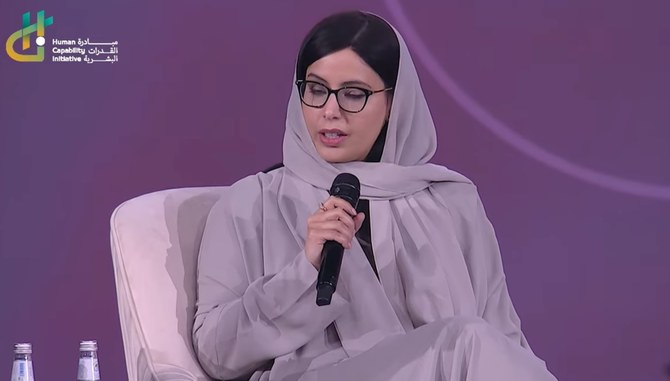

RIYADH: Economic development, conflict resolution, and future resilience are all rooted in cross-border human capital readiness, a panel of experts claimed during the Human Capability Initiative in Riyadh.
As the global community grapples with an ever-growing climate crisis, geopolitical tensions, and an imminent “fourth” industrial revolution, Saudi Arabia’s Permanent Representative to the EU, Haifa Al-Jedea, emphasized the need for accelerated access to essential human capital.
For this to happen at the required scale and speed, she affirmed the necessity for multilateral efforts involving governments, multinational entities, and the private sector.
Al-Jedea raised questions about whether sufficient investment and attention are being directed toward human capital within the existing global systems. She highlighted that the current frameworks may fall short in addressing future global challenges.
She said: “Are we using the same priorities that are being applied in the private sector to UN organizations in our peace efforts? Are we investing in the same way that we are in our war efforts toward peace that includes human capability development, but also the application of different kinds of tech?”
Al-Jedea said she echoed the need to adapt international organizations to focus on future skills, adding: “The system that is created today was created in the post-World War II environment. Are we ready? As the UN, as the European Union, as any other international organization, together with governments, are we ready to tackle future issues? Do we have the human capabilities within our organizations and governments to be able to tackle these future challenges?”
A recent report on the prosperity of nations revealed that about 80 percent of a country’s wealth is generated from human capital, as stated by Fadia Saadah, the World Bank’s regional director of human development in the Middle East and North Africa.
In less developed nations, this figure decreases to around 40 percent, as outlined by Saadah, thus affirming that in order to advance development, more specifically inclusive development, “we cannot do so without the adequate human capital.”
At the core of building the necessary talent, is a grassroots approach, she noted, saying: “Whenever we talk about human capital, you really have to work with local institutions and with local capacity. I prefer to say unleashing the capacity rather than building it because I think there’s a lot of capacity that sometimes we just need to direct it and invest in it. So working and joining hands with local institutions is critical for any initiative that’s looking at human capital.”
The World Economic Forum’s managing director Saadia Zahidi, speaking alongside Saadah, highlighted the organization’s efforts to implement concrete examples of localized re-skilling and up-skilling.
These initiatives aim to serve as scalable models on a global level, addressing the human capital deficit.
Among them is the “reskilling revolution” initiative, which seeks to better educate and train a billion people over the span of 10 years, with a target of completion by 2030, Zahidi said.
“In 20 countries, we have helped set up education, skills, and jobs accelerators. And together, this set of work has already reached 600 million people, well ahead of the target that we had set for ourselves. So, I believe, at least, that it’s very possible, from the experiments that we’ve done so far, that we can actually surface the best-in-class knowledge and get countries to put some of these in place,” she added.
Managing the vast array of transitions that the world is witnessing in an equitable manner requires an inclusive approach that “makes people feel like they are participating in economic opportunities in the world,” said Kai Roemmelt, the CEO of Udacity, while speaking on the panel.
He attributed much of the tensions witnessed in many communities — whether terrorism, extremism, or poverty — to a lack of equal access. Roemmelt praised the technological surge of the fourth industrial revolution as an asset, rather than a detriment to human capacity building.
“So, we need to make sure that that we give people access to opportunity, and I think AI and online learning are ways to do that. There are a lot of programs; we have a program that we do together with Google for Palestine. We have programs for underprivileged youth in many parts of the world. And I believe that allows people equal access to these opportunities, regardless of where they are, regardless of whether they are in a city in a rural area,” he said.


