

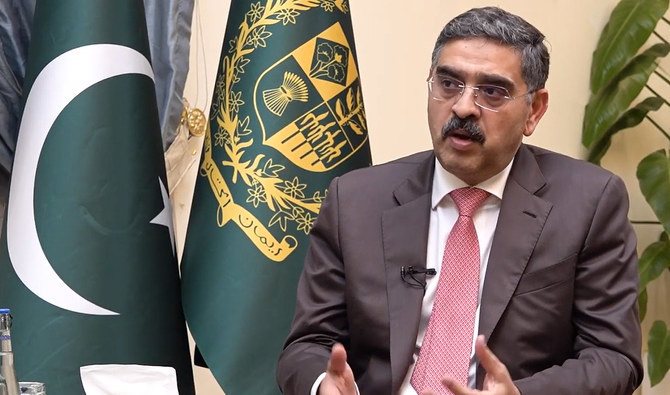
PM denies state responsibility for Baloch missing persons during Islamabad court appearance 

In this screengrab taken from WE News's YouTube page on October 12, 2023, Pakistani interim prime minister Anwaar-ul-Haq Kakar speaks during an interview with an online publication, WE News, in Islamabad. (WE News/File)
Short Url
Updated 28 February 2024
Follow

PM denies state responsibility for Baloch missing persons during Islamabad court appearance 

  • Pakistan’s army, intelligence agencies deny carrying out enforced disappearances
  • Balochistan province is the site of a decades long low-level separatist insurgency 

ISLAMABAD: Caretaker Prime Minister Anwaar-ul-Haq Kakar said on Wednesday the Pakistani state was not responsible for enforced disappearances, a recurring problem that is often blamed on security agencies in the country’s impoverished southwestern Balochistan province.

The prime minister issued the statement during an appearance before the Islamabad High Court in connection with a case regarding Baloch missing students.

Balochistan has long been plagued by enforced disappearances, with families saying men are picked up by security forces, disappear often for years, and are sometimes found dead, with no official explanation. Pakistan’s military and intelligence agencies deny they carry out enforced disappearances.

Separatist groups like the Baloch Liberation Army (BLA), the most prominent of several separatist groups operating Balochistan, have been fighting a decades long insurgency for independence for mountainous and mineral-rich Balochistan, Pakistan’s largest province by territory but the smallest in terms of population. Rights activists, political leaders and families say the insurgency has been used as a pretext to pick up innocent civilians, which the state denies. 

“It is not correct to consider the entire state guilty [for enforced disappearances in Balochistan],” Kakar was widely quoted by local media as telling the court, castigating state critics for not holding separatists and militants responsible when they killed innocent civilians and security officials. 

Balochistan borders Afghanistan to the north, Iran to the west and has a long coastline on the Arabian Sea. It has Pakistan’s largest natural gas field and is believed to hold many more undiscovered reserves. It is also rich in precious metals including gold, the production of which has grown over recent years.

Balochistan is a key location in China’s huge multi-billion China Pakistan Economic Corridor (CPEC), part of President Xi Jinping’s massive Belt and Road infrastructure initiative. Though separatists mostly target Pakistani security forces and state installations in Balochistan, they have also attacked Chinese workers and projects. 

In a rare statement on the issue in 2019, the military sympathized with families of missing Balochs but said some may have joined militant groups and “not every person missing is attributable to the state.”

Pakistan has repeatedly blamed India for fanning militancy in Balochistan, a charge New Delhi denies. 


Pakistan says CPEC has helped bridge cultural and language barriers with China

Updated 10 sec ago
Follow

Pakistan says CPEC has helped bridge cultural and language barriers with China

  • Ataullah Tarar suggests Pakistan-China digital platform to counter ‘disinformation’ around CPEC
  • People-to-people ties have remained limited between the two states despite strong official relations

ISLAMABAD: Federal Minister for Information and Broadcasting Ataullah Tarar said on Wednesday the China-Pakistan Economic Corridor (CPEC) has brought about a “cultural change,” helping break barriers of language and bringing the two countries closer together.

Pakistan and China have longstanding strategic relations, though much of their interactions have traditionally occurred at the government-to-government level through diplomatic, strategic and economic engagements. People-to-people ties between them have mostly remained limited, though the Pakistani minister said there was a gradual shift in the trend in the wake of the multibillion-dollar economic, infrastructure development and regional connectivity initiative.

Launched in 2015, CPEC includes investments in energy, transport, and industrial zones, and has since become a cornerstone of bilateral ties and Pakistan’s long-term development strategy.

“CPEC in Pakistan has broken a lot of barriers. It has broken the barrier of language, and it has broken the barriers of division. It has brought harmony,” Tarar said while addressing a ceremony organized by the Pakistan-China Institute, a local think tank.

“This corridor brought about a cultural change where we had investments coming in, where we had infrastructure being built, where we had industry being built, where we had airports and seaports being developed.”

He said it was “heartening” to see cultural change in Pakistan, such as a Chinese citizen speaking fluent Urdu or a Pakistani citizen speaking Mandarin.

Tarar said the cultural shift had become part of Pakistan’s ethos as the two countries move forward, describing Chinese President Xi Jinping’s 2015 visit as a turning point in reviving the economy.

He also maintained CPEC was targeted by a disinformation campaign, suggesting a digital media platform between Pakistan and China to counter the problem.

“I would suggest that maybe the Pakistan-China Institute can come up with a digital media platform to call out fake news and to label fake news circulating around CPEC,” he said, adding the government would fully support the endeavor.

“I think that will go a long way in not only strengthening the media cooperation but also in getting rid of misinformation and stating the correct facts in a very timely manner,” he added.

Tarar said the initiative will help promote a positive narrative around CPEC 2.0, referring to the next phase of the initiative that aims to focus on industrial development in Pakistan.