



KARACHI: The Sindh Police Museum in the southern Pakistani city of Karachi is housed inside a single-story colonial-era building chock-full of rare artifacts like photos, uniforms, swords and guns that tell the story of the evolution of the provincial police force since when it was first set up in 1843.
The building, itself built in 1865, was turned into a museum in 2019. The photo gallery offers a visual journey into the history of Sindh Police, showing historical events like the guard-of-honor presented to the founder and first governor-general of Pakistan, Muhammad Ali Jinnah. The artifacts section showcases police uniforms from different eras as well as swords, vintage communications equipment, medals and ceremonial shields as well as important and interesting orders from General Sir Charles James Napier, the British governor of Sindh.
One name that repeatedly shows up during a tour of the museum is that of Edward Charles Martson, who was appointed by Sir Napier and served as the head of Sindh Police from 1848 to 1872, transforming it into a model department for other regions in the British-ruled Indian subcontinent.
Creating this museum collection has not been easy, said Shamim Ahmed, the in-charge of the museum.
“We had to search for relatives or descendants of [former] police officers, we searched for them and collected [these things],” he told Arab News in an interview this week. “The documents and files as well as the weapons were collected the same way.”
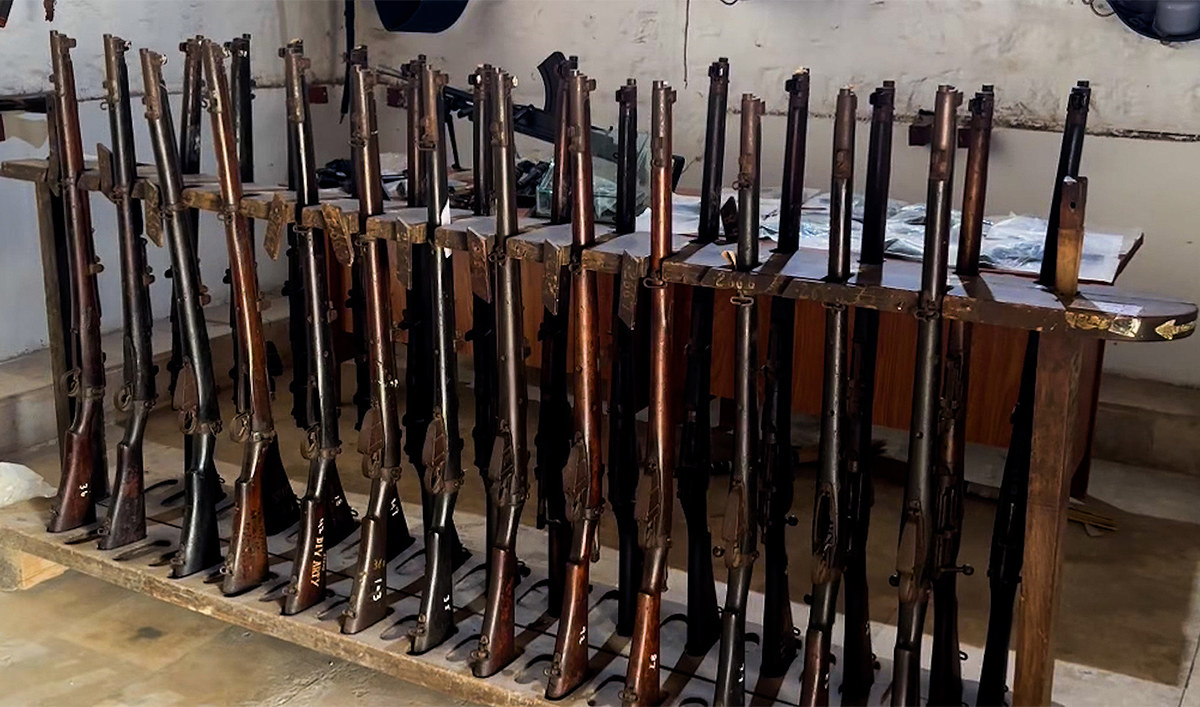
Old guns used by Sindh Police on display at the Sindh Police Museum in Karachi, Pakistan, on February 26, 2024. (AN photo)
Work on the project was started in 2010 by then Karachi police chief Saud Mirza and his team who sifted through the provincial archives department for almost a year to find important documents relating to the police department, according to the museum in-charge.
“What you’ve seen isn’t complete yet,” he told Arab News. “There are still some sections that we need to develop further.”
For now, the museum offers a glimpse into the history of the mounted and rural police force that helped maintain order in rural parts of Sindh as well as of the city police unit that now manages Karachi, the provincial capital and commercial hub of Pakistan.
One of the most interesting aspects of the display are colonial-era police reports written in the local Sindhi language. One, dated Jan. 3, 1883, narrates the tale of Umar Jaro, a resident of Sindh’s Thatta district, whose cherished cow was stolen and who rallied a seasoned tracker, locally called ‘jhogi’ or ‘puggy,’ and teamed up with Constable Bachal Shah of the British-era Sindh Police to track the culprit’s footprints and finally nail him at a house near Hyderabad.
Zulfiqar Rashidi, a former member of the core team that worked on the museum project, said British police officers deputed in Sindh had to pass a compulsory Sindhi language exam to show that they would be able to successfully police the area where people mostly communicated in the native language.
While the provincial police have modernized and received new weapons and training to combat crime, the language used in official documents remains the same, Rashidi said.
“The columns of the FIR [first information report], whether old or new, show no significant changes. Look at the terms like location of incident, reporting time, time of occurrence, number of people involved, what was stolen, all these elements have remained consistent throughout,” Rashidi said, comparing Jaro’s 1883 police report with recent ones.
“Since our Sindh Police has a history, and quite an old one, all the records and information about the police, from the past to the present, have been gathered,” museum in-charge Ahmed said as he turned the pages of a compilation of old police documents.
“If we didn’t preserve them by establishing a police museum, all these things would have been lost in 20-25 years. No one would have any knowledge about these things.”


