

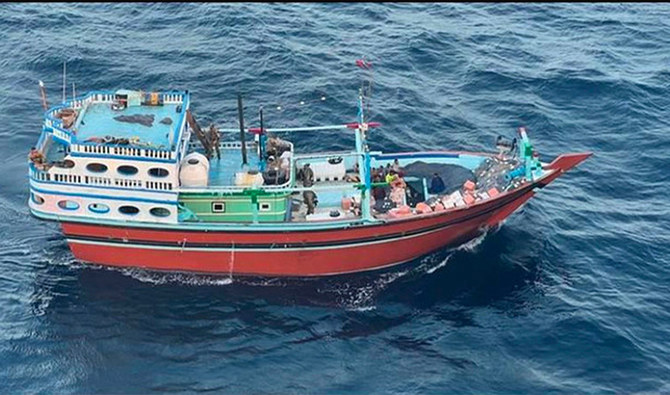

RICHMOND: A Pakistani national who US officials say was the captain of a ship carrying Iranian-made missile components to Houthi rebels in Yemen was ordered Tuesday to remain behind bars as he awaits trial on charges of attempting to smuggle a warhead and other weapons, and lying to US Coast Guard officers as they boarded the boat.
Two Navy SEALs drowned while boarding the unflagged vessel in the Arabian Sea on Jan. 11 in the wake of continued Houthi attacks on commercial and military ships in the Red Sea and the Gulf of Aden.
In court documents, federal prosecutors said the boat’s captain, Muhammad Pahlawan, refused to slow the ship when the US Navy began its boarding attempt and “shouted for the crew to burn the boat before the Navy could board it.”
The ship was described as a dhow.
“Rather than turn the engine off, however, Pahlawan told crewmembers not to stop the dhow while the Navy was approaching,” court documents stated. “In fact, Pahlawan tried to make the dhow go faster. Finally, another crewmember, not Pahlawan, stepped up to the engine and stopped the boat.”
US officials said Navy Special Warfare Operator 1st Class Christopher J. Chambers slipped into the gap created by high waves between the vessel and the SEALs’ combatant craft.
As Chambers fell, Navy Special Warfare Operator 2nd Class Nathan Gage Ingram jumped in to try to save him, according to US officials familiar with what happened. The SEAL who jumped in after the other operator in a rescue attempt was following protocol, according to court documents.
Efforts to find and rescue the two SEALs were unsuccessful and they were later declared dead by the Navy.
During a detention hearing in US District Court in Richmond, Virginia, on Tuesday, FBI Special Agent Lauren Lee testified that Pahlawan initially said he was the boat’s engineer and that the captain had gotten off the ship. He also said he was not aware of any cargo on the ship, Lee said. She said he later contradicted himself, saying, “I am in command of the boat.”
Assistant US Attorney Troy Edwards Jr. argued that Pahlawan should remain in custody pending trial because he is a danger to the community and poses a serious risk of flight. Edwards said Pahlawan has no ties to the US and that the most serious charge against him — intentionally transporting a warhead knowing it would be used by Houthi rebel forces — constitutes a federal crime of terrorism and carries a maximum prison sentence of 20 years.
The charge of making material false statements carries a maximum of five years in prison.
Pahlawan’s attorney, Assistant Supervisory Federal Public Defender Amy Austin, suggested that the interpreter used by US officials when they were questioning crew members on the boat may not have spoken Punjabi, Pahlawan’s language. Lee said she did not know which language the interpreter spoke, but she said Pahlawan answered questions posed to him by the interpreter during sometimes hours-long interviews.
During a search of the ship, US forces found and seized Iranian-made advanced conventional weaponry, including critical parts for medium-range ballistic missiles and anti-ship cruise missiles, a warhead, and propulsion and guidance components, an FBI agent wrote in an affidavit. The agent said the items found are consistent with weaponry used by Houthi rebel forces in recent attacks on merchant ships and US military ships.
The affidavit quoted US Central Command, which stated that it was the first seizure of “Iranian-supplied advanced conventional weapons” to the Houthis since their strikes began in November.
The rebels have repeatedly targeted ships in the Red Sea and surrounding waters over Israel’s war against Hamas in the Gaza Strip. They have frequently targeted vessels with tenuous or no clear links to Israel, imperiling shipping in a key route for trade among Asia, the Mideast and Europe.
Three other crew members were charged with providing false information to US Coast Guard officers. They were also ordered detained following detention hearings Tuesday.
Specifically, the men lied about Pahlawan’s identity as captain, the weapons on board and the ship’s departure from Iran, court documents stated. The men had claimed their voyage’s origin was Pakistan.
Their attorneys have declined to comment.
Another 10 crew members are being detained under the federal material witness law. It allows courts to issue warrants for the arrest and detention of a person if their testimony is “material in a criminal proceeding,” and if it “may become impracticable to secure the presence of the person by subpoena.”
The FBI affidavit states that crew members had been in contact multiple times by satellite phone with a member of Iran’s paramilitary Revolutionary Guard.


