WARSAW: Polish Prime Minister Donald Tusk said on Tuesday he could not rule out widening a national ban on imports of Ukrainian grains to other products if the European Union does not act to protect the bloc’s markets.
Tusk made the remarks during a visit to Prague as thousands of Polish farmers took to the streets of Warsaw, carrying the national flag and blowing handheld horns, escalating a protest against food imports from Ukraine and EU green rules.
Farmers across Europe have been protesting for weeks against constraints placed on them by the EU’s “Green Deal” regulations meant to tackle climate change, as well as rising costs and what they say is unfair competition from outside the EU, particularly Ukraine.
The EU in 2022 waived duties on Ukrainian food imports following Russia’s invasion of Ukraine.
Poland last year extended a ban on Ukrainian grain imports.
“We are talking about it with the Ukrainian side — that it will be necessary to expand the embargo to other products if the European Union does not find more effective ways to protect the European and Polish markets,” Tusk said on Tuesday.
Polish Agriculture Minister Czeslaw Siekierski said in a Tuesday evening interview on Polsat News TV that further talks with Ukraine on solutions were planned for Wednesday and various possibilities were being considered.
“Tomorrow we will also talk about it with Ukraine’s minister of economy, who will be a guest at the Ministry of Development and New Technologies,” he said, adding that he would be participating.
He said Polish farmers were invited to the agriculture ministry for talks on Thursday.
Speaking after Siekierski on Polsat News, protest organizer Szczepan Wojcik said the invitation was welcome, but warned of more protests if no progress was made during the next few days.
“Further protests in Warsaw have already been announced for March 6. Farmers are already organizing on the roads, and border crossings will continue to be blocked,” he said.
Asked about the possibility of further escalation, Wojcik said, “The farmers are desperate. ... The ball is in the government’s court.”
Earlier in the day, Tusk said the EU had to solve the problems created by its decision to open its borders to imports of Ukrainian food products.
He added that Poland was ready to co-finance purchases of Polish, European and Ukrainian food and agricultural products to be sent as humanitarian aid to famine-stricken countries, and that “Europe should certainly find funds for this.”
Back home, farmers rallied in central Warsaw before marching toward parliament and then Tusk’s office. A city hall official cited by PAP state news agency put the number of protesters around 10,000.
“We are protesting because we want the ‘green deal’ to be lifted, as it will lead our farms to bankruptcy with its costs...that are not comparable to what we harvest and to what we are paid,” said Kamil Wojciechowski, 31, a farmer from Izbica Kujawska in central Poland.
“What we’re paid for our work, it has decreased because of the influx of grain from Ukraine and this is our second demand — to block the influx of grain from Ukraine,” he said.
The farmers began a series of protests throughout the country earlier this month, which included a near-total blockade of all Ukrainian border crossings, as well as disruptions at ports and on roads nationwide.
“We won’t give up. We have no choice. Our farms will go bankrupt, we will lose our livelihoods,” Pawel Walkowiak, 47, a corn and wheat producer from Konarzewo in western Poland, said.
The city hall official said Tuesday’s protest in Warsaw took place without major incidents.


Poland mulls wider ban on Ukrainian food imports as farmers warn of more protests

https://arab.news/yjrs2
Poland mulls wider ban on Ukrainian food imports as farmers warn of more protests

- Tusk made the remarks during a visit to Prague as thousands of Polish farmers took to the streets of Warsaw, escalating a protest against food imports from Ukraine and EU green rules
- Poland last year extended a ban on Ukrainian grain imports


Zelensky says Russia preparing for new ‘year of war’
- Putin earlier said Russia would achieve its goals in its Ukraine offensive, including seizing Ukrainian territories it claims as its own
KYIV, Ukraine: Ukrainian President Volodymyr Zelensky said Wednesday Russia was preparing to wage a new “year of war” on his country in 2026, after his counterpart Vladimir Putin said Moscow would “certainly” achieve its objectives.
“Today, we heard yet another signal from Moscow that they are preparing to make next year a year of war,” Zelensky said in his regular evening address.
The statement was a reaction to Putin, who earlier said Russia would achieve its goals in its Ukraine offensive, including seizing Ukrainian territories it claims as its own, amid a flurry of international diplomacy to end the war.
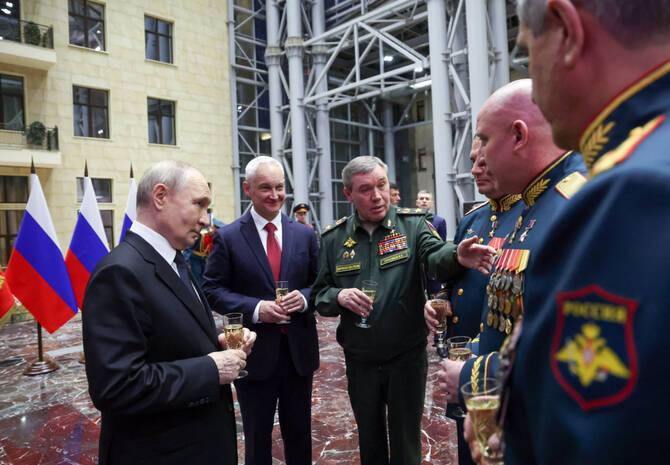
“The goals of the special military operation will certainly be achieved,” Putin told a meeting with defense ministry officials in Moscow, using the Kremlin’s wording for the nearly four-year war.
“We would prefer to do this and eliminate the root causes of the conflict through diplomacy,” he said, vowing to seize the Ukrainian lands Russia claims to have annexed “by military means” if “the opposing country and its foreign patrons refuse to engage in substantive discussions.”
Putin’s hawkish comments come as Ukraine on Monday hailed “progress” made on the question of future security guarantees for Kyiv, after two days of talks with US President Donald Trump’s envoys in Berlin.
But according to Zelensky, differences remain on the question of what territories Ukraine would have to cede to Russia.
Washington’s initial proposal — criticized by Ukraine and its allies as overly favorable to Russia — would have seen Kyiv withdraw from its eastern Donetsk region and the United States de facto recognize the Donetsk, Crimea and Lugansk regions as Russian.
Zelensky at EU summit
The current contents of the revised plan remain unclear.
Earlier on Wednesday, the Kremlin said Russia was waiting for information from the US on the outcome of the talks in Berlin.
“We expect that, as soon as they are ready, our American counterparts will inform us of the results of their work with the Ukrainians and the Europeans,” Kremlin spokesman Dmitry Peskov told reporters.
In September 2022, Russia claimed to have officially annexed the Zaporizhzhia, Donetsk, Lugansk and Kherson regions, even though it did not have full military control over all of them.
Zelensky is expected to attend a summit in Brussels on Thursday to lobby European Union leaders to adopt a plan to use frozen Russian assets to support Ukraine’s defenses.
He said in his evening address that Putin’s bellicose signals “are not only for us.”
“It is important that our partners see this, and important that they not only see it but also respond, including our partners in the United States of America, who often say that Russia supposedly wants to end the war,” he said, accusing Moscow of trying to “undermine diplomacy.”


