

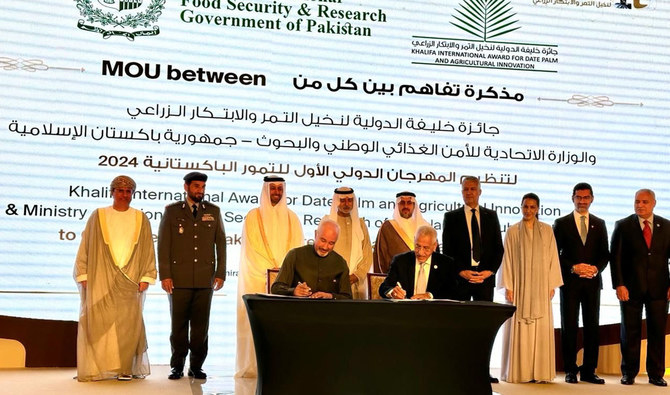
Pakistan, UAE sign agreement for promotion of date palm cultivation

Pakistani ambassador Faisal Niaz Tirmizi (left) and Dr. Abdelouahhab Zaid, (right) General Secretary of the Khalifa International Award for Date Palm and Agricultural Innovation, sign MOU for promotion of Date Palm cultivation in Abu Dhabi, UAE on February 26, 2024. (Photo courtesy: Pakistan mission, UAE)
Short Url
Updated 26 February 2024
Follow

Pakistan, UAE sign agreement for promotion of date palm cultivation

  • The United Arab Emirates is Pakistan’s third-largest trading partner, after China and the United States
  • Under the deal, the UAE will provide technological support to Pakistan to increase date palm cultivation

ISLAMABAD: Pakistan and the United Arab Emirates (UAE) on Monday signed a memorandum of understanding (MoU) to enhance agricultural innovation and research to develop and promote various aspects of date palm cultivation and related industry, Pakistan’s top diplomat to the UAE said.

The UAE is Pakistan’s third-largest trading partner, after China and the United States. Policymakers in Pakistan consider the Gulf state an optimal export destination due to its geographical proximity, which minimizes transportation and freight costs while facilitating commercial transactions. Presently, Pakistan’s primary exports to the UAE include textile products and a variety of food items.

Pakistan’s Ambassador Faisal Niaz Tirmizi and Dr. Abdelouahhab Zaid, general-secretary of the Khalifa International Award for Date Palm and Agricultural Innovation, signed the MoU in Abu Dhabi. The signing ceremony was attended by Sheikh Nahyan bin Mubarak Al Nahyan, the UAE minister of tolerance and coexistence.

“The MoU will help in promoting joint cooperation and sharing of expertise between the two sides,” Tirmizi told Arab News. “It will also provide an opportunity to Pakistani farmers to increase cultivation of date palm including through innovative ideas.”

Being one of the pioneers, the UAE will provide technological support to Pakistan to increase date palm cultivation as Pakistan’s rich topography presents immense potential in the sector, according to the Pakistani ambassador.

Pursuant to the deal, Pakistan will organize its first international date palm festival this year.

“Pakistan and the UAE enjoy fraternal relationship and are engaged on a range of mutually beneficial collaborative projects, including in the realm of political, economic, agricultural, cultural, energy and defense cooperation,” Tirmizi added.


Pakistan to launch AI screening in January to target fake visas, agent networks

Updated 5 sec ago
Follow

Pakistan to launch AI screening in January to target fake visas, agent networks

  • New system to flag forged-document travelers before boarding and pre-verify eligibility
  • Move comes amid increasing concern over fake visas, fraudulent agents, forged papers

ISLAMABAD: Pakistan will roll out an AI-based immigration screening system in Islamabad from January to detect forged documents and prevent illegal overseas travel, the government said on Thursday. 

The move comes amid increasing concern over fake visas, fraudulent agents and forged papers, with officials warning that such activity has contributed to deportations, human smuggling and reputational damage abroad. Pakistan has also faced scrutiny over irregular migration flows and labor-market vulnerability, particularly in the Gulf region, prompting calls for more reliable pre-departure checks and digital verification.

The reforms include plans to make the protector-stamp system — the clearance required for Pakistani citizens seeking overseas employment — “foolproof”, tighten labor-visa documentation, and cancel the passports of deportees to prevent them from securing visas again. The government has sought final recommendations within seven days, signalling a rapid enforcement timeline.

“To stop illegal immigration, an AI-based app pilot project is being launched in Islamabad from January,” Interior Minister Mohsin Naqvi said following a high-level meeting chaired by him and Minister for Overseas Pakistanis Chaudhry Salik Hussain.

Naqvi said the new screening technology is intended to determine travelers’ eligibility in advance, reducing airport off-loads and closing loopholes exploited by traffickers and unregistered agents.

The interior minister added that Pakistan remains in contact with foreign governments to improve the global perception and ranking of the green passport, while a uniform international driving license will be issued through the National Police Bureau.

The meeting also approved zero-tolerance measures against fraudulent visa brokers, while the Overseas Pakistanis Ministry pledged full cooperation to streamline the emigration workflow. Minister Hussain said transparency in the protector process has become a “basic requirement,” particularly for labor-migration cases.

Pakistan’s current immigration system has long struggled with document fraud, with repeated cases of passengers grounded at airports due to forged papers or agent-facilitated travel. The launch of an AI screening layer, if implemented effectively, could shift the burden from manual counters to pre-flight verification, allowing authorities to identify risk profiles before departure rather than after arrival abroad.

The reforms also come at a moment when labor mobility is tightening globally. Gulf states have begun demanding greater documentation assurance for imported labor, while European and Asian destinations have increased scrutiny following trafficking arrests and irregular-entry routes from South Asia. For Pakistan, preventing fraudulent departures is increasingly linked to protecting genuine workers, reducing deportation cycles and stabilizing the country’s overseas employment footprint.