The Taliban hold another public execution as thousands watch at a stadium in northern Afghanistan

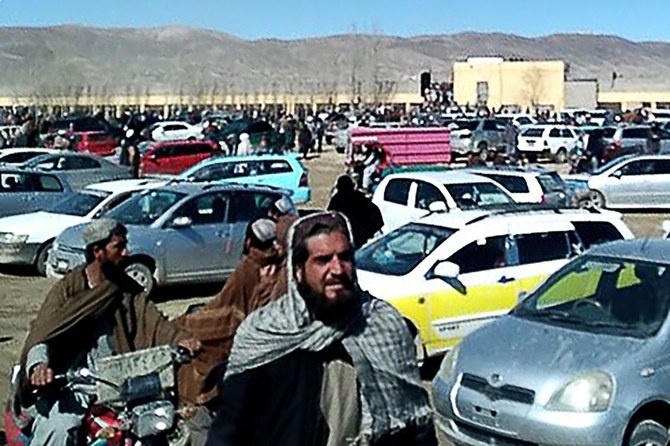
This screen grab from a video taken on January 22, 2024, shows Afghan men leaving a football stadium after attending the public execution by Taliban authorities of two men convicted of murder, in Ghazni. (FILE/AFP)
Short Url
Updated 26 February 2024
Follow

The Taliban hold another public execution as thousands watch at a stadium in northern Afghanistan

  • The execution took place in heavy snowfall in the city of Shibirghan
  • It was also the fifth public execution since the Taliban seized power of Afghanistan in August 2021

ISLAMABAD: The Taliban held a public execution on Monday of a man convicted of murder in northern Afghanistan as thousands watched at a sports stadium, the third such death sentence to be carried out in the past five days.
The execution took place in heavy snowfall in the city of Shibirghan, the capital of northern Jawzjan province, where the brother of the murdered man shot the convict five times with a rifle, according to an eyewitness . Security around the stadium was tight, said the witness, speaking on condition of anonymity because he was not authorized to talk to the media.
It was also the fifth public execution since the Taliban seized power of Afghanistan in August 2021 as the US and NATO troops were in the final weeks of their withdrawal from the country after two decades of war.
The development was ominous as the Taliban, despite initial promises of a more moderate rule, began carrying out severe punishments in public — executions, floggings and stonings — shortly after coming to power. The punishments are similar to those under their previous rule of Afghanistan in the late 1990s.
Taliban government officials were not immediately available for comment.
The statement said Monday’s death sentence was carried out following approval by three of the country’s highest courts and the Taliban supreme leader, Mullah Haibatullah Akhundzada. The executed man, identified as Nazar Mohammad from the district of Bilcheragh in Faryab province, had killed Khal Mohammad, also from Faryab. The killing took place in Jawzjan.
On Thursday in the southeastern Ghazni province, the Taliban executed two men convicted of stabbing their victims to death. Relatives of the victims fired guns at the two men, also at a sports stadium as thousands of people watched.
Separate statements from the Taliban’s supreme court said a man and a woman convicted of adultery were flogged with 35 lashes each in northern Balkh province over the weekend. Two other people were lashed in eastern Laghman province, also over the weekend; they were given each 30 lashes for allegedly committing immoral acts.
The United Nations has strongly criticized the Taliban for carrying out public executions, lashings and stonings since seizing power, and called on the country’s rulers to halt such practices.


New ‘superfood’ transforms livelihoods in India’s rural east

A farmer harvests makhana, or lotus seeds, in Kapchhahi village in India’s eastern state of Bihar. (Mahesh Mukhia)
Updated 08 December 2025
Follow

New ‘superfood’ transforms livelihoods in India’s rural east

  • Known as fox nut or lotus seed, makhana is rich in protein, dietary fiber, minerals
  • Most of the world’s makhana production is in Bihar, one of India’s poorest states

BIHAR: Wading through knee-deep, stagnant water, Mahesh Mukhia plunges his hands into the mud, pulling up handfuls of sludge that he and others toss into a large, partially submerged basket.

After a while, they shake the basket to drain away the water and debris. What remains is makhana — round black seeds that have lately gained popularity as India’s new superfood.

A regional Indian snack, also known as fox nut or lotus seed, makhana is the edible seed of the prickly waterlily. The plant grows in freshwater ponds and wetlands in southern and eastern Asia.

After makhana seeds are handpicked from pond beds, cleaned, and sun-dried, they are roasted at high heat so their hard black shells crack open and release the white, popcorn-like puffed kernels, which are eaten as snacks or used in dishes.

It has long been known for its nutritional value — high in plant-based protein and dietary fiber, the seeds are also rich in minerals and gluten-free — which over the past few years have helped it gain global attention and are transforming farmlands in Bihar, one of India’s poorest states.

“Earlier, people were not researching it but now, after research, makhana’s nutritional values have been highlighted. Now this is a superfood. That’s why demand is growing everywhere,” said Mahesh Mukhia, a farmer in Kapchhahi village in Bihar’s Darbhanga district, whose family has been harvesting the seeds for generations.

“The difference is that my forefathers did farming in a traditional way, but we’ve learnt to do it in a scientific way,” Mukhia told Arab News.

“There is Bhola Paswan Shastri Agricultural College in the neighboring Purnea district. I went there for training. After I started practicing farming the way I learnt, the yield increased by more than 30 percent.”

Makhana farming is highly labor-intensive, starting with the cultivation of water lilies in shallow ponds. The plants require constant monitoring as they are sensitive to water levels and pests.

Harvesting takes place between August and October. Workers pluck the seeds by hand and then dry them under the sun for several days before they can be processed.

The processing and roasting of makhana also require significant effort. The dried seeds are first de-shelled by manually cracking them, followed by multiple rounds of roasting to make them crisp.

Whole families are involved in the production, which has been expanding since 2020, when the state government introduced the Makhana Development Scheme.

Besides training in farming and processing, growers who cultivate fox nut receive $820 per hectare.

“The rate has also gone up. The makhana that we used to sell at 200-300 ($2-$3) rupees per kg is now selling at 1,000 ($12) or 1,500 rupees per kg,” Mukhia said.

“Makhana farmers are now making a profit. Those who are growing makhana are earning well, those who are popping it are also doing well, and those involved in trading are making profits too. We are getting good demand from everywhere. I just received an order for 25 tonnes recently.”

Bihar currently produces over 85 percent of India’s makhana and accounts for most of the world’s production, according to Ministry of Commerce and Industry estimates.

According to reports by the Indian Brand Equity Foundation and the Agricultural and Processed Food Products Export Development Authority, India accounts for roughly 85 to 90 percent of the world’s production.

Farmland where the crop is grown has increased many times over the past decade and can now be compared to the area covering half of New York City.

More than 600,000 people are involved in the makhana industry in Bihar, according to Niraj Kumar Jha, Darbhanga district’s horticulture officer.

“Earlier, we were cultivating 5,000 hectares in the Kosi and Mithlanchal regions. But now it has expanded to 35,000 hectares, and with many supportive schemes, farmers are increasingly encouraged to grow makhana,” he said.

“We are strengthening our marketing channels. We’ll reach the metro cities as well as world markets ... We can see that makhana is growing very popular, not only in India.”