Murad Ali Shah, a Stanford graduate, secures third term as chief minister of Pakistan’s Sindh

1 / 2
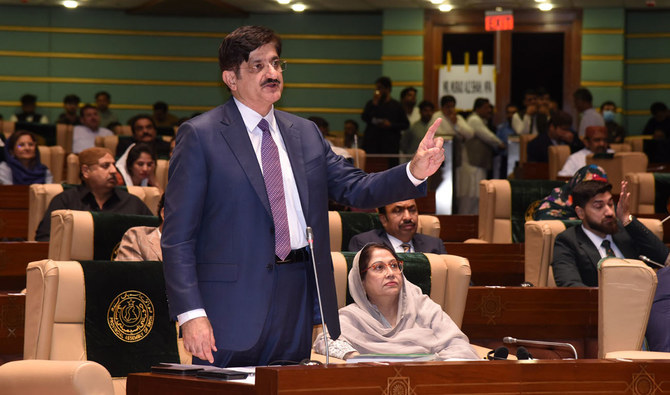
Syed Murad Ali Shah speaks on the assembly floor after being elected the chief minister of Sindh province in Karachi, Pakistan on February 26, 2024. (Photo courtesy: Government of Pakistan)
2 / 2
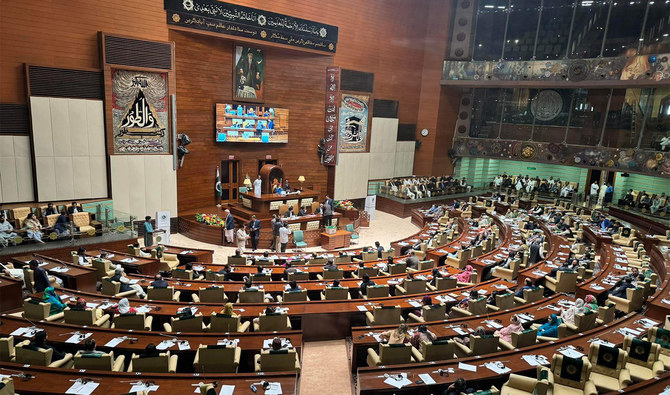
Newly elected members elect speaker and deputy speaker at the provincial legislature of Pakistan's Sindh Assembly in Karachi, Pakistan, on February 25, 2024. (@TalalChandio/File)
Short Url
Updated 26 February 2024
Follow

Murad Ali Shah, a Stanford graduate, secures third term as chief minister of Pakistan’s Sindh

  • Shah was first elected as chief minister in 2016 midterm and in 2018 for a period of five years
  • He bagged 112 votes, while his opponent, Ali Khurshidi, from the MQM-P secured only 36 votes

KARACHI: The provincial assembly in Pakistan’s southern Sindh province elected on Monday Murad Ali Shah, a professional engineer and banker who graduated from Stanford University, as the chief minister of the province for the third term.

Shah, whose father Abdullah Shah also served as the chief minister, was first elected for the top provincial office in 2016, when his party removed veteran politician, Qaim Ali Shah, from the post after criticism over his way of administering the province. In 2018, Shah was again elected as the chief minister after his Pakistan Peoples Party (PPP) won majority in the province. He served on the post until August last year.

In the Feb. 8 national election, the PPP once again bagged the highest 84 provincial seats and nominated Shah as the candidate for CM’s office. In Monday’s election, he secured 112 votes in the 168-member House, while his opponent, Ali Khurshidi, from the Muttahida Qaumi Movement-Pakistan (MQM-P) secured 36 votes.

After being elected as the CM, Shah said he would take along all political parties, including the MQM-P that fielded a candidate against him, and the Jamaat-e-Islami (JI) and ex-PM Khan-led Pakistan Tehreek-e-Insaf (PTI) opposition parties.

“We are never scared of criticism, no one is perfect... if you don’t criticize, then how we will learn,” he said, addressing Khan-backed independent candidates in the House. “I want to thank people on both sides [treasury and opposition] and also the people of this province.”

Shah promised to address the “immediate challenges” of militancy, rampant street crime and bandits hiding in riverine areas of the province, saying it would be a priority of his government.

The newly elected chief minister of Sindh is a seasoned politician with a diverse background in engineering and finance.

Born in the provincial capital of Karachi in August 1962, Shah acquired his early education from the St. Patricks High School and a Bachelor’s degree in Civil Engineering from the NED University of Engineering and Technology. He pursued dual Masters of Science degrees in Civil-Structural Engineering and Engineering Economic Systems from Stanford University in California.

Shah has an extensive experience of working in both public and private sectors in Pakistan, UK, Kuwait, and the US from 1986 to 2002. He worked as an engineer at multiple positions before becoming an investment banker at prestigious institutions like Citibank and the Gulf Investment Corporation.

In 2002, Shah ventured into politics and has since excelled in navigating the tricky arena, winning five provincial assembly elections and holding key provincial portfolios like revenue, irrigation, finance, energy and planning and development.

His election to the CM’s office came two days after the provincial assembly in Sindh held its inaugural session, amid protests by opposition parties over alleged rigging of the election. On Sunday, Shah’s party had Owais Qadir Shah and Anthony Naveed elected as speaker and deputy speaker of the House.



Pakistan PM calls for faster CPEC implementation, pledges security for Chinese workers

Updated 27 February 2026
Follow

Pakistan PM calls for faster CPEC implementation, pledges security for Chinese workers

  • Shehbaz Sharif pushes expanded cooperation in agriculture, IT and mining under CPEC phase two
  • Chinese envoy reaffirms Beijing’s support for Pakistan’s sovereignty and economic development

ISLAMABAD: Prime Minister Shehbaz Sharif on Friday called for speeding up projects under the China-Pakistan Economic Corridor (CPEC) and pledged stronger security guarantees for Chinese workers and investments, during a meeting with China’s ambassador in Islamabad.

Sharif made the remarks as the two countries strive to launch the second phase of CPEC, a multibillion-dollar infrastructure and energy initiative launched in 2015 as part of China’s Belt and Road Initiative (BRI).

CPEC’s first phase focused largely on power generation and transport infrastructure aimed at easing Pakistan’s chronic energy shortages and improving connectivity. The second phase seeks to expand cooperation into industrial development, with an emphasis on special economic zones and export-oriented growth.

“While highlighting the importance of accelerating ongoing CPEC projects, the Prime Minister stressed on the need to enhance cooperation in agriculture and IT and mining & minerals,” said a statement circulated by the PM Office after the meeting.

“He also underscored Pakistan’s resolve to provide a secure and conducive environment for Chinese personnel, investments, and institutions in Pakistan,” it added.

Chinese nationals and projects in Pakistan have faced security threats in the past, including attacks by militant groups targeting infrastructure sites and convoys. Islamabad has repeatedly vowed to tighten security and has deployed special protection units for Chinese workers.

China is Pakistan’s closest ally in the region and a key economic partner, with CPEC widely regarded by Islamabad as central to long-term economic growth.

During the meeting, the prime minister conveyed greetings to Chinese President Xi Jinping and Premier Li Qiang, particularly on the occasion of the Chinese New Year.

China’s Ambassador to Pakistan, Jiang Zaidong, reiterated Beijing’s support for Pakistan’s sovereignty and socioeconomic development, according to the statement. Both sides also exchanged views on regional and international issues and agreed to maintain close coordination.