

Saudi approach toward capital allocation, economic diversification lauded

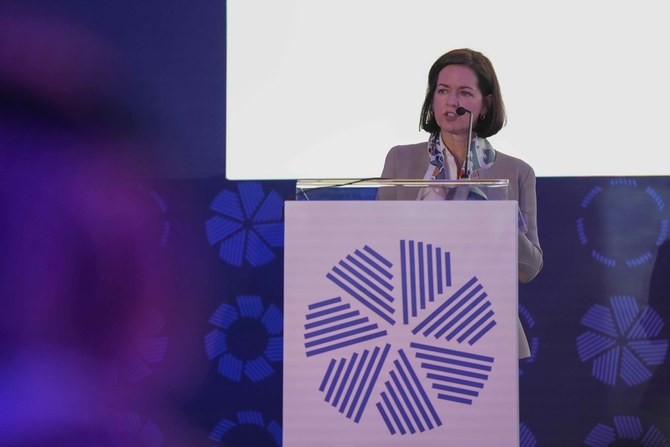
Marg Franklin, president and CEO of CFA Institute, speaks at the Middle East Investment Conference in Riyadh. AN photo by Huda Bashatah
Short Url
Updated 26 February 2024
Follow

Saudi approach toward capital allocation, economic diversification lauded

RIYADH: Saudi Arabia’s general disposition around capital allocation is diversified, as financial institutions in the Kingdom are “savvy and strong” with long-term strategies, according to a senior executive.

In an interview with Arab News on the sidelines of the Middle East Investment Conference held in Riyadh, President and CEO of CFA Institute Marg Franklin noted that Saudi Arabia aims to move away from its heavy reliance on oil by diversifying its investment portfolio.

This diversification plan involves investing in small and medium-sized enterprises within the Kingdom to broaden the economy’s scope.

She said: “If you look at Saudi Arabia’s general disposition around capital allocation, it really centers on diversification, and that is really where we’ve seen the savviest and strongest financial institutions who have a very long-term view and very long-term objectives really achieve those ambitions for the capital.”

Franklin highlighted the importance of asset owners in the Middle East, who prioritize serving their citizens over short-term gains, emphasizing long-term objectives and sustainability in capital allocation.

Additionally, amid Saudi Arabia’s ambitious Vision 2030 program, Franklin noted that the CFA Institute emerges as a key player in shaping the nation’s economic landscape.

With a three-pronged approach focused on education, advocacy, and policy, the institute is instrumental in fostering a robust and well-functioning capital market.

“When we look here in Saudi Arabia, it’s an ambitious program for 2030 and what’s exciting about it is how much it’s related to the population of Saudi, so it really lines up with those last six words of our mission for the ultimate benefit of society,” Franklin said.

She added: “The key things where CFA Institute, I think has a distinct role to play is first of all in developing and enhancing the capital markets, making sure they’re efficient and fair.”

Franklin continued: “Because at the end of the day, when you’re bringing in global capital or exporting global capital, there is a common language that goes with it. But there will be unique features here in the region, specifically Islamic finance.”

The second aspect Franklin highlighted is capacity building and talent development. This includes the renowned CFA program, known for its comprehensive curriculum and ethical foundation, providing a common platform for investment professionals globally.

“Then finally, just building those baseline skills, because we know one of Saudi Arabia’s key objectives is to build financial literacy, and that’s crucial if you’re going to increase the savings of citizens,” Franklin said.


Kuwait to boost Islamic finance with sukuk regulation

Updated 05 February 2026
Follow

Kuwait to boost Islamic finance with sukuk regulation

  • The move supports sustainable financing and is part of Kuwait’s efforts to diversify its oil-dependent economy

RIYADH: Kuwait is planning to introduce legislation to regulate the issuance of sukuk, or Islamic bonds, both domestically and internationally, as part of efforts to support more sustainable financing for the oil-rich Gulf nation, Prime Minister Sheikh Ahmad Abdullah Al-Ahmad Al-Sabah said on Wednesday.

Speaking at the World Governments Summit in Dubai, Al-Sabah highlighted that Kuwait is exploring a variety of debt instruments to diversify its economy. The country has been implementing fiscal reforms aimed at stimulating growth and controlling its budget deficit amid persistently low oil prices. Hydrocarbons continue to dominate Kuwait’s revenue stream, accounting for nearly 90 percent of government income in 2024.

The Gulf Cooperation Council’s debt capital market is projected to exceed $1.25 trillion by 2026, driven by project funding and government initiatives, representing a 13.6 percent expansion, according to Fitch Ratings.

The region is expected to remain one of the largest sources of US dollar-denominated debt and sukuk issuance among emerging markets. Fitch also noted that cross-sector economic diversification, refinancing needs, and deficit funding are key factors behind this growth.

“We are about to approve the first legislation regulating issuance of government sukuk locally and internationally, in accordance with Islamic laws,” Al-Sabah said.

“This enables us to deal with financial challenges flexibly and responsibly, and to plan for medium and long-term finances.”

Kuwait returned to global debt markets last year with strong results, raising $11.25 billion through a three-part bond sale — the country’s first US dollar issuance since 2017 — drawing substantial investor demand. In March, a new public debt law raised the borrowing ceiling to 30 billion dinars ($98 billion) from 10 billion dinars, enabling longer-term borrowing.

The Gulf’s debt capital markets, which totaled $1.1 trillion at the end of the third quarter of 2025, have evolved from primarily sovereign funding tools into increasingly sophisticated instruments serving governments, banks, and corporates alike. As diversification efforts accelerate and refinancing cycles intensify, regional issuers have become regular participants in global debt markets, reinforcing the GCC’s role in emerging-market capital flows.

In 2025, GCC countries accounted for 35 percent of all emerging-market US dollar debt issuance, excluding China, with growth in US dollar sukuk issuance notably outpacing conventional bonds. The region’s total outstanding debt capital markets grew more than 14 percent year on year, reaching $1.1 trillion.