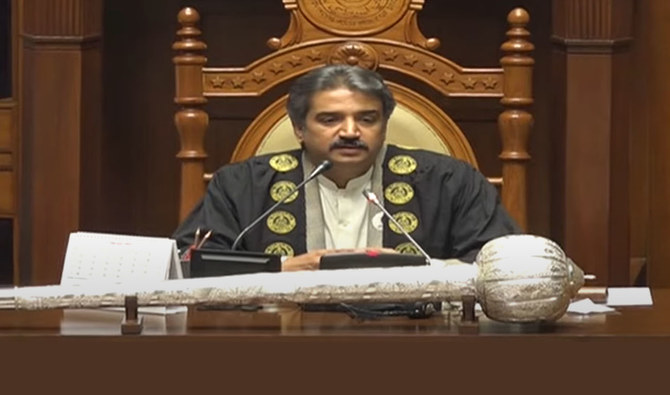
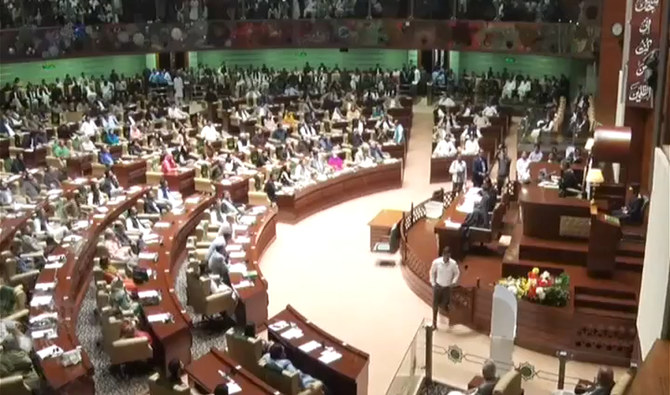
KARACHI: Pakistan’s Sindh provincial assembly on Sunday elected Syed Owais Qadir Shah as the speaker and Anthony Naveed as the deputy speaker of the House, who both hailed from the Pakistan Peoples Party (PPP) that won this month’s national election in the southern Sindh province.
Shah bagged 111 votes in the speaker’s election, while his opponent, Sofia Saeed Shah, from the Muttahida Qaumi Movement-Pakistan (MQM-P) party was polled 36 votes, Outgoing Speaker Agha Siraj Durrani announced during the assembly’s session.
“So, I declare honorable member Syed Owais Qadir Shah who has secured the highest number of votes to have been elected as a speaker of the provincial assembly of Sindh,” Durrani said to thunderous applause from legislators.
Shah took oath shortly and took over the session that saw the election of Naveed as his deputy.
In the deputy speaker’s election, PPP’s Naveed also bagged 111 votes, while MQM-P’s candidate Rashid Khan secured 36 votes. Shah announced result of the election that was followed by Naveed’s oath-taking as the deputy speaker.
“I take oath that I will have a firm belief in Pakistan and stay loyal that whenever I, being the deputy speaker of the Sindh provincial assembly, will be asked to perform my duties, I will discharge my duties and will perform my job with honesty, to the best of my capabilities and truthfulness in accordance with the Constitution of the Islamic Republic of Pakistan, and rules and regulations of the assembly,” the newly elected deputy speaker said as he took oath of his post.
“And I will always play my role for the sovereignty, integrity, solidarity, interest and prosperity of Pakistan... I will not let my personal interests influence my official affairs and decisions.”
The PPP has nominated Murad Ali Shah, former Sindh chief minister, for the top provincial office once again. The election for the post of Sindh chief minister is scheduled to be held on Monday.
The voting for speaker and deputy speaker took place a day after the inaugural session of the Sindh Assembly in which newly elected members of the southern Pakistani provinc-e were sworn in.
Saturday’s oath-taking ceremony was marred by protests in Karachi staged by supporters of various political parties who alleged that the Feb. 8 elections were heavily rigged.
Supporters of the Jamaat-e-Islami, Grand Democratic Alliance, Jamiat Ulema-e-Islam and other nationalist parties gathered near the provincial assembly in Karachi’s southern zone to protest alleged manipulation of Feb. 8 election, which was marred by a mobile network outage and delays in release of constituency results.
The PPP bagged 84 seats in the southern Pakistani province, followed by the MQM-P which secured 28 seats, while 14 seats were won by independent candidates. The JI and the GDA won two seats each.
While the inaugural Sindh Assembly session was in progress, several Pakistani parties on Saturday announced they would observe February 27 as a “Black Day” in response to Sindh police firing tear gas at their supporters protesting suspected rigging in the general elections earlier this month.
In view of the protest calls, the Sindh caretaker government on Friday imposed a ban under Section 144 on public assembly, gatherings, protests, processions, and demonstrations in Karachi’s South zone, where the provincial legislature is located, for a period of 30 days, according to the provincial home department.
Section 144 of the Code of Criminal Procedure (CrPC) empowers the administration to issue orders in public interest and place a ban on any activity for a specific period of time.


![]()
![]()

Pakistan’s Sindh Assembly elects speaker, deputy speaker from majority party
Short Url
https://arab.news/2f42e
Pakistan’s Sindh Assembly elects speaker, deputy speaker from majority party
- Owais Qadir Shah and Anthony Naveed secure 111 votes to win the election
- Election for the post of Sindh chief minister is scheduled to be held on Monday
Latest updates


© 2026 SAUDI RESEARCH & PUBLISHING COMPANY, All Rights Reserved And subject to Terms of Use Agreement.