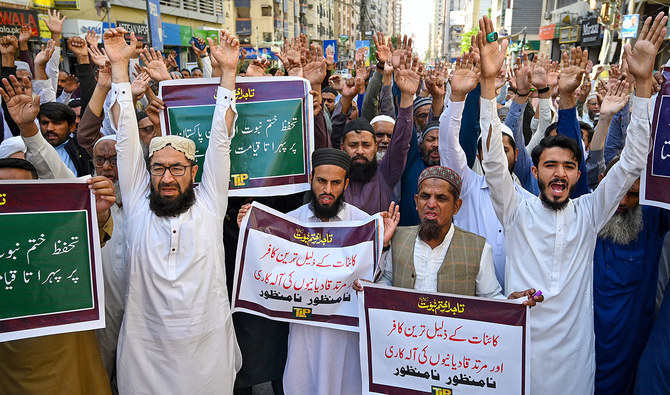
PESHAWAR: Thousands of Pakistanis protested against the Supreme Court’s top judge on Friday, after he issued a ruling related to blasphemy that sparked online backlash and thinly veiled death threats.
A campaign targeting Supreme Court Chief Justice Qazi Faez Isa began after he ordered the release of a man from the Ahmadi community, considered heretical by hard-line Muslim scholars.
The man had been accused of disseminating a forbidden Ahmadi text, which firebrand clerics consider tantamount to blasphemy — an incendiary issue in Muslim-majority Pakistan, where even unproven allegations of offending Islam have sparked violence.
Around 3,000 people gathered at rallies across the northwestern city of Peshawar after Friday prayers.
Crowds blocked roads and chanted “Death to Qadianis” — a slur referring to Ahmadis — as well as “Long live Islam.”
The Supreme Court issued a statement on Thursday evening defending his ruling, denying that it went against the Islamic constitution of Pakistan.
“This impression is absolutely wrong,” it said. “The organized campaign against judiciary and judges is unfortunate.”
A spokesman for Pakistan’s Ahmadi community, Amir Mahmood, told AFP that “one-sided negative propaganda is being spread against this judgment” which protected a man from “being persecuted for his religious belief.”
Isa’s ruling first went unnoticed two weeks ago, before it was highlighted by social media accounts linked to the Tehreek-e-Labbaik Pakistan party behind violent anti-blasphemy protests.
Posts calling for him to resign have been shared thousands of times on social media.
The Pakistani chapter of the Taliban militant group — known as Tehreek-e-Taliban Pakistan (TTP) — called Isa “an enemy of Islam” and “a damned man.”
The Human Rights Commission of Pakistan said Isa’s ruling “protects the constitutional right of all religious minorities to freedom of religion or belief.”
“Those political leaders and sections of the media that are responsible for this campaign must be restrained,” the organization said on social media platform X.
Ahmadis have been discriminated against and persecuted for decades in Pakistan.
The second amendment of Pakistan’s constitution, made in 1974, declares Ahmadis non-Muslims.
The law also prohibits them from professing to be Muslims or spreading their faith, and allows the death penalty for those found guilty of insulting Islam.
In his judgment, Isa ruled that according to the constitution, “every citizen shall have the right to profess, practice and propagate his religion.”
“Freedom of faith is one of the fundamental tenets of Islam. But sadly, in matters of religion, tempers flare up and the Qur’anic mandate is forsaken,” he added.
He also said the book allegedly disseminated by the accused had not been outlawed at the time of the alleged crime in 2019.
Cleric Fazlur Rehman, the influential leader of the conservative religious party Jamiat Ulema-e-Islam, said Isa’s reasoning was “false and based on bad intentions.”
In 2011, the governor of eastern Punjab province was killed by his bodyguard after calling for reforms to the stringent blasphemy laws that Ahmadis frequently fall foul of.


Thousands protest Pakistan Supreme Court minorities ruling
https://arab.news/9krtf
Thousands protest Pakistan Supreme Court minorities ruling

- CJP Faez Isa ordered the release of a man from Ahmadi community, considered heretical by Muslim scholars
- Around 3,000 people gathered at protest rallies across the northwestern city of Peshawar after Friday prayers

Pakistan says defense pact with Saudi Arabia elevated brotherly ties to ‘new heights’
- Pakistan, Saudi Arabia signed strategic defense pact last year pledging aggression against one will be treated as attack on both
- Deputy PM Ishaq Dar says enduring bonds with Islamic and Arab nations form vital pillar of Pakistan’s foreign policy
ISLAMABAD: Deputy Prime Minister Ishaq Dar said on Wednesday that Pakistan’s defense pact with Saudi Arabia elevated its brotherly ties with the Kingdom to “new heights,” stressing that close ties with Arab and Islamic nations form a key pillar of Islamabad’s foreign policy.
Pakistan and Saudi Arabia signed a Strategic Mutual Defense Agreement on Sept. 17 last year, pledging that aggression against one country would be treated as an attack on both, enhancing joint deterrence and formalizing decades of military and security cooperation.
Both nations agreed in October 2025 to launch an economic cooperation framework to strengthen trade and investment ties.
“In the Middle East, our landmark Strategic Mutual Defense Agreement with Saudi Arabia has elevated our brotherly ties to new heights,” Dar said while speaking at the Pakistan Governance Forum 2026 event in Islamabad.
The Pakistani deputy prime minister was speaking on the topic “Navigating International Relations Amidst Changing Geo-Politics.”
Dar noted that Pakistan has reinforced partnerships with other Middle Eastern nations such as the UAE, Qatar, Jordan, Oman, Egypt and Bahrain. He said these partnerships have yielded “concrete agreements” in investment, agriculture, infrastructure, and energy sectors.
“Our enduring bonds with Islamic and Arab nations form a vital pillar of our foreign policy, and we will continue to expand our partnerships across Asia, Latin America, and Africa,” he said.
Dar pointed out that the presidents of Kazakhstan, Uzbekistan and Kyrgyzstan have undertaken visits to Pakistan in recent months, reflecting Central Asian nations’ desire to boost cooperation with Islamabad.
On South Asia, the Pakistani deputy PM said Pakistan has successfully transformed its fraternal ties with Bangladesh into “a substantive partnership.”
“Similarly, the trilateral mechanism involving China, Pakistan, and Bangladesh has been launched with a view to expanding and deepening regional cooperation and synergy,” the Pakistani minister said.
He said Islamabad has strengthened its “all-weather” partnership with China via the second phase of the multi-billion-dollar China-Pakistan Economic Corridor agreement and “unwavering support” from both sides for each other’s core interests.
Dar said Pakistan had also reinvigorated its partnership with the US, advancing cooperation in trade, technology, investment, and regional stability.
“This calibrated approach has enhanced our ability to navigate complexity with skill and confidence, ensuring that our national interests are served without compromising our core foreign policy principles,” he said.


