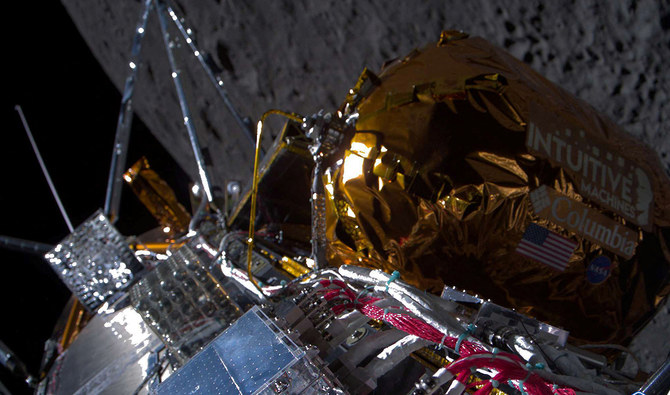

A spacecraft built and flown by Texas-based company Intuitive Machines landed near the moon’s south pole on Thursday, the first US touchdown on the lunar surface in more than half a century and the first ever achieved by the private sector.
NASA, with several research instruments aboard the vehicle, hailed the landing as a major achievement in its goal of sending a squad of commercially flown spacecraft on scientific scouting missions to the moon ahead of a planned return of astronauts there later this decade.
But initial communications problems following Thursday’s landing raised questions about whether the vehicle may have been left impaired or obstructed in some way.
The uncrewed six-legged robot lander, dubbed Odysseus, touched down at about 6:23 p.m. EST (2323 GMT), the company and NASA commentators said in a joint webcast of the landing from Intuitive Machines’ mission operations center in Houston.
The landing capped a nail-biting final approach and descent in which a problem surfaced with the spacecraft’s autonomous navigation system that required engineers on the ground to employ an untested work-around at the 11th hour.
It also took some time after an anticipated radio blackout to re-establish communications with the spacecraft and determine its fate some 239,000 miles (384,000 km) from Earth.
When contact was finally renewed, the signal was faint, confirming that the lander had touched down but leaving mission control immediately uncertain as to the precise condition and orientation of the vehicle, according to the webcast.
“Our equipment is on the surface of the moon, and we are transmitting, so congratulations IM team,” Intuitive Machines mission director Tim Crain was heard telling the operations center. “We’ll see what more we can get from that.”
Later in the evening, the company posted a message on the social media platform X saying flight controllers “have confirmed Odysseus is upright and starting to send data.”
QUESTION OF OBSTRUCTION
Still, the weak signal suggested the spacecraft may have landed next to a crater wall or something else that blocked or impinged its antenna, said Thomas Zurbuchen, a former NASA science chief who oversaw creation of the agency’s commercial moon lander program.
“Sometimes it could just be one rock, one big boulder, that’s in the way,” he said in a phone interview with Reuters.
Such an issue could complicate the lander’s primary mission of deploying its payloads and meeting science objectives, Zurbuchen said.
Accomplishing the landing is “a major intermediate goal, but the goal of the mission is to do science, and get the pictures back and so forth,” he added.
NASA Administrator Bill Nelson immediately cheered Thursday’s feat as a “triumph,” saying, “Odysseus has taken the moon.”
As planned, the spacecraft was believed to have come to rest at a crater named Malapert A near the moon’s south pole, according to the webcast. The spacecraft was not designed to provide live video of the landing, which came one day after it reached lunar orbit and a week after its launch from Florida.
Thursday’s landing represented the first controlled descent to the lunar surface by a US spacecraft since Apollo 17 in 1972, when NASA’s last crewed moon mission landed there with astronauts Gene Cernan and Harrison Schmitt.
To date, spacecraft from just four other countries have ever landed on the moon — the former Soviet Union, China, India and, mostly recently, just last month, Japan. The United States is the only one ever to have sent humans to the lunar surface.
Odysseus is carrying a suite of scientific instruments and technology demonstrations for NASA and several commercial customers designed to operate for seven days on solar energy before the sun sets over the polar landing site.
The NASA payload focuses on space weather interactions with the moon’s surface, radio astronomy and other aspects of the lunar environment for future landing missions.
Odysseus was sent on its way to the moon last Thursday atop a Falcon 9 rocket launched by Elon Musk’s company SpaceX from NASA’s Kennedy Space Center in Cape Canaveral, Florida.
DAWN OF ARTEMIS
Its arrival marked the first “soft landing” on the moon ever by a commercially manufactured and operated vehicle and the first under NASA’s Artemis lunar program, as the US races to return astronauts to Earth’s natural satellite before China lands its own crewed spacecraft there.
NASA aims to land its first crewed Artemis in late 2026 as part of long-term, sustained lunar exploration and a stepping stone toward eventual human flights to Mars. The initiative focuses on the moon’s south pole in part because a presumed bounty of frozen water exists there that can be used for life support and production of rocket fuel.
A host of small landers like Odysseus are expected to pave the way under NASA’s Commercial Lunar Payload Services (CLPS) program, designed to deliver instruments and hardware to the moon at lower costs than the US space agency’s traditional method of building and launching those vehicles itself.
Leaning more heavily on smaller, less experienced private ventures comes with its own risks.
Just last month the lunar lander of another firm, Astrobotic Technology, suffered a propulsion system leak on its way to the moon shortly after being placed in orbit on Jan. 8 by a United Launch Alliance (ULA) Vulcan rocket.
The malfunction of Astrobotic’s Peregrine lander marked the third failure of a private company to achieve a lunar touchdown, following ill-fated efforts by companies from Israel and Japan.