

Indonesia urges G20 countries to push for immediate ceasefire in Gaza

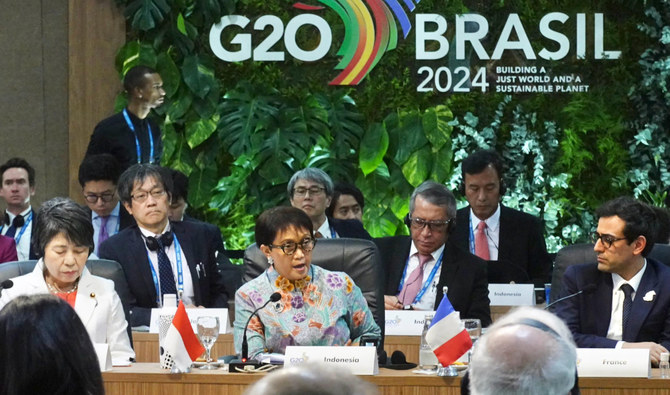
Indonesian Foreign Minister Retno Marsudi speaks during a G20 ministerial session in Rio de Janeiro, Brazil on Feb. 21, 2024. (Ministry of Foreign Affairs)
Short Url
Updated 22 February 2024
Follow

Indonesia urges G20 countries to push for immediate ceasefire in Gaza

  • FM Marsudi calls for increased support for Palestine through UNRWA
  • G20 foreign ministers gather in Rio de Janeiro as Brazil kicks off group’s presidency

JAKARTA: Indonesia’s foreign minister has called on G20 countries to push for an immediate ceasefire in Gaza as the group’s top diplomats gathered for the first ministerial meeting under Brazil’s presidency. 

Foreign ministers of the group of the 20 biggest global economies gathered in Rio de Janeiro Feb. 21-22 to address international issues and set a roadmap for work to accomplish ahead of a leaders’ summit in November. 

Foreign Minister Retno Marsudi said Israel’s ongoing onslaught on Gaza was an “atrocity that goes beyond any plausible justification,” as she addressed a session on the G20’s role in the wake of global tensions.


“G20 must act now to end this crisis … First, push for an immediate and permanent ceasefire at any cost,” Marsudi told the participants. 

“This is the ultimate game-changer to stop the bloodshed, ease humanitarian suffering, and create a conducive environment for a fair negotiation toward a two-state solution.”

More than 29,300 Palestinians have died with over 69,000 injured during four months of Israel’s military operations in Gaza, according to the enclave’s health authorities.

Indonesia has long been among the Palestinian peoples’ most vocal advocates in multiple international forums, and is among more than 50 countries which are presenting arguments at the International Court of Justice this week in a case against Israel’s occupation of Palestinian territories.

Indonesia’s stance is partly informed by seeing Palestinian statehood as mandated by the nation’s constitution, which calls for the abolition of colonialism. 

In Brazil, Marsudi also urged other G20 nations to avoid double standards and to work together to lower global tensions and prevent further escalation. 

“We cannot stand by and watch this horror unfold. We cannot turn a blind eye to the suffering of civilians, including women and children. We cannot ignore our moral and legal obligations to protect human rights and uphold international law,” she said. 

 “We must not stand idly as Israel continues to destroy homes, hospitals, schools, and refugee camps … Now, more than ever, Palestine needs our solidarity and help.” 

She also appealed to G20 members to increase their support for Palestine, including through the UN Relief and Works Agency for Palestine Refugees, which has suffered funding cuts after Israel accused some of its staff of being involved in the Oct. 7 attack by Gaza-based militant group Hamas. 

“We have to show the world that we are united and capable of being a catalyst for positive change to any crisis,” Marsudi said. “Let us show to the world that we, G20 members, are contributors to peace and stability.”


UN refugee agency chief: ‘Very difficult moment in history’

UNHCR High Commissioner Barham Salih during an interview in Rome on Monday. (AP)
Updated 4 sec ago
Follow

UN refugee agency chief: ‘Very difficult moment in history’

  • According to his agency also known as UNHCR, there are 117.3 million forcibly displaced people around the world from 194 countries

ROME: The first refugee to lead the UN refugee agency has said that the world faces “a very difficult moment in history” and is appealing to a common humanity amid dramatic change.
Repression of immigrants is growing, and the funding to protect them is plummeting. 
Without ever mentioning the Trump administration or its policies directly, Barham Salih said his office will have to be inventive to confront the crisis, which includes losing well over $1 billion in US support.

FASTFACT

There are 117.3 million forcibly displaced people around the world from 194 countries.

“Of course it’s a fight, undeniably so, but I think also I’m hopeful and confident that there is enough humanity out there to really enable us to do that,” said Salih, a former president of Iraq.
He was also adamant on the need to safeguard the 1951 refugee convention as the Trump administration campaigns for other governments to join it in upending a decades-old system and redefining asylum rules.
Salih, who took up his role as high commissioner for refugees on Jan. 1, described it as an international legal responsibility and a moral responsibility.
According to his agency also known as UNHCR, there are 117.3 million forcibly displaced people around the world from 194 countries. Salih’s challenge is supporting some 30 million refugees with significantly less funds.
In 2024 and 2025, funding from the US dropped from $2.1 billion to $800 million, and yet the country remains UNHCR’s largest donor.
“Resources made available to helping refugees are being constrained and limited in very, very significant way,” Salih said.
The Trump administration is also reviewing the US asylum system, suspending the refugee program in 2025 and setting a limit for entries to 7,500, mostly white South Africans — a historic low for refugee admittance since the program’s inception in 1980.
The Trump administration also has tightened immigration enforcement as part of its promise to increase deportations, while facing criticism for deportations to third countries and an uproar over two fatal shootings by federal officers and other deaths.
“We have to accept the need for adapting with a new environment in the world,” Salih said. 
His agency is seeking to be more cost-effective, “to really deliver assistance to the people who need it, rather than be part of a system that sustains dependency on humanitarian assistance,” he added. Salih has already met Pope Leo XIV at the Vatican. He said he was grateful for the support of the pontiff — the first pope from the US.
“The voice of the church and faith-based organizations in this endeavor is absolutely vital,” Salih said. “His moral support, his voice of the need for supporting refugees and what we do as UNHCR at this moment is very, very important.”