US and international organizations demand Pakistan lift social media restrictions amid democracy fears

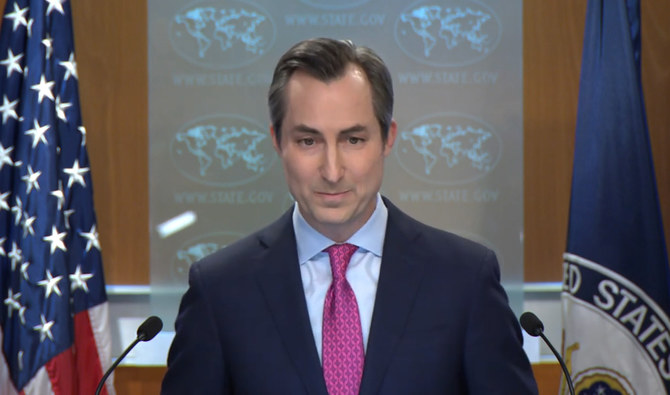
US State Department Spokesperson Matthew Miller speaks during a news conference at the State Department in Washington, DC, on February 21, 2024. (Photo courtesy: Screengrab/YouTube/@StateDept)
Short Url
Updated 22 February 2024
Follow

US and international organizations demand Pakistan lift social media restrictions amid democracy fears

  • US says it communicated its concerns through official channels after platform X became inaccessible in Pakistan
  • Global media and Internet watchdogs point out such developments hinder exercise of democracy, free expression

ISLAMABAD: The world reacted to sporadic Internet shutdowns and social media disruptions in Pakistan on Wednesday, with the US State Department confirming that Washington had officially urged the Pakistani administration to lift digital restrictions, while other international organizations raised concerns for democracy and media freedom.
Pakistani social media users have only managed to access platform X intermittently since Saturday when a senior government official made a public admission of vote manipulation in the February 8 general elections which triggered a politically charged debate in the country.
The electoral contest was marred by a nationwide outage of cellphone networks and delays in results by election officials, raising widespread speculation of rigging and leading to protests by several political parties in different parts of the country.
“We are concerned by any reports of restrictions on the exercise of the freedom of expression and association in Pakistan, including the partial or complete government-imposed Internet shutdowns, which includes, of course, on social media platforms,” State Department spokesperson Matthew Miller told a media briefing.
He informed that Washington had asked Pakistan to respect freedom of expression and “restore access to any social media that has been restricted, including Twitter, I think now known as X.”
Asked if these concerned had been communicated through official channels, Miller responded in the affirmative.
Prior to that, Netblocks, a London-based Internet monitor, also took notice of the social media disruption and commented on its implications in a post.
“Metrics show that X/Twitter remains largely restricted in #Pakistan past the four-day mark; imposed on Saturday as disclosures relating to election fraud circulated on the platform, the measure significantly hinders the exercise of democracy and media freedom,” it said.
Committee to Protect Journalist (CPJ), a press freedom organization, also reacted to the development, urging the Pakistan government to ensure “free flow of information to facilitate media reporting about post-election issues in Pakistan.”
The Sindh High Court also took up a case against the ongoing blockade of X on Wednesday, instructing the Pakistan Telecommunications Authority to restore the social media platform.


Pakistan plans $80 million seafood zone at Karachi harbor to target Gulf markets

Updated 7 sec ago
Follow

Pakistan plans $80 million seafood zone at Karachi harbor to target Gulf markets

  • Plan aims to move exports away from raw seafood toward higher-value processed products
  • Project will be developed under public-private partnership or build-operate-transfer model

KARACHI: Pakistan plans to develop a seafood processing and export zone at Karachi’s Qur’angi Fisheries Harbor that could cost up to $80 million to boost value-added exports and position the country as a supplier to the Gulf and other regional markets, Maritime Affairs Minister Muhammad Junaid Anwar Chaudhry said on Saturday.

The proposed 100-acre project aims to shift Pakistan away from exporting raw seafood by building modern processing, cold-chain and packaging infrastructure linked to international buyers, as Islamabad looks to expand its blue economy and deepen maritime trade ties with the region.

In a statement, Chaudhry said the zone would be developed, financed and operated under a public-private partnership or build-operate-transfer (BOT) model, with private investors running the facilities and the Qur’angi Fisheries Harbor Authority retaining regulatory oversight.

“The estimated project cost ranges between $60 million and $80 million, based on regional benchmarks from countries such as Vietnam, China and Ecuador, which have developed similar seafood parks,” Chaudhry said.

He said the facility would include 20 to 25 medium- to large-scale seafood processing units for fish, shrimp and cephalopods, alongside large-scale cold storage, blast freezing, packaging facilities, logistics and export terminals, and a wastewater treatment plant to ensure environmentally compliant operations.

“Packaging and labeling units would operate under international food safety and quality standards, including HACCP and ISO certifications, offering vacuum packing, modified atmosphere packaging and retail-ready solutions,” he said, referring to Hazard Analysis and Critical Control Points, a preventive food safety system.

ISO certification verifies that a company’s management systems meet international standards.

The minister said the zone would be used exclusively for commercial seafood processing, packaging, cold storage and export-oriented activities, with multi-temperature storage ranging from minus 18 to minus 40 degrees Celsius and ice plants capable of producing 50 to 100 tons daily.

Chaudhry said the preferred investment structure is a BOT concession under which the private partner would finance, develop and operate the project for an expected 20-year tenure, with ownership reverting to the harbor authority at the end of the concession period.

He added that the estimated internal rate of return was projected between 13 percent and 17 percent, with revenue generated through lease rentals, processing fees, logistics services and export-linked earnings.

“The project will position Pakistan as a key maritime trade and seafood export hub serving Gulf, East African and Asian markets,” Chaudhry said.