

Ukraine leader downplays loss of Avdiivka, seeks faster support

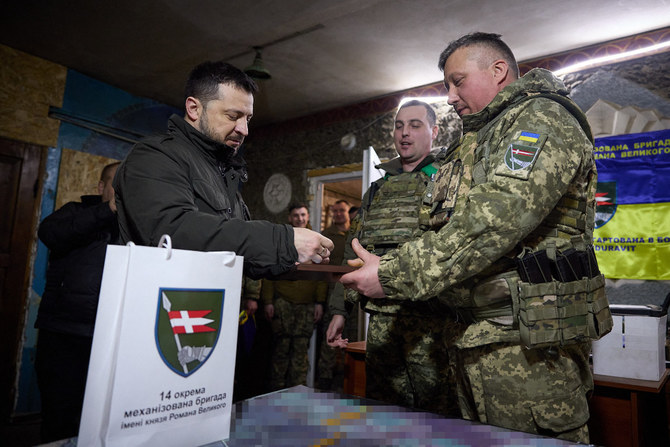
Ukrainian President Volodymyr Zelensky (L) visits the frontline positions of Ukrainian troops in the Kupyansk sector on Feb. 19, 2024, amid the Russian invasion of Ukraine. (Ukrainian Presidential Press Service / Handout via AFP)
Short Url
Updated 22 February 2024
Follow

Ukraine leader downplays loss of Avdiivka, seeks faster support

  • Russian troops took control of Avdiivka last week in Moscow’s biggest battlefield gain since its forces captured Bakhmut last May
  • Zelensky pointed to earlier gains made by Ukraine forces, particularly in the northeastern Kharkiv region and destruction of Russian ships

KYIV: President Volodymyr Zelensky downplayed Ukraine’s loss of the eastern town of Avdiivka to Russian forces and called for faster support from allies as the war against Russia neared the two-year mark, in comments broadcast on Wednesday.

Russian troops took control of Avdiivka last week in Moscow’s biggest battlefield gain since its forces captured Bakhmut last May. Kremlin leader Vladimir Putin says Russia will press on with its drive through eastern Ukraine.
Zelensky, in excerpts from an interview with Fox News to be aired on Thursday, acknowledged that last year had been “complicated” for Ukraine, particularly as 2023 came to a close.
But, speaking in English, he pointed to earlier gains, particularly in the northeastern Kharkiv region, where the Fox interview took place.
“During these two years we got (back) part of the Kharkiv region. Now we are in this region ... and we unblocked the Black Sea. There are grain routes and we destroyed a lot of their ships of the Russian fleet,” Zelensky said.
“That is what we did over two years. And what they could do? Only this one place. But what for?“
Avdiivka lies 15 km (nine miles) northwest of the Russian-held main town of Donetsk region, also named Donetsk.
Russian analysts say its capture will keep Donetsk safe from Ukrainian shelling as Moscow considers how to pursue its drive to capture all of Donetsk and Luhansk regions.
In his comments, Zelensky expressed new discontent with the slowdown in Western aid for Ukraine’s war effort, without singling out the United States.
US President Joe Biden’s request to extend a big aid package has been held up by wrangling in the US Congress.
“We have to be more quick. That means to lose all the bureaucracy. Otherwise we will not have any chance,” he said.
The president acknowledged that finding an alternative to US support would not be easy.
“Of course, we will find. We will not stay in the same place. We have to survive. We have to find some parallel steps,” he said in the interview, conducted in part on a hospital ward.
“You understand that this help is crucial. So without it, sorry, we will have more and more such heroic guys who will be in the hospitals. If you don’t have a real defending shield and similar powerful artillery with rounds, of course you will lose people.”
The US Senate has passed a $95 billion aid package that includes funds for Ukraine, but House of Representatives Speaker Mike Johnson has declined to bring it up for a vote on the floor of the House.


Venezuela advances amnesty bill that could lead to mass release of political prisoners

Updated 4 sec ago
Follow

Venezuela advances amnesty bill that could lead to mass release of political prisoners

  • Such an amnesty is a central demand of the country’s opposition and human rights organizations with backing from the United States

CARACAS: Venezuela’s legislature on Thursday advanced an amnesty bill proposed by acting President Delcy Rodríguez that could lead to the release of hundreds of opposition leaders, journalists and human rights activists detained for political reasons.
Such an amnesty is a central demand of the country’s opposition and human rights organizations with backing from the United States. But the contents of the bill have not been released publicly, and rights groups have so far reacted with cautious optimism — and with demands for more information.
The bill, introduced just weeks after the US military captured then-President Nicolás Maduro, still requires a second debate that has yet to be scheduled. Once approved, it must be signed by Rodríguez before it can go into effect.
In announcing the bill late last month, Rodríguez told a gathering of justices, magistrates, ministers, military brass and other government leaders that the ruling party-controlled National Assembly would take up the legislation with urgency.
“May this law serve to heal the wounds left by the political confrontation fueled by violence and extremism,” she said in a pre-taped televised event. “May it serve to redirect justice in our country, and may it serve to redirect coexistence among Venezuelans.”
Rights groups, fearing some political detainees will be excluded, want more details about the requirements for amnesty before any final vote.
The Venezuelan Program for Education-Action in Human Rights, or PROVEA, issued a statement emphasizing that the bill must be made public urgently due to its potential impact on victims’ rights and broader Venezuelan society.
Based on what is known so far about the legislation, the amnesty would cover a broad timeline, spanning the administration of the late Hugo Chávez from 1999 to 2013 and that of his political heir, Maduro, until this year. It would exclude people convicted of murder, drug trafficking, and serious human rights violations, reports indicate.