

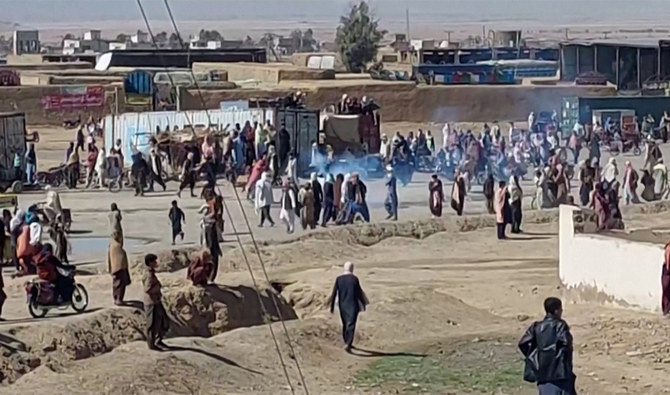
Pakistan guards use tear gas to disperse protesters at Chaman border with Afghanistan

Pakistan border guards use tear gas to disperse people protesting against the implementation of a visa and passport regime for travel through a main border crossing with Afghanistan at Chaman border, Pakistan, on February 20, 2024. (REUTERS)
Short Url
Updated 21 February 2024
Follow

Pakistan guards use tear gas to disperse protesters at Chaman border with Afghanistan

  • Laborers are protesting government’s implementation of strict visa, passport requirements for cross-border travel
  • Before Nov. 2023 expulsion drive against illegal foreigners, people could travel across porous border without these documents 

ISLAMABAD: Pakistan border guards used tear gas Tuesday to disperse hundreds of people protesting against the implementation of a visa and passport regime for travel through a main border crossing with Afghanistan.

Protesters have been camped near the Chaman border crossing in the southwestern Balochistan province since October last year when Pakistan announced it would expel all illegal foreigners, mostly Afghans, from Nov. 1, and enforce strict immigration-related restrictions on border crossings, making the possession of valid passports and visas a requirement for travel. The “one document regime” replaced the decades-old practice of granting special travel permits to individuals from divided tribes straddling the nearly 2,600-kilometer border between the two countries.

“There was an operation against the protesters in the afternoon [Tuesday],” a Pakistani laborer, Grann, said in Pashto. “So, we have all gathered here and are throwing stones at the fortress [check post].”

Video footage widely shared on mainstream and social media showed tear gas in the air and hundreds of protesters near the border. 

Graan said the protests were being held against the requirement for passports at Chaman, a main crossing for travelers and goods between Pakistan and landlocked Afghanistan. The other major crossing is at Torkham in the northwest.

“We want to be allowed to come and go freely,” Graan said. “The border has been sealed for 4 months and 10 days. We have nothing left to eat. There is no oil or flour in our homes, and they [Pakistan government] are saying they will only accept passports. We are helpless.”

The expulsion drive was launched amid a row with Kabul over charges that it harbors anti-Pakistan militants, which the Taliban government denies. 

Until November last year, Pakistan was home to over 4 million Afghan migrants and refugees, about 1.7 million of them undocumented. Many came after the Taliban retook Afghanistan in 2021, and a large number have been present since the 1979 Soviet invasion. Islamabad says it is battling economic and security crises and can no longer host thousands of Afghans. 

Thousands of tribespeople used to travel through the Chaman border crossing daily for work or to meet family members on the other side. They would use a slip of paper, locally called tazkira, granted to them under easement rights that guaranteed free travel.

Since the expulsion drive began, local tribesmen, laborers and traders have been protesting daily at the Chaman border, saying the new policy has disrupted cross-border economic activity and led to unemployment. 

“We have nothing to eat, we are surviving on loans,” another protester, Abdul Rasheed, said. “Now we have reached a stage where we are giving water to our infants instead of milk … The Friendship Gate [between Pakistan and Afghanistan] should kindly be opened.”

According to government data, 493,648 Afghans have been repatriated since the expulsion policy began in Nov. 1 last year. 

With input from Reuters


UN torture expert decries Pakistan ex-PM Khan’s detention

Updated 12 December 2025
Follow

UN torture expert decries Pakistan ex-PM Khan’s detention

  • Khan’s party alleges government is holding him in solitary confinement, barring prison visits
  • Pakistan’s government rejects allegations former premier is being denied basic rights in prison

GENEVA: Pakistan’s former prime minister Imran Khan is being held in conditions that could amount to torture and other inhuman or degrading treatment, the United Nations’ special rapporteur on torture warned Friday.

Alice Jill Edwards urged Pakistan to take immediate and effective action to address reports of the 73-year-old’s inhumane and undignified detention conditions.

“I call on Pakistani authorities to ensure that Khan’s conditions of detention fully comply with international norms and standards,” Edwards said in a statement.

“Since his transfer to Adiala Jail in Rawalpindi on September 26, 2023, Imran Khan has reportedly been held for excessive periods in solitary confinement, confined for 23 hours a day in his cell, and with highly restricted access to the outside world,” she said.

“His cell is reportedly under constant camera surveillance.”

Khan an all-rounder who captained Pakistan to victory in the 1992 Cricket World Cup, upended Pakistani politics by becoming the prime minister in 2018.

Edwards said prolonged or indefinite solitary confinement is prohibited under international human rights law and constitutes a form of psychological torture when it lasts longer than 15 days.

“Khan’s solitary confinement should be lifted without delay. Not only is it an unlawful measure, extended isolation can bring about very harmful consequences for his physical and mental health,” she said.

UN special rapporteurs are independent experts mandated by the Human Rights Council. They do not, therefore, speak for the United Nations itself.

Initially a strong backer of the country’s powerful military leadership, Khan was ousted in a no-confidence vote in 2022, and has since been jailed on a slew of corruption charges that he denies.

He has accused the military of orchestrating his downfall and pursuing his Tehreek-e-Insaf (PTI) party and its allies.

Khan’s supporters say he is being denied prison visits from lawyers and family after a fiery social media post this month accusing army leader Field Marshal Asim Munir of persecuting him.

According to information Edwards has received, visits from Khan’s lawyers and relatives are frequently interrupted or ended prematurely, while he is held in a small cell lacking natural light and adequate ventilation.

“Anyone deprived of liberty must be treated with humanity and dignity,” the UN expert said.

“Detention conditions must reflect the individual’s age and health situation, including appropriate sleeping arrangements, climatic protection, adequate space, lighting, heating, and ventilation.”

Edwards has raised Khan’s situation with the Pakistani government.