

Oil Updates – prices rise as investors weigh Red Sea attacks, US rate cut outlook

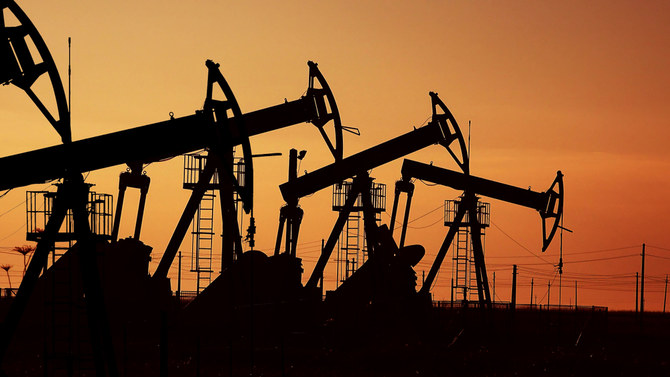
Brent crude futures rose 24 cents or 0.3 percent to $82.58 a barrel by 10:21 a.m. Saudi time. Shutterstock
Short Url
Updated 21 February 2024
Follow

Oil Updates – prices rise as investors weigh Red Sea attacks, US rate cut outlook

NEW DELHI  Oil prices regained some ground in Asian trade on Wednesday amid concerns over attacks on shipping in the Red Sea and growing expectations that cuts to US interest rates will take longer than thought, according to Reuters.

Brent crude futures rose 24 cents or 0.3 percent to $82.58 a barrel by 10:21 a.m. Saudi time, while US West Texas Intermediate crude futures were up 21 cents or 0.3 percent at $77.25.

The Brent and WTI contracts fell 1.5 percent and 1.4 percent, respectively, from near three-week highs on Tuesday as the premium for prompt US crude futures to the second-month contract more than doubled to $1.71 a barrel — its widest level in roughly four months.

That encourages energy companies to sell now rather than paying to store product for future months. The premiums slid to 4 cents a barrel on Wednesday.

“Crude futures prices have become relatively range-bound, and have at least $6-7 per barrel of risk premium embedded at current levels,” said Vandana Hari, founder of oil market analysis provider Vanda Insights.

She said prices could remain range-bound until the next turning point in the Gaza crisis, whether that be a de-escalation through a ceasefire or an exacerbation by Israel’s onslaught in Rafah.

Attacks in support of the Palestinians on vessels in the Red Sea and Bab Al-Mandab strait by Yemen’s Iran-aligned Houthis have continued to stoke concerns over freight flows through the critical waterway. Drone and missile strikes have hit at least four vessels since Friday.

Washington on Tuesday again vetoed a draft UN Security Council resolution on the Israel-Hamas war, blocking a demand for an immediate humanitarian ceasefire. The US is instead pushing for the Security Council to adopt a resolution tying a ceasefire to the release of Israeli hostages by Hamas.

Meanwhile, Russia, which has pledged output cuts of 500,000 barrels per day as part of a package of cuts with OPEC and its allies, known as OPEC+, said on Tuesday that it intends to fulfil its quota in February despite a decline in oil refining.

Refinery throughput in Russia has fallen by 7 percent since the start of the year, the country’s energy minister said on Tuesday, after facilities were damaged by Ukrainian drone attacks.

Concerns that rate cuts by the Federal Reserve could take longer than thought have weighed on the outlook for oil demand. US inflation data last week pushed back expectations for an imminent start to the Fed’s easing cycle, with economists polled by Reuters now forecasting a cut in June.

US crude inventories were seen up last week, while distillates and gasoline stockpiles were seen dropping, a preliminary Reuters poll showed on Tuesday.

Analysts polled by Reuters estimated on average that crude inventories rose by about 4.3 million barrels in the week to Feb. 16. 


Jordan’s industry fuels 39% of Q2 GDP growth

Updated 31 December 2025
Follow

Jordan’s industry fuels 39% of Q2 GDP growth

JEDDAH: Jordan’s industrial sector emerged as a major contributor to economic performance in 2025, accounting for 39 percent of gross domestic product growth in the second quarter and 92 percent of national exports.

Manufactured exports increased 8.9 percent year on year during the first nine months of 2025, reaching 6.4 billion Jordanian dinars ($9 billion), driven by stronger external demand. The expansion aligns with the country’s Economic Modernization Vision, which aims to position the country as a regional hub for high-value industrial exports, the Jordan News Agency, known as Petra, quoted the Jordan Chamber of Industry President Fathi Jaghbir as saying.

Export growth was broad-based, with eight of 10 industrial subsectors posting gains. Food manufacturing, construction materials, packaging, and engineering industries led performance, supported by expanded market access across Europe, Arab countries, and Africa.

In 2025, Jordanian industrial products reached more than 144 export destinations, including emerging Asian and African markets such as Ethiopia, Djibouti, Thailand, the Philippines, and Pakistan. Arab countries accounted for 42 percent of industrial exports, with Saudi Arabia remaining the largest market at 955 million dinars.

Exports to Syria rose sharply to nearly 174 million dinars, while shipments to Iraq and Lebanon totaled approximately 745 million dinars. Demand from advanced markets also strengthened, with exports to India reaching 859 million dinars and Italy about 141 million dinars.

Industrial output also showed steady improvement. The industrial production index rose 1.47 percent during the first nine months of 2025, led by construction industries at 2.7 percent, packaging at 2.3 percent, and food and livestock-related industries at 1.7 percent.

Employment gains accompanied the sector’s expansion, with more than 6,000 net new manufacturing jobs created during the period, lifting total industrial employment to approximately 270,000 workers. Nearly half of the new jobs were generated in food manufacturing, reflecting export-driven growth.

Jaghbir said industrial exports remain among the economy’s highest value-added activities, noting that every dinar invested generates an estimated 2.17 dinars through employment, logistics, finance, and supply-chain linkages. The sector also plays a critical role in narrowing the trade deficit and supporting macroeconomic stability.

Investment activity accelerated across several subsectors in 2025, including food processing, chemicals, pharmaceuticals, mining, textiles, and leather, as manufacturers expanded capacity and upgraded production lines to meet rising demand.

Jaghbir attributed part of the sector’s momentum to government measures aimed at strengthening competitiveness and improving the business environment. Key steps included freezing reductions in customs duties for selected industries, maintaining exemptions for production inputs, reinstating tariffs on goods with local alternatives, and imposing a 16 percent customs duty on postal parcels to support domestic producers.

Additional incentives in industrial cities and broader structural reforms were also cited as improving the investment climate, reducing operational burdens, and balancing consumer needs with protection of local industries.