

Eleven Ukraine children returned from Russia

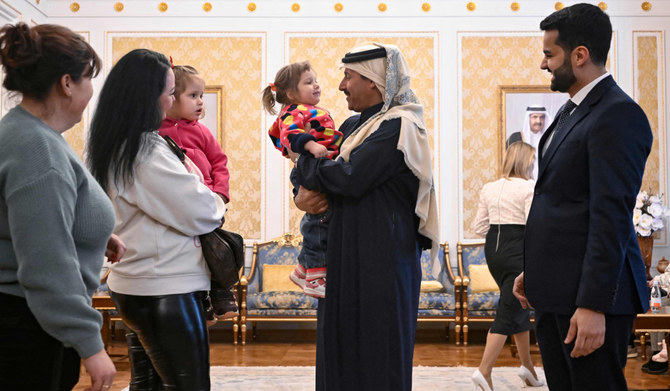
Ambassador of Qatar to Russia Sheikh Ahmed bin Nasser Al Thani and Russia's presidential commissioner for children's rights Maria Lvova-Belova (unseen) interact with Ukrainian children before their departure to Ukraine from Russia under a deal brokered by Qatar, at the Qatari embassy in Moscow on February 19, 2024. (AFP)
Short Url
Updated 21 February 2024
Follow

Eleven Ukraine children returned from Russia

  • Ukraine estimates 20,000 children have been forced to Russia since the war erupted in February 2022

MOSCOW: Eleven Ukrainian children crossed the border from Belarus to Ukraine Tuesday evening, in the latest return of children taken to Russia and occupied territories during the nearly two-year Ukraine war.
Emerging from the darkness at a humanitarian crossing on the Belarus border, the children hugged family members who had been waiting for more than six hours.
Oleksandr, 16, is the oldest among those returned by Moscow through a Qatar-mediated scheme.
“My new life is starting,” he said, smiling shyly and describing the “joy and slight nerves.”


Ambassador of Qatar to Russia Sheikh Ahmed bin Nasser Al Thani and Russia's presidential commissioner for children's rights Maria Lvova-Belova interact with Ukrainian children before their departure to Ukraine from Russia under a deal brokered by Qatar, at the Qatari embassy in Moscow on February 19, 2024. (AFP)

The children were received by the Qatari embassy in Moscow on Monday before traveling to Belarus and walking across the one-kilometer border zone — while some relatives were able to meet the children directly in Moscow.
Two critically ill children were brought over in an ambulance and rushed to hospital.
Ukraine estimates 20,000 children have been forced to Russia since the war erupted in February 2022.
President Volodymyr Zelensky has called the action “a genocide.” Russia denies the accusations.


Russia's presidential commissioner for children's rights Maria Lvova-Belova interacts with Ukrainian children before their departure to Ukraine from Russia under a deal brokered by Qatar, at the Qatari embassy in Moscow on February 19, 2024. (AFP)

The group of children is the fourth and largest to have been returned with Qatar’s help and included some as young as two, Ukrainian Human Rights Commissioner Dmytro Lubinets told AFP at the border.
“Believe me, we will bring them all back,” Lubinets assured the waiting relatives.

Oleksandr’s aunt Viktoria, 47, had not seen him since the war broke out.
She unsuccessfully tried to collect her nephew three times and only managed to speak to him on the phone recently.
Officials in Russian-occupied Lugansk sent him to a state boarding school, similar to a children’s home, where they took away his documents and “psychologically pressured him to stop him leaving,” she said.
“Our situation seemed deadlocked.”
Oleksandr was sent to the school after his mother and older brother, 21, were killed by shelling of their car as they tried to flee the Lugansk region in July 2022.
Sometimes Oleksandr dreams of his mother screaming as she died, his aunt added.
Now she plans to take her nephew to live with her in Zhytomyr near Kyiv.
“We will celebrate and show him the city.”
Computer developer Sergiy, 36, from Kyiv, also pulled his niece and nephew into a tight embrace as he collected them at the border.
After their parents died, Lev, 13, and Zhazmin, 10, lived with a distant relative in their home city of Russian-occupied Mariupol.
The relative moved them to the suburbs of Moscow as Mariupol became a fierce battlefield in the spring of 2022, before later returning to the Ukrainian city.
The relative “had no desire to take care of the children” so she tried to put them in a state children’s home, Sergiy said.
“I thought it was almost impossible to get the kids back.”
Smiling, Sergiy said he was ready to become a father of two, having no children himself.
“I will try to show them what it is like when they are needed and when someone can properly care of and support them.”
Another mother, who wished to remain anonymous, collected her 13-year-old son after she was held prisoner in Mariupol.

“With an intermediary... we have new approaches, and you can see the result,” Lubinets said.
Lubinets added that he had just returned from meeting Qatar’s prime minister to discuss the return of both children and civilians.
“I can’t disclose the details publicly yet, but I will say that I saw the maximum interest for Qatar to take part in this.”
For his part, Qatari ambassador Hadi Nasser Mansour Al-Hajjri told AFP that the country was ready to help bring out more people.
“If there is a request from both sides, we will do it, we are eager to do it.”
“We are open for any possibilities: bringing prisoners of war or political prisoners... and the kids, we are open for all these things.”
Since July 2023, Qatar has helped bring out almost 30 children, the ambassador said.
“We are almost the only country involved in the issue so we will continue.”


Pakistan killed over 80 militants in strikes on TTP camps in Afghanistan — official

Updated 23 February 2026
Follow

Pakistan killed over 80 militants in strikes on TTP camps in Afghanistan — official

  • Saturday’s airstrikes followed a series of attacks inside Pakistan amid a surge in militancy
  • The Afghan Taliban authorities accuse Pakistani forces of killing civilians in the airstrikes

ISLAMABAD: Pakistan’s airstrikes in Afghanistan destroyed seven Tehreek-e-Taliban Pakistan (TTP) camps and killed over 80 militants, a Pakistani security official said on Sunday, with the Afghan Taliban accusing Pakistani forces of killing civilians in the assault.

Saturday’s airstrikes followed a series of attacks inside Pakistan amid a surge in militancy. Authorities say the attacks, particularly in Khyber Pakhtunkhwa province and the Pakistani capital of Islamabad, were carried out by the TTP and allied groups that Islamabad alleges are operating from sanctuaries in Afghanistan. Kabul denies this.

According to Pakistan’s information ministry, recent incidents included a suicide bombing at a Shiite mosque in Islamabad, separate attacks in Bajaur and Bannu, and another recent incident in Bannu during the holy month of Ramadan, which started earlier this week. The government said it had “conclusive evidence” linking the attacks to militants directed by leadership based in Afghanistan.

“Last night, Pakistan’s intelligence-based air strikes destroyed seven centers of Fitna Al-Khawarij TTP in three provinces of Nangarhar, Paktika and Khost, in which more than eighty Khawarij (TTP militants) have been confirmed killed, while more are expected,” a Pakistani security official, who spoke on condition of anonymity, told Arab News.


An earlier statement from Pakistan’s information ministry said the targets included a camp of a Daesh regional affiliate, the Islamic State Khorasan Province (ISKP), which claimed a suicide bombing at an Islamabad Shiite mosque that killed 32 people this month.

In an X post, Afghan government spokesperson Zabihullah Mujahid said Pakistani forces had violated Afghan territory.

“Pakistani special military circles have once again trespassed into Afghan territory,” Mujahid said. “Last night, they bombed our civilian compatriots in Nangarhar and Paktika provinces, martyring and wounding dozens of people, including women and children.”

 The Afghan Taliban’s claims of civilian casualties could not be independently verified. Pakistan did not immediately comment on the allegation that civilians had been killed in the strikes.

In a post on X, Afghanistan’s foreign ministry said it had summoned Pakistan’s charge d’affaires to Afghanistan Ubaid-ur-Rehman Nizamani and lodged protest through a formal démarche in response to the Pakistani military strikes.

“IEA-MoFA (The Islamic Emirate of Afghanistan’s Ministry of Foreign Affairs) vehemently condemns the violation of Afghanistan’s airspace and the targeting of civilians, describing it as a flagrant breach of Afghanistan’s territorial integrity & a provocative action,” it said in a statement.

“The Pakistani side was also categorically informed that safeguarding Afghanistan’s territorial integrity is the religious responsibility of the Islamic Emirate of Afghanistan; henceforth, the responsibility for any adverse consequences of such actions will rest with the opposing side.”

Tensions between Islamabad and Kabul have escalated since the Afghan Taliban returned to power in 2021. Pakistan says cross-border militant attacks have increased since then and has accused the Taliban of failing to honor commitments under the 2020 Doha Agreement to prevent Afghan soil from being used for attacks against other countries. The Taliban deny allowing such activity and have previously rejected similar accusations.

Saturday’s exchange of accusations marks one of the most direct confrontations between the two neighbors in recent months and risks further straining already fragile ties along the volatile border.