

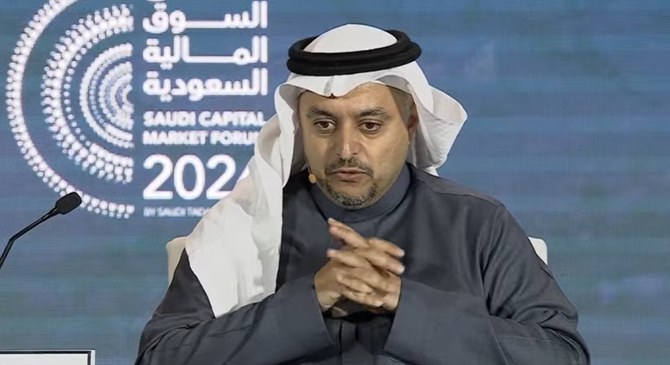

RIYADH: Energy security and equitable transition should be prioritized along with climate change as the world sails toward a sustainable future, according to an Aramco official.
Speaking at a panel discussion during the Saudi Capital Market Forum in Riyadh on Tuesday, the vice president of energy and economic insight at Saudi Aramco, Musaab Al-Mulla, said that the Kingdom is making significant strides in its transition journey by adopting new technologies like carbon capture, usage and storage.
“According to the latest World Economic Forum’s Energy Transition Index, energy transition is not only sustainability. It has three dimensions; sustainability, energy security, and equitable energy transition,” said Al-Mulla.
He added: “People think energy transition is only about climate. No, you have to solve for energy security and equitable energy transition.”
The executive highlighted that Saudi Aramco is the most reliable energy supplier in the world, and the company is working toward achieving its net-zero target by 2050.
Al-Mulla revealed that Aramco’s upstream carbon intensity figure remains among the lowest in the industry at 10.31 kilograms of carbon dioxide per barrel.
He added that Aramco is aiming to further reduce the carbon intensity figure.
The Aramco official also highlighted the importance of embracing advanced technologies like CCUs to ensure sustainability in the future.
“The world needs to scale up CCUs by 200-fold to meet climate change and maintain the temperature below 2 degrees. Although you are reducing emissions to the lowest, you will still have emissions remaining. So, offset is a great solution,” said Al-Mulla.
He added: “We are planting mangroves. We have put a target of planting 650 million mangroves in the Kingdom and out of the Kingdom to make sure that we are offsetting our operations to meet the target.”
Al-Mulla also noted that the global south will be driving the energy transition narrative in the future, as these countries will be facing the adverse effects of climate change, along with a scarcity of renewable investments.
“In 2050, how the energy mix globally will be 72 percent of the energy needed in the Global South, not in the Global North. So, the narrative will be led by the global south in the future,” added Al-Mulla.
During the same panel, Abdulaziz Al-Muhaiza, senior vice president, finance and group chief financial officer at Saudi Electricity Co., said the Kingdom has set a clear energy strategy to ensure a smooth transition.
Al-Muhaiza further noted that SEC is working to guarantee a reliable and sustainable power supply across the system, as it is pouring investments to connect all renewable projects within the Kingdom.
“Today, the energy mix for the power sector is oil and gas-based. And the energy transition target for 2030 is basically to have renewables and gas with carbon capture technology,” said Al-Muhaiza.
He added: “Our major investment will come in transmission and distribution. When we talk about transmission, we have a huge amount of investments from now until 2030. This is basically to connect all the renewable projects that are being built here in the Kingdom and to make sure that the system is reliable.”
Abdulhameed Al-Muhaidib, chief financial officer at ACWA Power, said that environmental, social, and corporate governance are part of the company’s business model.
He also added that ACWA Power is currently focusing on four pillars, which are renewables, water desalination, storage capacity, and converting traditional power plants into sustainable facilities.
When discussing ACWA Power’s power generation capacity, Al-Muhaidib said: “ACWA Power has more than 23 GW of renewables in our portfolio. Just to put it in perspective, this is almost the installed capacity of Oman, Bahrain and Qatar combined.”


